POSTECH and Samsung Research build AR glasses optics 1.5 mm thick; prototype shows text in sunlight
Korean researchers reported a metasurface waveguide that cuts light loss in a thin AR lens. The prototype works outdoors, but it is not yet ready for mass production.
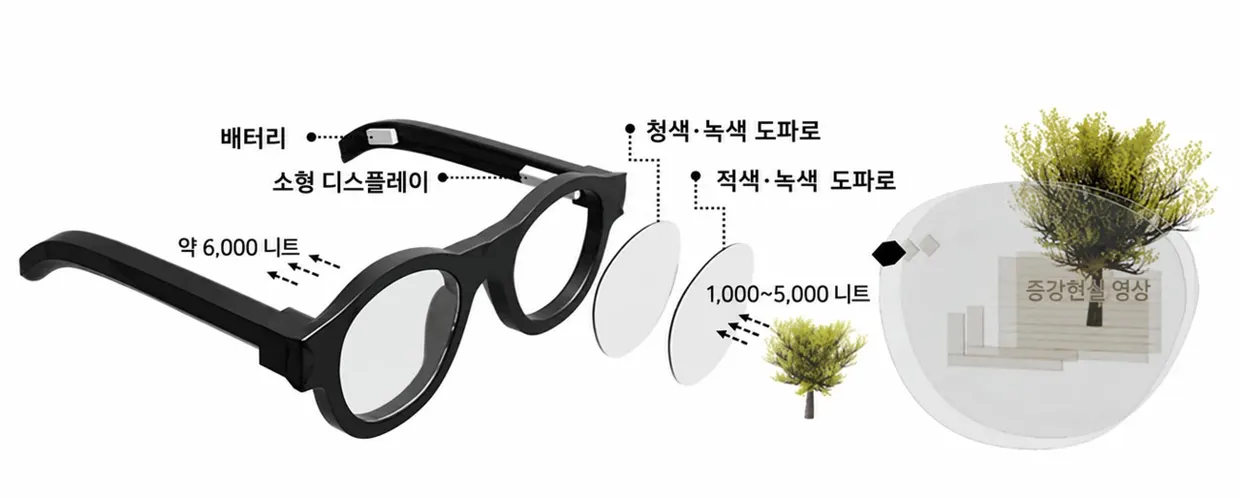
A team led by Professor Noh Junsuk at Pohang University of Science and Technology (POSTECH), together with Samsung Research of Samsung Electronics, has built an optical system for augmented-reality glasses based on a metasurface waveguide with a total thickness of 1.5 mm, according to biz.heraldcorp.com. The Ministry of Science and ICT announced the result on the 12th, and the work was published in Nature the same day biz.heraldcorp.com
biz.heraldcorp.combiz.heraldcorp.comOpen source ↗. In a prototype, white text was shown over a real scene in bright sunlight.
Light loss and the metasurface design
AR glasses overlay directions, messages or video on the view of the real world. To keep the image visible when the eye moves or the glasses slip, the area over which light is delivered has to be enlarged. This increases light loss and dims the picture.
In conventional designs, light from a micro-display enters a thin waveguide and is delivered to the eye by microstructures on its surface, but part of it leaves in unwanted directions. The direction and efficiency of delivery also differ for red, green and blue light, which distorts colour images.
The team designed the light path with nanometre precision. The core is a metasurface: an array of nanostructures smaller than the wavelength of light. It controls the direction and path of the light, reduces unwanted loss and keeps the image bright when the eye position changes biz.heraldcorp.com
biz.heraldcorp.combiz.heraldcorp.comOpen source ↗. For colour, two waveguide layers were combined. One carries mainly blue and green light, the other mainly red and green, which reduced the differences in delivery efficiency between colours.
Prototype and open issues
In the prototype glasses, white text was displayed outdoors in bright sunlight. Indoors, the glasses showed colour images that remained visible when the eye position shifted within a certain range. Because light is used more efficiently, the approach is expected to help reduce display power consumption in the future.
Commercialisation needs more research. Average brightness must reach the level demanded by industry, and the rainbow-like smearing caused by external light hitting the microstructures must be reduced. Uniform colour and brightness and a manufacturing process suitable for mass production are also still to be achieved.
The team plans to reduce the two waveguides to one and to apply large-area nanoimprint to lower manufacturing costs biz.heraldcorp.com
biz.heraldcorp.combiz.heraldcorp.comOpen source ↗. Noh said the work shows that precise control of the light path inside the lens allows a thin lens to produce a bright, clear image outdoors.