Mouse embryo nuclei soften at the two-cell stage as LC3 clears lamin B1, enabling zygotic gene activation
Researchers report that nuclei of two-cell mouse embryos become highly deformable, and that artificially stiffening them impairs zygotic gene activation and development.
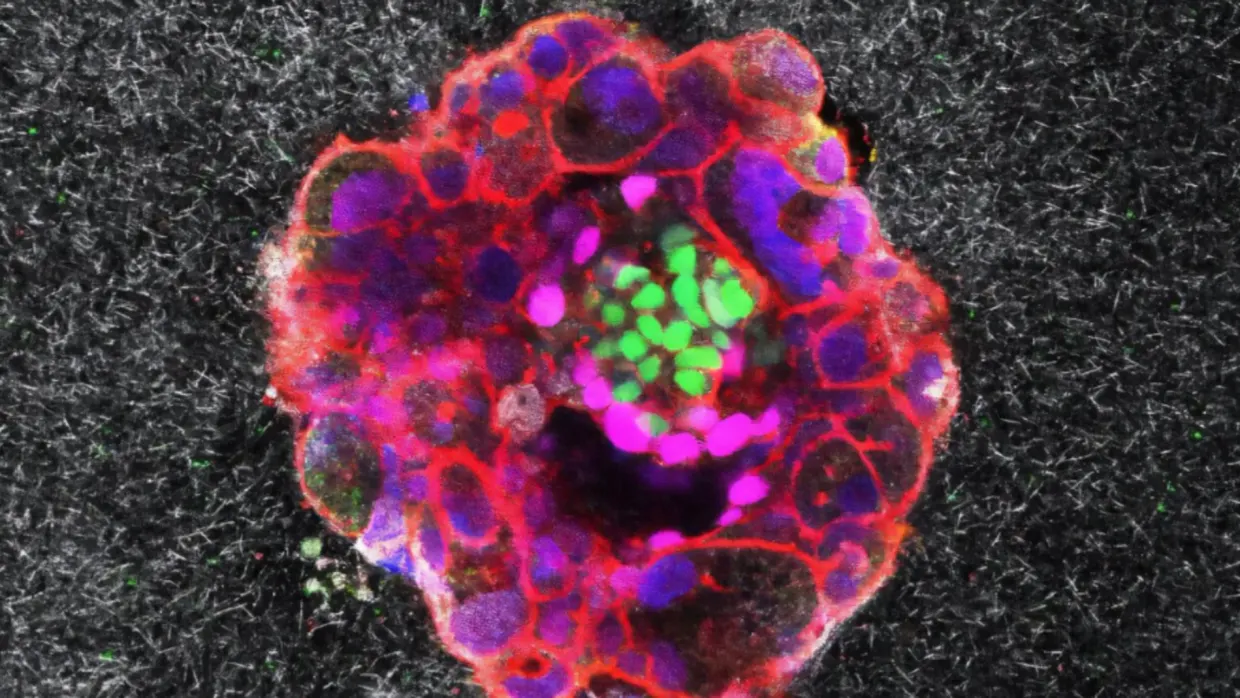
A study published in Nature, according to the paper at doi.org, describes a physical change in the nucleus of the early mouse embryo. The authors, described as a team from Kyushu University and the National Institute of Genetics in Japan led by Kei Miyamoto, report that nuclei become very soft and plastic at the two-cell stage. This state coincides with major zygotic gene activation (ZGA), the surge of new transcripts that occurs in the mid-to-late two-cell stage. nature.com
doi.orgnature.comOpen source ↗
How the nuclear softness was measured
To quantify mechanics without killing the cell, the authors used direct organelle capture with a nanocapillary. The embryo is held with a pipette, while a pressure-controlled nanocapillary captures and stretches the nucleus to measure its elasticity and stiffness.
Three-dimensional imaging with H2B–mCherry showed that nuclei are mostly spherical at the one-cell and four-cell stages but unevenly deformed at the two-cell stage. In time-lapse recordings at 1 h intervals over about 52 h, deformation began at around 21 h post-insemination, peaked at 24–26 h and regressed by 32–36 h.
Lamin B1, LC3 and gene activation
The authors attribute the deformability to rapid removal of lamin B1 from the nuclear envelope by the autophagy factor LC3. When lamin B1 was retained or overloaded, nuclei stiffened, zygotic genes were only partly activated and development was impaired. Embryos that kept their nuclei deformable escaped this transcriptional interference. nature.com
doi.orgnature.comOpen source ↗
High-resolution microscopy and sequential three-dimensional fluorescence in situ hybridization showed that active RNA polymerase II accumulated near the deformable nuclear envelope, together with coordinated positioning of key genomic loci. An engineered molecular tether that stiffens nuclei restricted these nuclear activities and suppressed the expression of key ZGA genes.
The work was done in mouse embryos. The authors conclude that embryos acquire a distinct physical nuclear state at the beginning of life that supports initiation of the zygotic transcription program.