QuantumScape shows Osprey solid-state cell: 80% capacity after 1,000 cycles at 1 atm in lab
A two-layer laboratory cell kept about 80% of its capacity over 1,000 cycles at one atmosphere. The cell is small, and no launch date for Osprey has been announced.
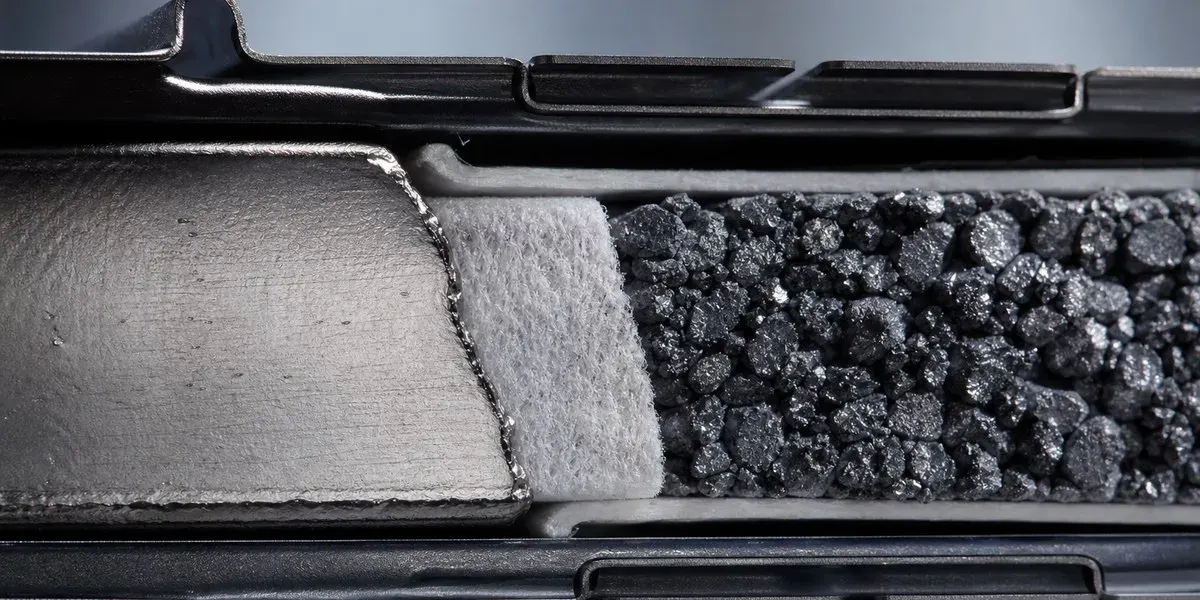
QuantumScape has unveiled Osprey, a platform for all-solid-state battery cells, ua.news reports. According to the company, a two-layer laboratory cell withstood 1,000 full charge and discharge cycles and retained about 80% of its initial capacity at an external pressure of one atmosphere. ua.news
ua.newsua.newsOpen source ↗
Design and test conditions
In the new design, QuantumScape replaced the liquid catholyte in the cathode with a solid sulfide electrolyte. The company kept the ceramic separator and the anode-free architecture, in which lithium is deposited on the separator side during the first charge. The QSE platform, including the QSE-5 cell, uses a high-nickel NMC cathode and a liquid catholyte, so it is not an all-solid-state system.
The 1,000-cycle test used a two-layer cell with a 50 by 65 mm cathode, the same area as in the QSE-5. It ran at 30°C over a 0% to 100% state-of-charge range at 1C for both charging and discharging, with a cathode areal loading of 5.5 mAh/cm².
This was a small laboratory cell. Electrek estimates its capacity at about 0.3–0.4 Ah, while the QSE-5 holds approximately 5 Ah. QuantumScape emphasizes low external pressure because sulfide systems often need strong compression to keep components in contact. By the company's calculation, 20 atmospheres on a 10 by 24.2 cm cell equals a force of about 5,000 kgf and calls for massive steel plates and tie rods in the battery pack. ua.news
ua.newsua.newsOpen source ↗
Fast charging, cold and energy density
The five-minute charge from 10% to 80% reported by QuantumScape was demonstrated at 10C and 80°C. The company has not released data for an equivalent result at room temperature. At −20°C, a single-layer cell with a 21 by 21 mm cathode retained 68% of its room-temperature capacity during slow C/3 discharge.
The energy density of up to 1,100 Wh/L is a QuantumScape projection. A confirming test with a high-loading cathode used an 11 mm cell at three atmospheres over 100 cycles. Osprey has so far been shown only at laboratory scale, and technologies for higher-throughput manufacturing are under development.
QuantumScape offers Osprey as an open platform: automakers can use the company's cathode or their own solid-state cathodes. No timeline for the industrial launch of Osprey has been announced. For the QSE-5, the company plans a 100 MWh production line, with manufacturing set to begin in 2028. ua.news
ua.newsua.newsOpen source ↗