Tokyo University of Science and NITTC make interlocked nitrogen-doped carbon nanohoops in eight steps
Japanese chemists combined reversible gold and copper bonds to assemble a [2]catenane of two strained rings in eight steps instead of more than 10, and biased its handedness with a chiral guest.
A joint team from Tokyo University of Science (TUS) and the National Institute of Technology, Tokyo College (NITTC) has synthesized a nanowerk.com
Nanowerknanowerk.comOpen source ↗catenane of two nitrogen-doped cycloparaphenylene nanohoops in eight steps from commercially available starting materials, according to tus.ac.jp
tus.ac.jp
tus.ac.jptus.ac.jpOpen source ↗. The work was published online in Angewandte Chemie International Edition and selected as a Hot Paper. The overall yield was 2.9%.
Catenanes are molecules in which rings are mechanically interlocked like chain links, with no chemical bonds between them. Cycloparaphenylenes (CPPs) are curved rings of para-linked benzene units and correspond to the shortest segments of carbon nanotubes. Such catenanes are hard to make: CPPs are highly strained, so the strain must be introduced only after the rings are interlocked.
Two dynamic bonds in one pot
Conventional routes carry out separate stages: temporarily linking partial frameworks of the two rings, closing the rings, and forming the strained CPP framework. They typically take more than 10 steps, with overall yields from 0.02% to 4.3%.
The new route combines two kinds of bonds that break and re-form reversibly in solution. One is the gold(I)-carbon σ-bond in macrocyclic gold complexes, the basis of the gold-template method for CPP synthesis developed earlier by members of the team. The other is the copper(I)-nitrogen coordination bond, taken from Sauvage's classical copper-template approach tus.ac.jp
tus.ac.jptus.ac.jpOpen source ↗.
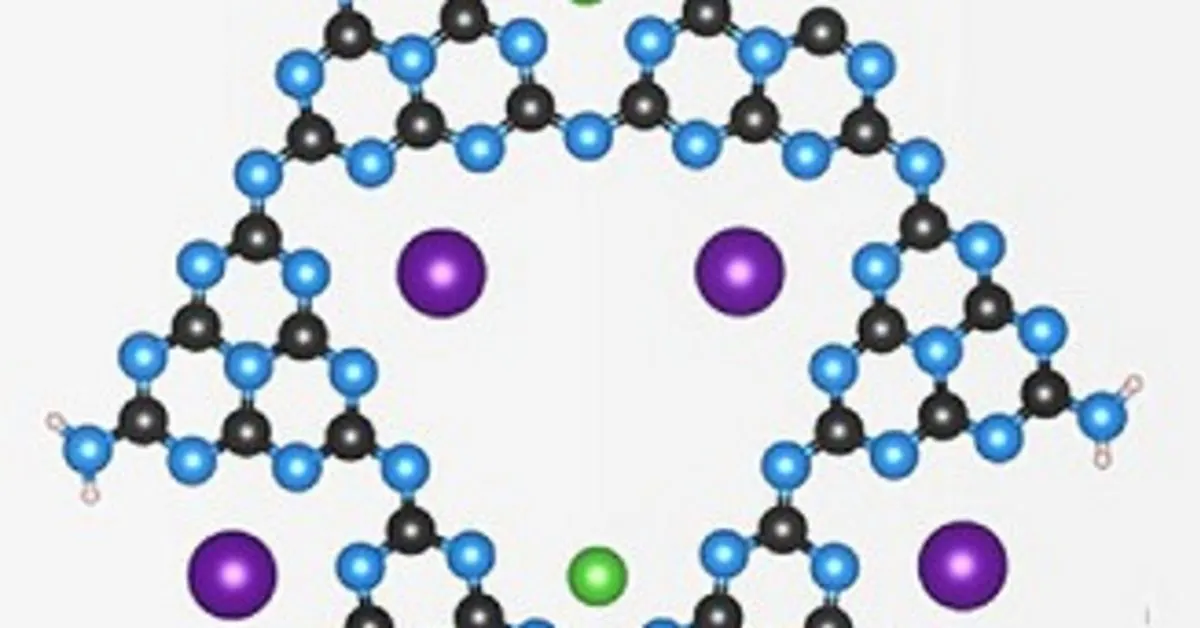
The researchers added a copper(I) salt to a nitrogen-containing macrocyclic gold(I) complex and heated the mixture. The two bond types worked together to assemble an interlocked gold-copper complex in a single pot. Removing the metals gave a metal-free nanowerk.com
Nanowerknanowerk.comOpen source ↗catenane of two fully π-conjugated nitrogen-doped [12]CPP-based nanohoops
tus.ac.jp
tus.ac.jptus.ac.jpOpen source ↗. From mass spectrometry and quantum chemical calculations, the authors proposed that copper(I) coordination acts as a template and drives the dynamic reorganization toward the catenane.
Handedness controlled by a chiral guest
The catenane shows co-conformational chirality: depending on the relative orientation of its two rings, it can be right-handed or left-handed. After the researchers added the chiral aluminum complex CASA-Na, circular dichroism spectroscopy showed the molecule biased toward one handedness, depending on which enantiomer of the reagent was used.
A non-interlocked nanohoop showed almost no such effect, which the team took as confirmation that the chirality comes from the interlocked structure.
The team was led by Tomohito Ide (NITTC) and Yoshitaka Tsuchido (TUS), with collaborators from Kyoto University and TUS. Tsuchido said the approach could allow precise synthesis of topologically complex π-electron nanomaterials, and that guest-induced control of handedness may open routes to chiral materials with tunable optical and electronic properties tus.ac.jp
tus.ac.jptus.ac.jpOpen source ↗.