Cologne physicists observe highly transmissive Andreev modes in a topological insulator Josephson junction
Experiments at the University of Cologne match the Fu–Kane model; whether the energy gap closes and reopens, a sign of topological superconductivity, remains unresolved.
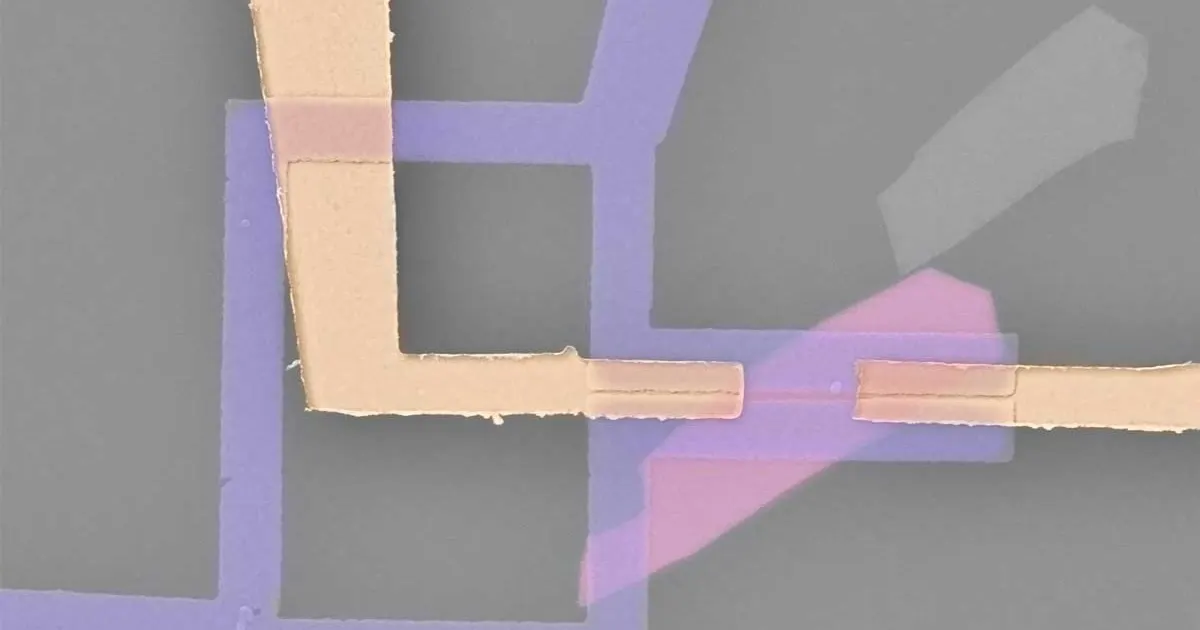
Physicists at the University of Cologne have observed highly transmissive Andreev modes in a Josephson junction made on the surface of a three-dimensional topological insulator. The work was published in Science Advances on 30 October 2026 science.org
Science Advancesscience.orgOpen source ↗. Jakob Schluck, Ella Nikodem and colleagues from Yoichi Ando's Topological Matter Laboratory Cologne report that the behaviour of these states matches theoretical predictions.
Topological insulator surface and Majorana modes
Topological quantum computing relies on special quantum states that should be less sensitive to local disturbances. In the 2008 proposal by Liang Fu and Charles Kane, a conventional superconductor on a topological insulator induces superconductivity in the topological surface state. Spin-momentum locking there guarantees spin-nondegenerate, perfectly transmitted Andreev modes, which lead to gap closing as the superconducting phase difference changes. Such topological superconductivity could open the way to Majorana zero modes, which are studied as a possible basis for topological qubits.
What the tunneling spectroscopy shows
The junction consists of two superconductors connected by a region that is not itself superconducting. The authors probed it through tunnel contacts, with the phase difference set by a flux loop. Highly transmissive Andreev modes appeared over a wide range of chemical potentials, which supports their origin in the topological surface state.
In an applied magnetic field, such modes were found locally, in line with theoretical predictions for Josephson vortices in the surface state science.org
Science Advancesscience.orgOpen source ↗. The results also agree with numerical simulations by Fabian Hassler's group at RWTH Aachen.
A key question remains open. Within the experimental resolution, the observed modes could indicate a gap closing and reopening, which might point to a transition to topological superconductivity. The present measurements cannot establish this unambiguously. According to Schluck, the energy and time resolution of the experiment must be improved to demonstrate the topological phase transition, and this is one of the group's next steps. The authors state that their results support the fundamental role of spin-momentum locking in Andreev physics in the topological surface state.