Quintillion subsea cable off Alaska records bowhead whale calls for the first time using DAS
Lea Bouffaut's team detected bowhead whale vocalizations in subsea telecom cable data using DAS. Existing lines can serve for acoustic monitoring of marine mammals.
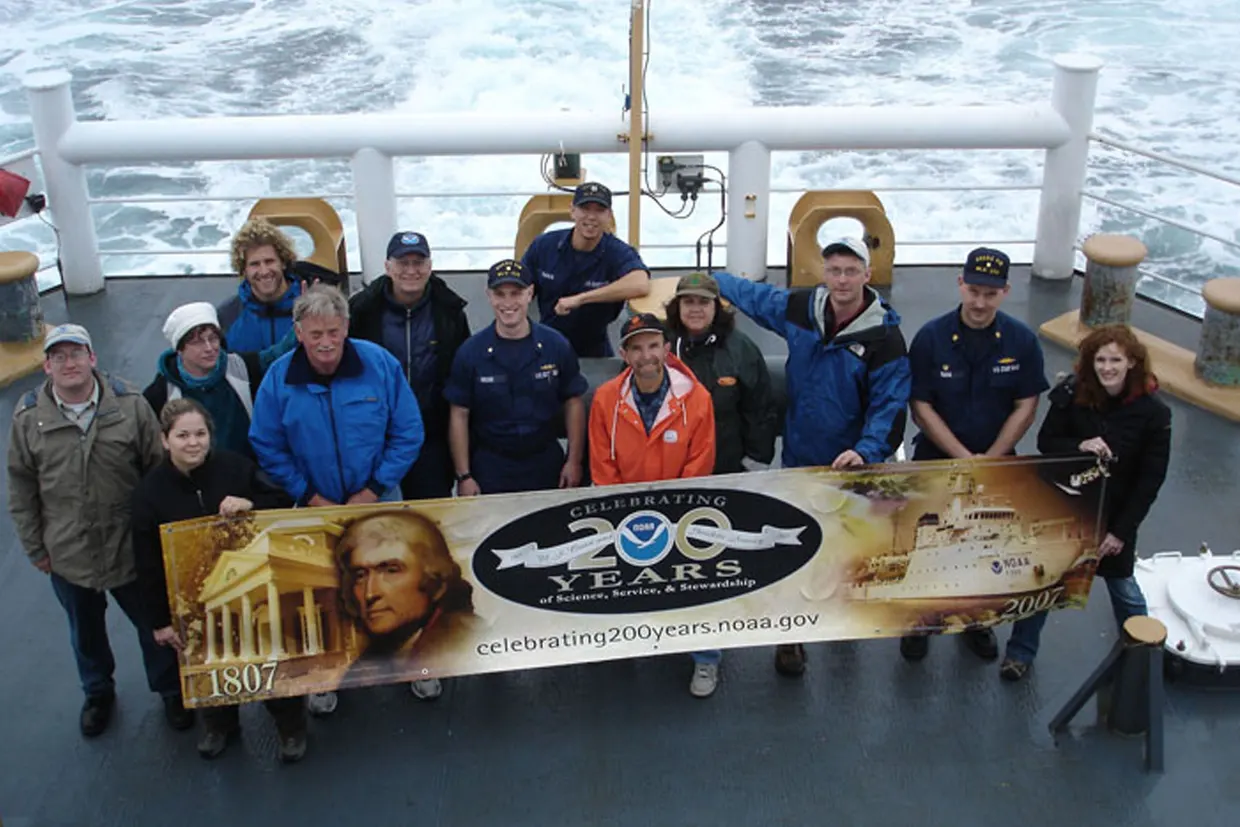
Researchers have turned ordinary optical fiber off the coast of Alaska into a network of acoustic sensors and, for the first time, used it to record high-frequency vocalizations of bowhead whales (Balaena mysticetus), Naked Science reports. The work was led by Lea Bouffaut, a specialist in underwater acoustics and signal processing at Cornell University in the US. The results were published in the journal Methods in Ecology and Evolution. naked-science.ru
Naked Sciencenaked-science.ruOpen source ↗
In spring 2026, Bouffaut worked in Utqiagvik, in northern Alaska, together with representatives of the Barrow Whaling Captains Association and the North Slope Borough Department of Wildlife Management. They analyzed data from a telecommunications cable operated by Quintillion. After several weeks of processing terabytes of data, the team detected vocalizations of this species.
How DAS turns a cable into sensors
The method is called Distributed Acoustic Sensing (DAS). The equipment sends short laser pulses along the cable and analyzes the light that scatters in the fiber and returns; this effect is known as backward Rayleigh scattering. Sound waves in the water or on the seabed slightly deform the fiber and change the optical path of the light. The instrument records these changes, and from them researchers reconstruct acoustic signals, determine their characteristics and, if needed, estimate the position of the source.
Unlike hydrophones, which record sound at a single location, DAS collects data along the whole cable, which spans tens of kilometers. No dedicated observation system has to be laid: existing lines on the seabed are used. naked-science.ru
Naked Sciencenaked-science.ruOpen source ↗
Why bowhead whales were a harder case
Traditional hydrophones are often placed far apart, so scientists may hear an animal without knowing where it is. Deploying and servicing underwater instruments also requires trips to sea.
In 2022, Bouffaut's team showed that DAS can be used to listen to blue whales (Balaenoptera musculus) and fin whales (Balaenoptera physalus). Their calls are loud and lie below 100 hertz. Bowhead whales use higher frequencies, roughly 150 to 300 hertz, and their vocalizations can be less intense, which makes them harder to pick up.
According to the authors, the result confirms that the technology can be extended to all groups of baleen whales. They note that this would allow more accurate estimates of abundance and real-time tracking of migration and of responses to changing environmental conditions. naked-science.ru
Naked Sciencenaked-science.ruOpen source ↗