INRS's C-BLIP profilometry records 3D surface motion at up to 150,000 frames per second
The C-BLIP method projects grayscale fringes at ultrahigh speed with incoherent light and streams 3D images continuously. In demonstrations it reached 150 kfps.
Researchers led by Cheng Jiang and Jinyang Liang at the Institut national de la recherche scientifique (INRS, Québec) have developed chromatically band-limited illumination profilometry, C-BLIP. According to nature.com, the method images 3D surfaces at up to 150 thousand frames per second (kfps) nature.com
nature.comnature.comOpen source ↗. The work was published in Nature Communications.
C-BLIP belongs to single-shot fringe projection profilometry. A 3D object is illuminated with periodic fringes, and the 3D surface shape is recovered from the deformed fringe image. The authors state that earlier time-resolved systems were limited by the speed of pattern projection and image acquisition, and that their imaging speed was capped at about 22 kfps.
How the system works
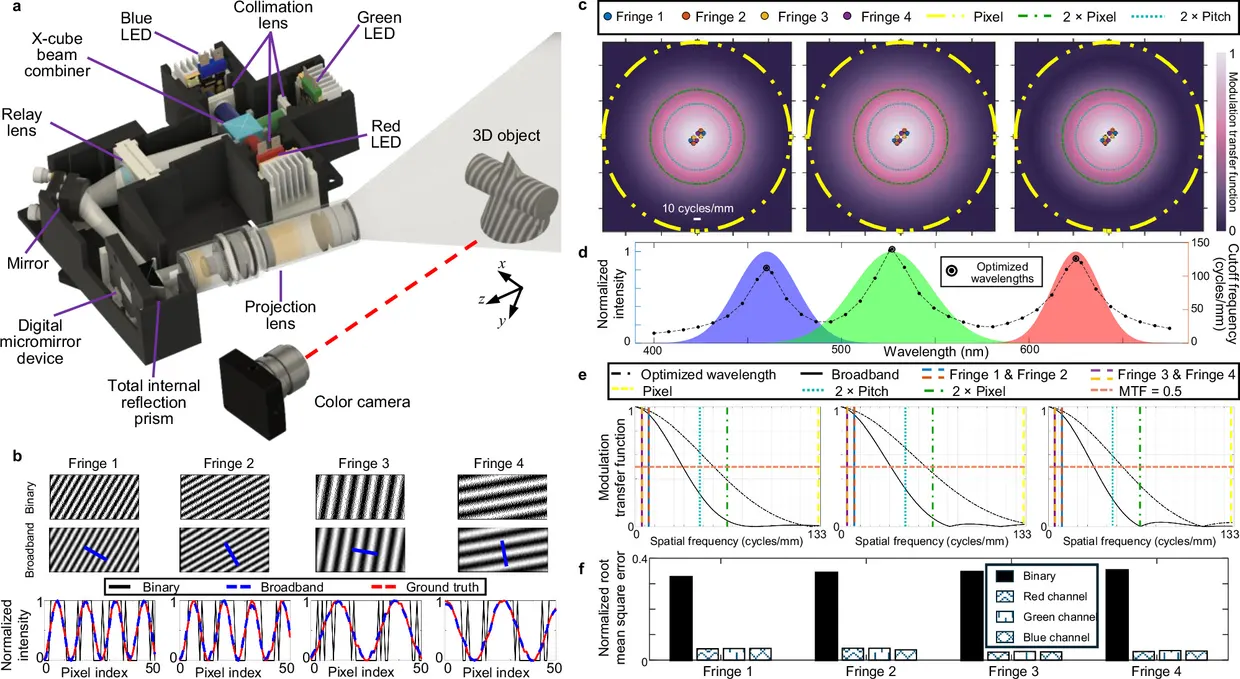
On the illumination side, C-BLIP combines a digital micromirror device with a user-selectable encoding region of interest and a custom-designed projection lens. The lens provides chromatically band-limited illumination, so programmable grayscale fringes are produced from binary patterns using incoherent light sources. Defocusing and spatial filtering, used in earlier approaches, either distort the phase or require coherent light, according to the authors.
On the detection side, the system acquires spatially multiplexed color fringe images and then reconstructs the 3D image nature.com
nature.comnature.comOpen source ↗. This allows continuous streaming rather than recording into the internal memory of a camera.
Demonstrations
The authors demonstrated color 3D imaging of a turbofan blade-projectile collision at 25 kfps. They also showed intensity 3D imaging of the fall aerodynamics of a maple samara at 75 kfps, and ultrasound encryption and recovery at 150 kfps.
According to the INRS retelling, in one controlled experiment the camera recorded the vibrations of a loudspeaker membrane, and a spoken message was reconstructed from them. The camera captures the membrane motion, not the sound waves in the air. The research team describes the speed as a record for optical 3D profilometry. The authors name industrial inspection, bionics and data security as areas of application.