Serial blood samples from 47 women show how acute myeloid leukaemia clones evolved years before diagnosis
Annual blood samples, the earliest taken 15 years before diagnosis, showed that early driver clones grow slowly, while later ones can sweep the blood decades before leukaemia.
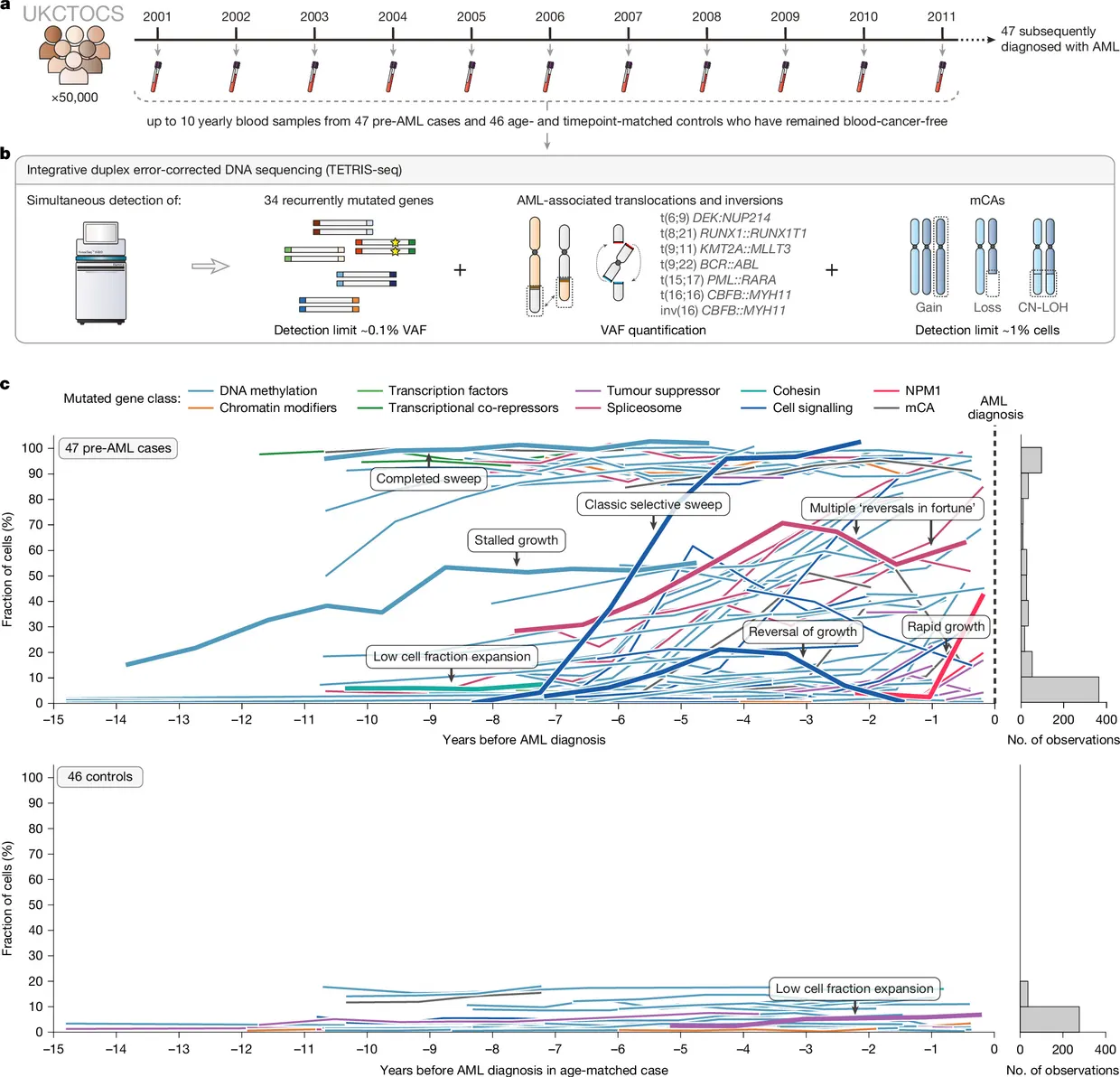
Researchers analysed serial blood samples from 47 women who later developed acute myeloid leukaemia (AML) to describe how pre-cancerous clones evolve, according to a study in Nature. The samples came from the UK Collaborative Trial of Ovarian Cancer Screening (UKCTOCS), which enrolled 202,638 cancer-free post-menopausal women aged 50–74 years between 2001 and 2005. Of these, 50,640 were randomized to an arm with annual blood samples for up to 11 years nature.com
Naturenature.comOpen source ↗. The earliest samples were collected as early as 15 years before AML diagnosis.
Cohort and sequencing method
The 47 women were diagnosed with AML at a median age of 72 years (range 53–83) and had up to 10 serial samples each (median 5). The authors obtained 249 pre-AML samples and 249 timepoint-matched samples from 47 age-matched controls who remained cancer free. One control was later excluded after developing myelodysplastic syndrome.
The team designed a method called TETRIS-seq: duplex error-corrected sequencing of a panel covering gene mutations, chromosomal rearrangements and mosaic chromosomal alterations, combined with a custom in silico de-noising algorithm. Duplex consensus depth exceeded 1,500×, which allowed detection of single nucleotide variants and indels at variant allele frequencies of 0.1% or higher. Chromosomal gains, losses and copy-neutral loss of heterozygosity of 5 Mb or more were detectable down to about 1% cell fraction.
Clone dynamics before diagnosis
Clonal haematopoiesis was found in 72% (33 of 46) of controls. Variants in controls were typically below 20% cell fraction, looked stable over time and were mostly in genes such as DNMT3A and TET2 nature.com
Naturenature.comOpen source ↗. Among variants detected at more than one timepoint, the study counted 132 in future AML cases and 59 in controls.
Using evolutionary theory, the authors estimated when key driver events were acquired and how much selective advantage each gave. According to their data, the first driver mutations are typically acquired in the first few decades of life, when the blood is still highly polyclonal. These early clones grow slowly and later acquire further drivers with selective advantages up to 100-fold larger than those of the early drivers.
Faster-growing clones with multiple drivers can cause complete somatic sweeps of the blood decades before diagnosis, a feature the authors found strongly associated with future AML. They report that the clonal dynamics of blood are consistent with a small set of simple evolutionary rules that balance chance and determinism. The cohort consists only of post-menopausal women.