Waterloo team demonstrates coherent single-photon reflection from a quantum dot in a nanowire waveguide
Authors from Waterloo, NRC Canada and Queen's University report reflection of single photons from a quantum dot in a nanowire; all reflected photons interacted with the dot.
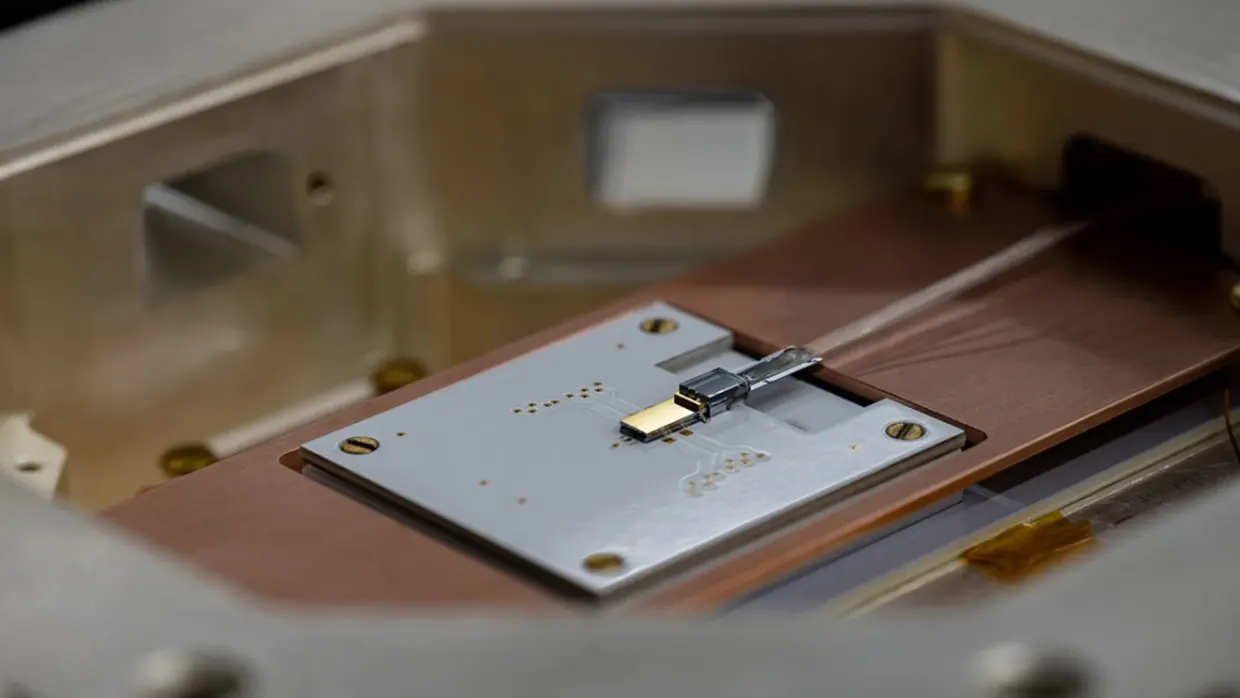
A team from the University of Waterloo, the National Research Council Canada and Queen's University has reported coherent reflection of single photons from a semiconductor quantum dot in a nanowire waveguide. The work, by Tarun Patel, Matteo Pennacchietti, Michael E. Reimer and colleagues, was published in Nature Communications on 11 November 2026. nature.com
Nature Communicationsnature.comOpen source ↗ The quantum dot is strongly coupled to the fundamental waveguide mode of the nanowire.
Why the reflection port was hard to reach
Single-atom waveguide-QED systems have emerged as a leading platform for demonstrating non-linear optics in the few-photon regime, according to the authors. Devices with such non-linear behavior are necessary for developing deterministic gates for photonic quantum computing.
Artificial atoms coupled to nanophotonic or superconducting waveguides can be used to build highly efficient light-matter interfaces for such interactions, where every photon in the system interacts with the quantum emitter. However, access to the reflection port of the waveguide has remained a challenge. The reason is the inability to reject stray electromagnetic fields that do not interact with the artificial atom.
Tapered nanowire and extinction technique
The authors use the tapered end of the nanowire for ideal mode-matching in a vertical geometry. This was enabled by an extinction technique developed in the work. nature.com
Nature Communicationsnature.comOpen source ↗ The mode-matching allows efficient transfer of photons from the input to the reflection port, with all of the photons having interacted with the quantum dot.
The authors describe the platform as high-efficiency and scalable. They state that it opens applications in few-photon quantum non-linear optics, and note that such a platform has been proposed for creating key resource states for universal photon-based quantum computing.
The authors are affiliated with the Department of Electrical and Computer Engineering, the Institute for Quantum Computing and the Department of Physics and Astronomy at the University of Waterloo, with the National Research Council Canada in Ottawa, and with the Department of Physics, Engineering Physics and Astronomy at Queen's University in Kingston.