Colorado State University's TeCoBot prototype: tensegrity robots with claws dock into chains, loops and branches
Colorado State University engineers built TeCoBot, a compliant modular robot. Units work alone or dock by claws into different shapes for joint manipulation and movement.
Engineers at the Department of Mechanical Engineering, Colorado State University, described a modular reconfigurable robot called TeCoBot in a paper on nature.com nature.com
nature.comnature.comOpen source ↗. The design combines a compliant tensegrity-based body with claw-based connection mechanisms. Each robot can manipulate objects and move on its own, and several robots can self-reconfigure into different morphologies, including chains, loops and branches. The work is a laboratory prototype.
Tensegrity body and claws
The authors start from a limitation of existing systems. Modular reconfigurable robots usually rely on rigid modules that lack structural compliance, while continuum robots are flexible but cannot self-reconfigure into multi-robot configurations. TeCoBot is meant to combine the advantages of both architectures.
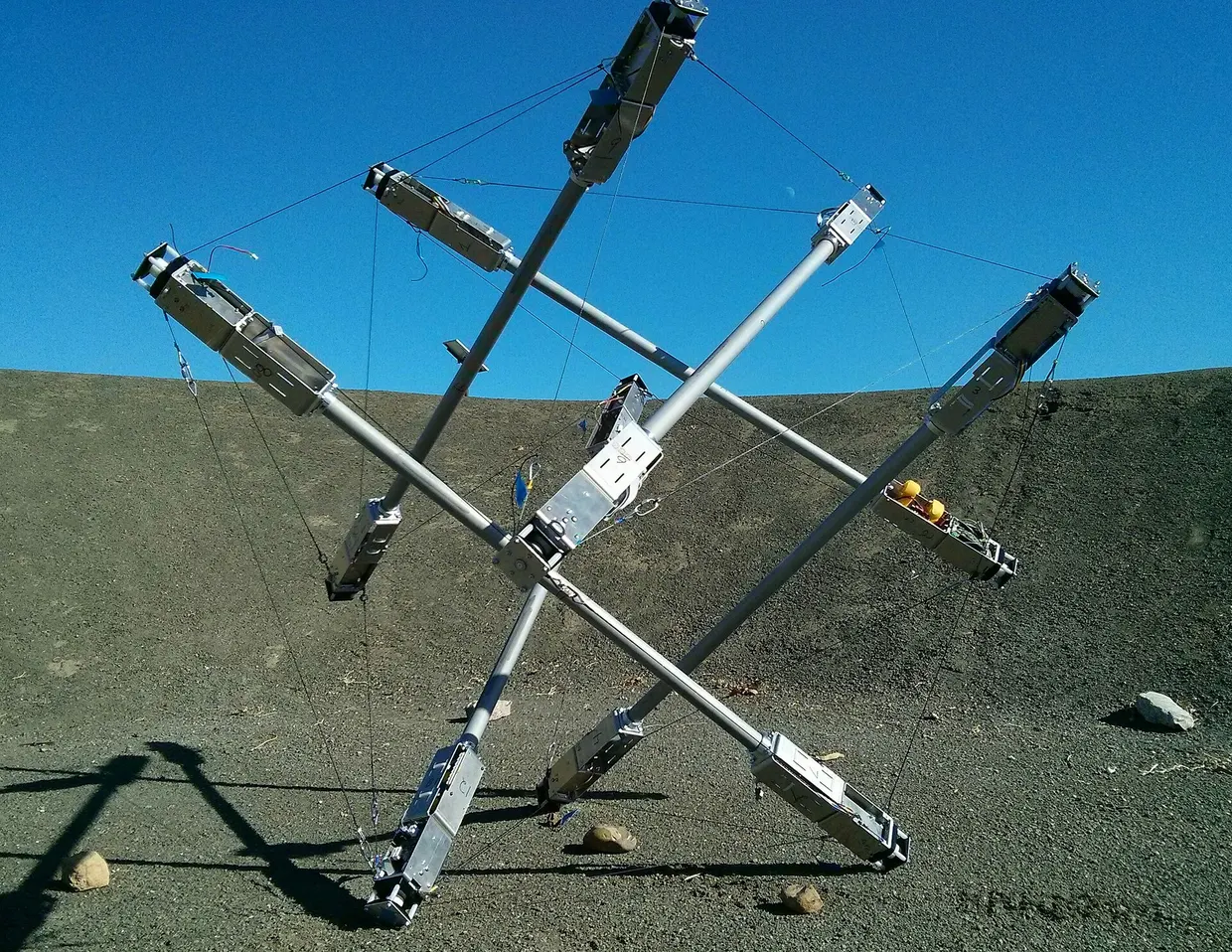
In a tensegrity structure, rods are held in place by a web of tensioned cables rather than locked together rigidly. As a result, the body can bend, twist around obstacles or collapse onto itself. The units are 3D-printed, plastic and rubber, and nearly two feet long, with a claw at each end. The claws let one robot grasp another and join it.
Demonstrated tasks
According to the authors, the robots were tested on coordinated object manipulation and transport, multimodal locomotion, and loco-manipulation in real-world scenarios nature.com
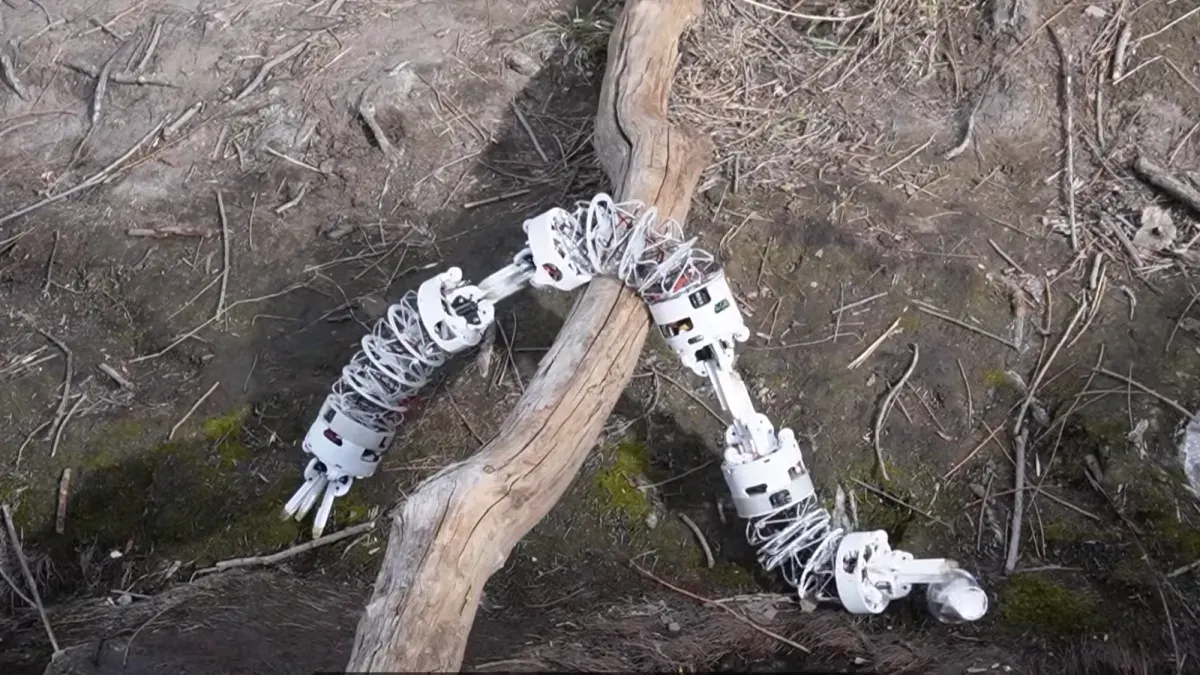
nature.comnature.comOpen source ↗. A single unit, controlled remotely by an operator, crossed a large branch outdoors. It also rolled over itself repeatedly, climbed a pipe and moved like a snake.
Chained robots climbed onto a desk and picked up a pen, opened a sealed jar, and carried an object across a room. Joined units can move as one body or work independently.
The authors name manufacturing, space exploration and search-and-rescue operations as potential applications. Associate Professor Jianguo Zhao said in a statement that he envisions mostly autonomous teams of tens or even hundreds of such robots that travel to a site and deploy for a specific purpose.
The paper's source data are on figshare. The code, including ESP32 transmitter and receiver firmware and the autonomous visual docking implementation, is on GitHub under an MIT licence nature.com
nature.comnature.comOpen source ↗.