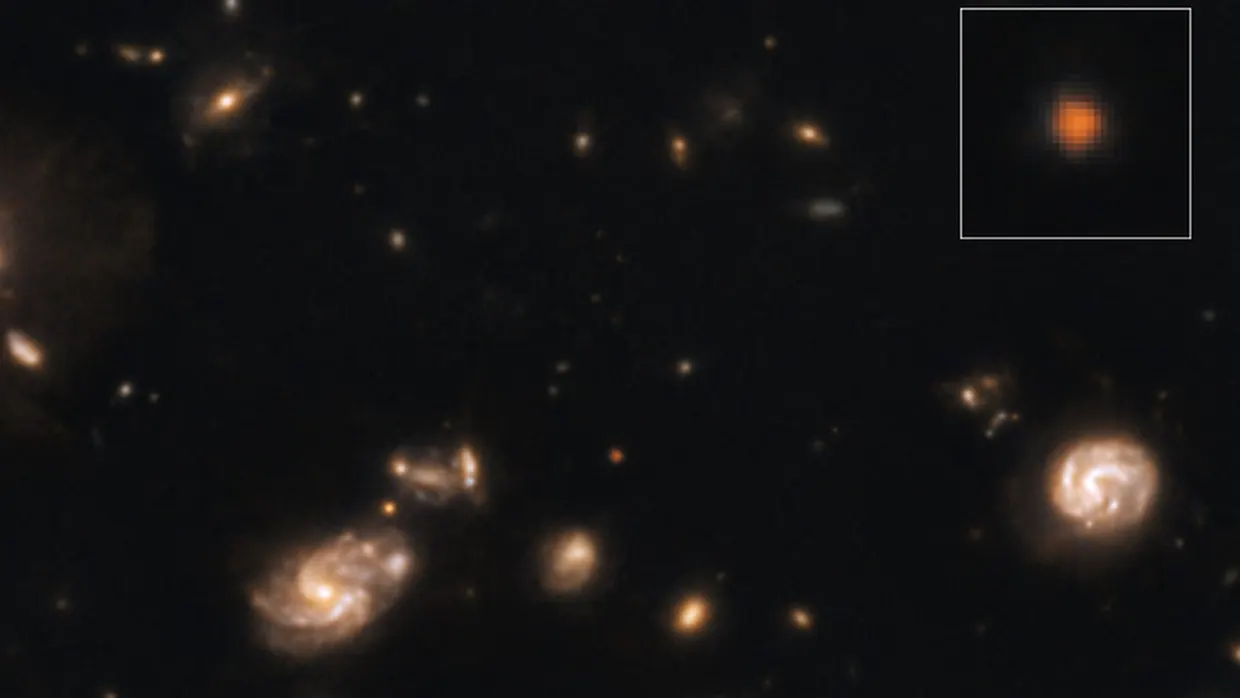
GPM J071507−114153: radio pulses every 7.9 min from a white dwarf with a G-type star companion
Astronomers found a long-period radio transient in which a white dwarf orbits a G-type star rather than an M dwarf. The orbital period is about 1.3 days.

A team reporting via dx.doi.org described a new long-period radio transient, GPM J071507−114153, with a pulse period of 7.9 minutes dx.doi.org
dx.doi.orgdx.doi.orgOpen source ↗. According to the Nanowerk account, the system lies about 5,000 light-years away. It is a binary of a low-mass white dwarf and a G-type star, identified by optical spectroscopy. Earlier optical follow-up had confirmed that at least 4 of 12 known long-period transients are binaries of a white dwarf and an M dwarf.
Long-period transients are repeating radio sources with periods of minutes to hours, small duty cycles and highly polarized emission. Their brightness temperatures point to a coherent emission mechanism. In this object the companion is a G-type star, the same class as the Sun, which the authors present as the first such case among white-dwarf systems of this kind.
Orbit and pulse timing
The radio pulses are modulated by a longer period of about 1.3 days. The authors interpret it as the orbital period of the binary. A timing analysis constrains the orbital configuration and suggests that the G-type star does not fill its Roche lobe.
The team processed more than 100 hours of radio data at the Pawsey Supercomputing Research Centre. Lead author Sam McSweeney said the pulses are clear enough to see the white dwarf moving in its orbit. In his words, this means the pulsations come from a region close to the white dwarf, or possibly from the white dwarf itself.
Faraday rotation in the companion's corona
Near the superior conjunction of the white dwarf, the rotation measure of the pulses changes rapidly. The authors find this consistent with Faraday rotation induced by the corona of the companion star dx.doi.org
dx.doi.orgdx.doi.orgOpen source ↗. The pulses therefore pass through the outer atmosphere of the G-type star and carry information about it.
From these results the authors conclude that in long-period transients powered by white dwarf binaries, the coherent pulsed radio emission depends crucially on interaction with the companion star. They show that the companion can be a G-type star in a day-long orbit. Dynamic spectra and measured pulse properties are available on Zenodo, and the processing code is on GitHub.