Durham team builds synthetic lattice from rotational states of ultracold RbCs molecules, eight sites, ~500 tunnelling periods
Physicists at Durham, Birmingham and Rice used rotational states of ultracold RbCs molecules as a synthetic dimension and probed topological edge states of the SSH model with site-resolved readout.
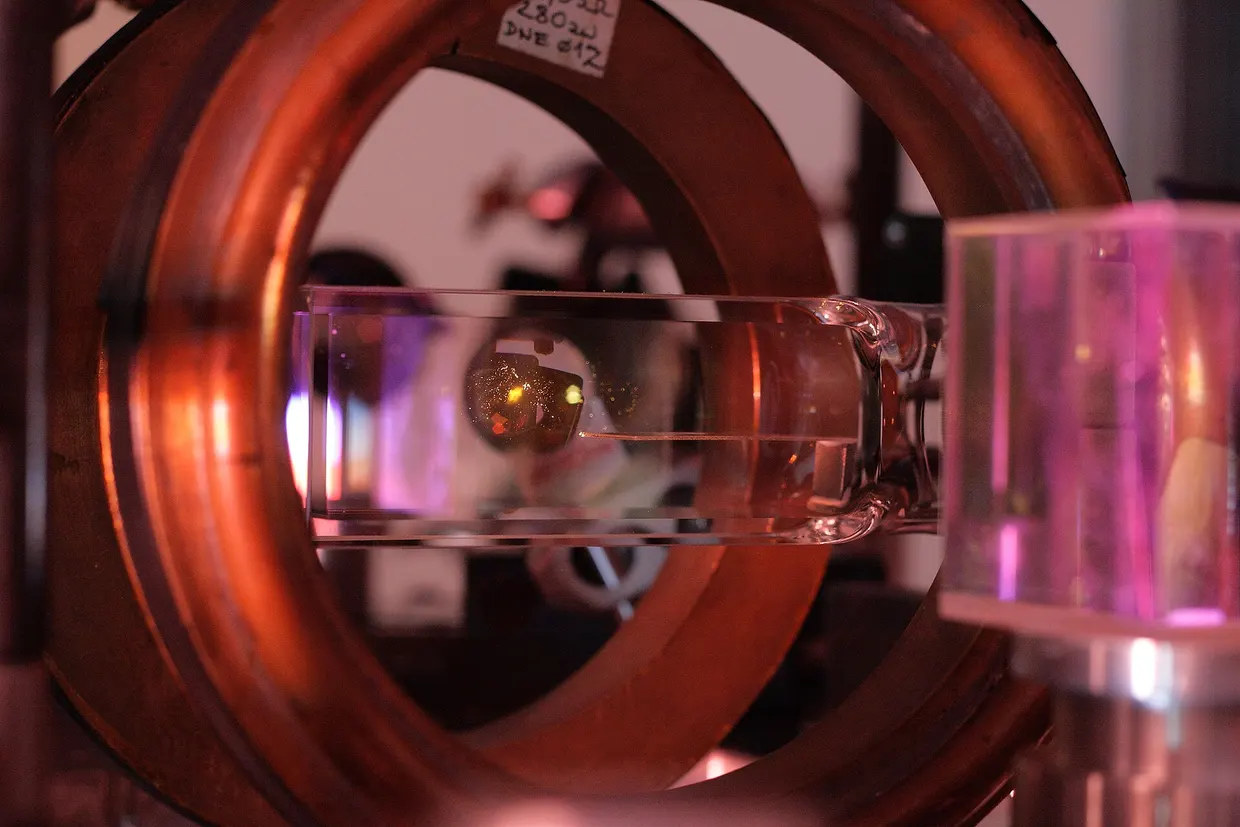
A group from Durham University, the University of Birmingham and Rice University has realised a one-dimensional synthetic lattice from the rotational states of ultracold RbCs molecules. The authors used it to study the topological properties of the Su-Schrieffer-Heeger (SSH) model, according to a paper in Nature Communications published on 11 November 2026 nature.com
Nature Communicationsnature.comOpen source ↗.
In a synthetic dimension, an additional spatial dimension is encoded in the internal states of a quantum system rather than in physical space. Ultracold polar molecules offer large Hilbert spaces of long-lived rotational and hyperfine states. Microwave fields link these states and simulate tunnelling between lattice sites.
Lattice and measurements
The lattice sites are rotational states of RbCs molecules. The authors probed the system spectroscopically using an auxiliary rotational state. They also studied the time dynamics after deterministic preparation of the initial state.
The researchers report long coherence times. These reach about 500 tunnelling periods, even for lattices spanning eight rotational states nature.com
Nature Communicationsnature.comOpen source ↗.
Edge states and perturbations
The setup provides full site-resolved readout over long evolution times. With it, the authors examined how robust topologically protected edge states are against perturbations. Some of the perturbations preserved chiral symmetry and others broke it.
The authors conclude that the results establish ultracold molecules as a platform for quantum simulation with synthetic dimensions. The work was done at the Department of Physics, Durham University, the School of Physics and Astronomy, University of Birmingham, and the Department of Physics and Astronomy and the Smalley-Curl Institute at Rice University. The correspondence authors are Adarsh P. Raghuram and Simon L. Cornish.