Halogen-free aqueous electrolyte enables four-electron iodine conversion in Zn–I2 and Al–I2 batteries
Authors report a halogen-free aqueous electrolyte for reversible four-electron iodine conversion in Zn–I2 and Al–I2 cells, avoiding concentrated, corrosive chloride and bromide salts.
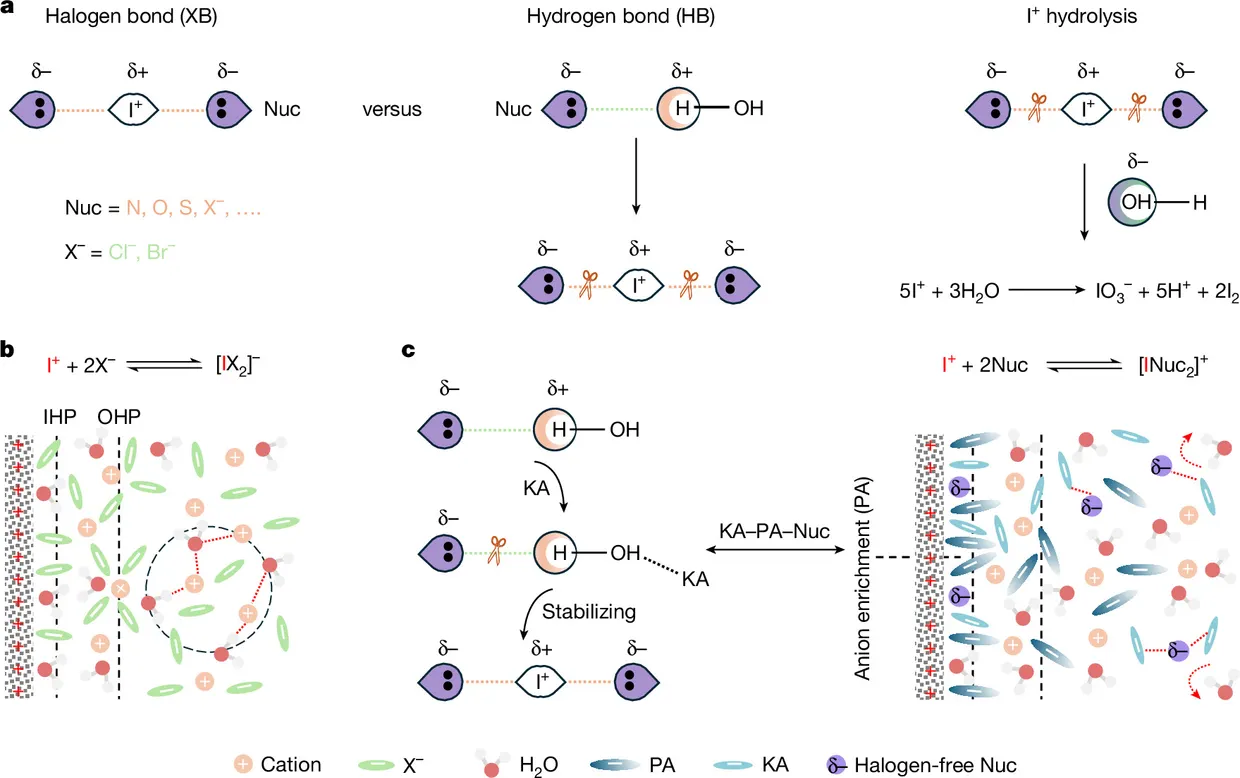
A research team has described an electrolyte framework that makes four-electron iodine conversion reversible in aqueous metal–iodine batteries without halogen-containing salts, according to a paper in Nature. The authors tested it in aqueous Zn–I2 and Al–I2 batteries. The electrochemical measurements were made in Zn–I2 coin cells with an iodine loading of 2.2 mg cm−2 nature.com
Naturenature.comOpen source ↗.
Why four-electron iodine chemistry is hard in water
The usual two-electron I−/I0 couple has a theoretical capacity of 211 mAh g−1 at 0.54 V versus the standard hydrogen electrode. Adding the I0/I+ step doubles the theoretical capacity to 422 mAh g−1 and brings in a second process at 1.07 V.
The difficulty is that the I+ cation is strongly electrophilic and is attacked by water, which leads to hydrolysis and poor reversibility. Earlier work stabilized I+ as interhalogen complexes, for example ICl2 or IBr2, in highly concentrated chloride- or bromide-containing electrolytes. The authors note that the high salt content and corrosivity of such electrolytes limit their wider use.
Kosmotropic anion–polar anion–nucleophile framework
The proposed framework combines three components: a kosmotropic anion (KA), a polar anion (PA) and a nucleophilic species (Nuc). According to the authors, polar anions create a water-deficient, anion-enriched interface. Kosmotropic anions weaken hydrogen bonding between Nuc and water, which leaves more Nuc available to stabilize I+ through linear Nuc–I+–Nuc halogen bonds nature.com
Naturenature.comOpen source ↗.
The halogen bonds are supported by Nuc-free control experiments, nuclear magnetic resonance spectroscopy and theoretical calculations. The framework was demonstrated with four halogen-free nucleophiles: urea, acetamide, pyridine and nicotinamide.
With urea as the nucleophile, the KA electrolyte showed only the I−/I0 process. The PA electrolyte also allowed I0/I+ oxidation, but with poor reversibility. The excess capacity at its second charge plateau was attributed to irreversible iodine oxidation together with parasitic water oxidation. Combining KA and PA produced two reversible redox peaks and the matching charge–discharge plateaus, which the authors describe as a synergistic effect. Cyclic voltammetry was run at 0.6 mV s−1 and galvanostatic charge–discharge at 1 A g−1.
The authors present the work as a shift from interhalogen stabilization to a halogen-free electrolyte chemistry for reversible multi-electron iodine conversion in aqueous environments nature.com
Naturenature.comOpen source ↗.