Cystadane lowered urine glycoasparagines by 68.6% in aspartylglucosaminuria in a phase Ib/II trial
In a 48-month open-label phase Ib/II trial in Finland, oral betaine reduced the main disease biomarker in 21 children and adolescents; the effect on disease progression remains untested.
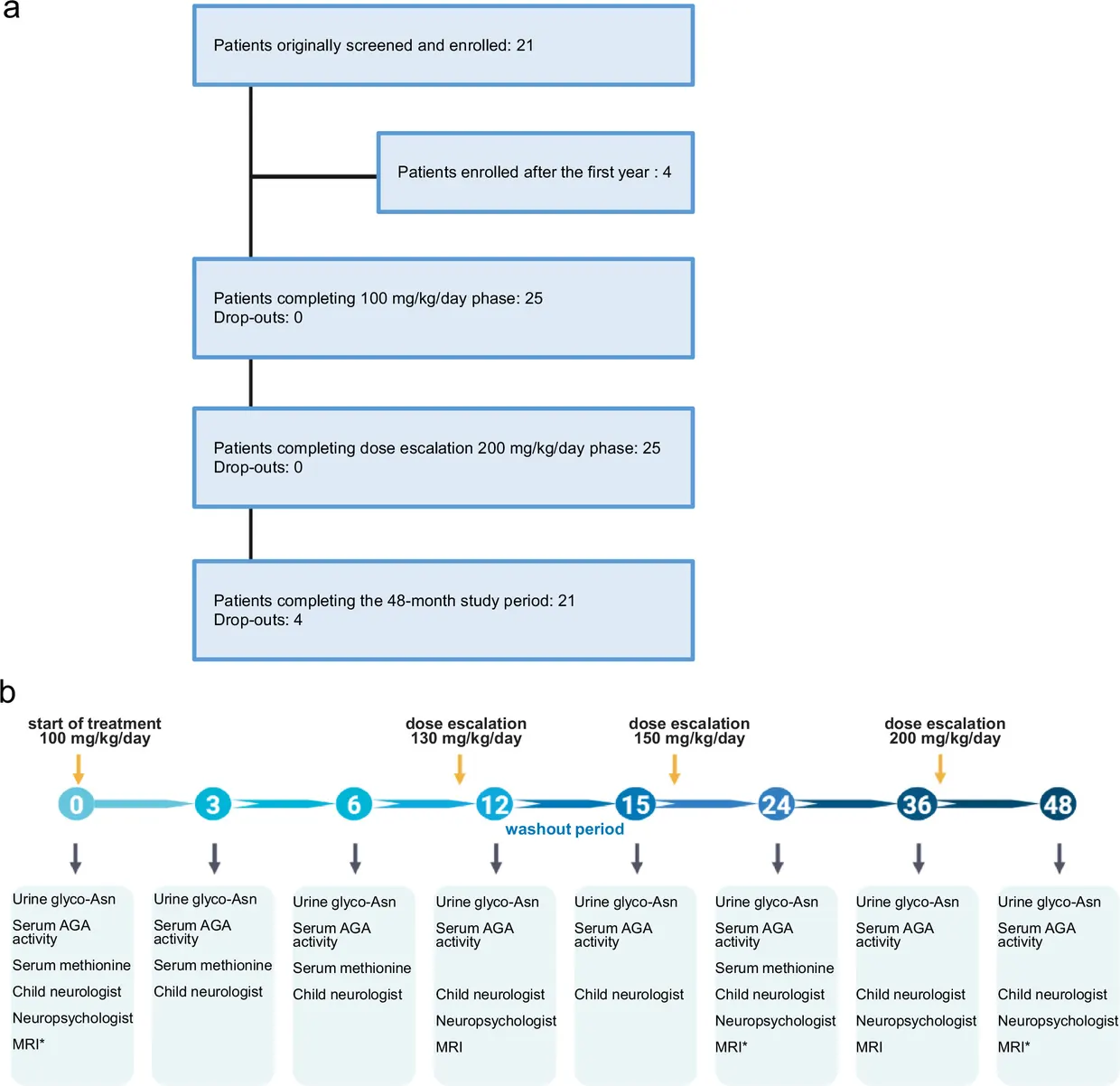
Finnish researchers reported results of a phase Ib/II trial of Cystadane (betaine anhydrous) in aspartylglucosaminuria (AGU), a lysosomal storage disorder with progressive cognitive decline. The investigator-initiated, single-center, open-label study was run at Helsinki University Hospital; 25 patients aged 3 to 17 years were recruited and 21 analyzed, according to Nature Communications nature.com
Nature Communicationsnature.comOpen source ↗. All were homozygous for the Finnish major variant of the AGA gene. The primary endpoint was met: urine glycoasparagines fell by 68.6% ± 10.8% (p = 0.000), the authors report.
Trial design
The study began in February 2018 with 21 participants aged 7 to 15 years (11 females, 10 males). Four more patients joined in May 2019 under an amended protocol: three aged 3 to 6 years and one aged 16 years 11 months. The original group completed 48 months in April 2022; the added patients took part for 33–34 months because the study closed on that date.
Cystadane was given orally. All patients started at 100 mg/kg/day in two equal portions; the dose was gradually raised to 200 mg/kg/day (or a maximum of 12 g/day) and kept for the final 12 months. Glycoasparagines were measured by liquid chromatography/mass spectrometry and normalized to urine creatinine.
Mechanism and other findings
AGU is caused by pathogenic variants of the AGA gene that leave the lysosomal enzyme aspartylglucosaminidase deficient. Earlier in vitro work by the same group showed that betaine acts as a pharmacological chaperone for the Finnish major variant: it binds the mutated precursor, aids its folding and increases processing into the active form. Betaine is already approved for homocystinuria under the names Cystadane and Amversio nature.com
Nature Communicationsnature.comOpen source ↗.
Besides the primary endpoint, the authors report an increase of AGA activity in patient blood, improvement in some subdomains of standardized neuropsychological tests, and reduced iron accumulation in specific brain regions on MRI. They describe the treatment as safe and well tolerated.
The authors note that larger and longer studies are needed to show effects on disease progression. The trial is registered as EudraCT 2017-000645-48.