Archaeologists excavate 17,000 m² Roman complex at Le Châtelet in Charente-Maritime
A 2026 dig at Saint-Agnant uncovered 600 m² of a luxurious Gallo-Roman complex with a plan unlike any known in the Roman world; its purpose is still open.
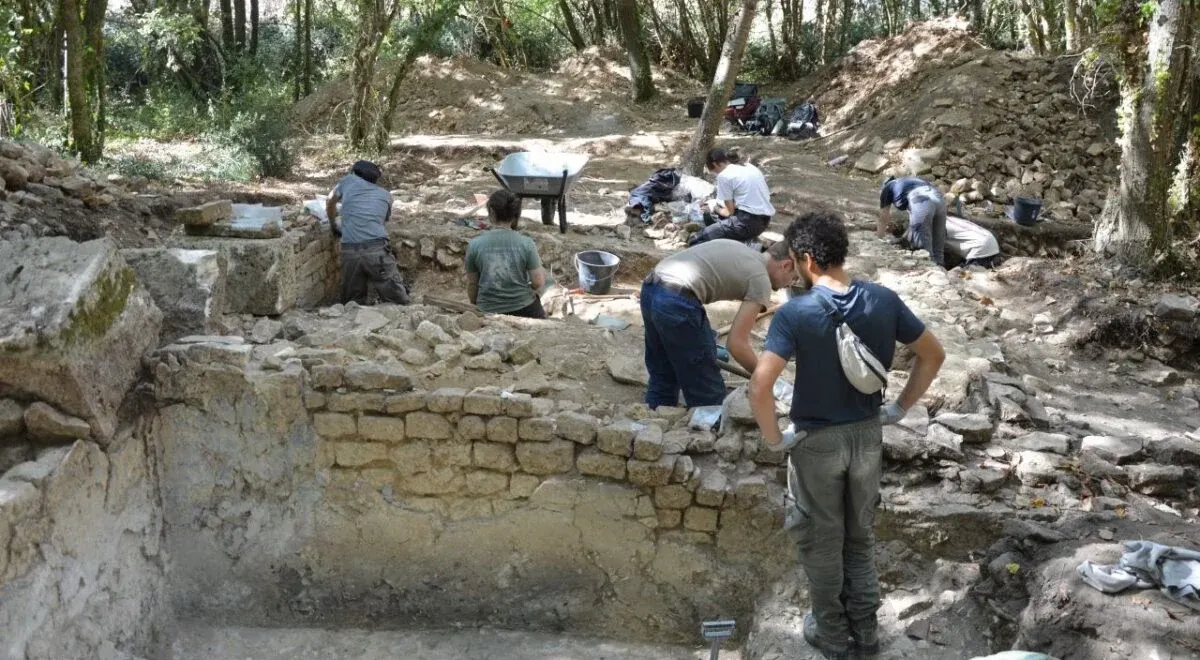
From 31 August to 18 September 2026, about thirty archaeologists reopened the Gallo-Roman site of Le Châtelet in Saint-Agnant (Charente-Maritime), near Rochefort, according to science-et-vie.com. The programmed dig was led by Bastien Gissinger of the Regional Archaeology Service of DRAC Nouvelle-Aquitaine. It targeted a monumental complex of about 17,000 m², built no earlier than the middle of the 1st century. Only 600 m² have been uncovered so far, and the interpretation remains open science-et-vie.com
science-et-vie.comscience-et-vie.comOpen source ↗.
Plan and decoration
Mosaics, painted plaster and painted ceilings cover floors, walls and ceilings. The painters used Egyptian blue, a synthetic pigment prized by the Romans. The central hall, which Gissinger calls a reception room, alone covers 120 m².
The soundings found neither a basin nor tile-powder plaster, which seems to rule out baths. Nothing suggests a sanctuary or a villa. According to Gissinger, the most likely option today is a very luxurious private residence, but there are six porticoed courts, too many for purely private use. This raises the idea that part of the complex was open to the public.
The plan has two series of three porticoed courts separating three built strips of more than 1,000 m² each. A wide corridor surrounds the whole, possibly added later. Semicircular masses at the south-east and south-west corners were spotted by earlier digs and by Lidar, an airborne laser scan that sees through the forest. Gissinger considers a later fortification, as at the forum of Bavay in the 4th century. It would also explain the place name, derived from the Latin castellum. This lead will be explored in later campaigns science-et-vie.com
science-et-vie.comscience-et-vie.comOpen source ↗.
Chronology and finds
The site was found in 1960 and sounded in 1967–1973 by amateur archaeologists Camille Gabet and Paul David of the Société de géographie de Rochefort. In 2026 the first task was to check their plan; the central mosaic panel and its frieze reappeared as expected.
The pioneers thought the building was abandoned and burned at the end of the 1st century. The new team sees enlargements and repairs, which point to longer use. Building materials were salvaged at the very end of the 3rd century, and pits, a hearth plate and wall bases show occasional occupation in the 4th century. Two finds are new: plaster with painted decoration preserved over 1.30 m high in a portico corner, and a brick bench that may be the base of a domestic altar.
Few objects were found outside the external dumps. According to Gissinger, the rooms were carefully maintained and then emptied of valuables before destruction. Surrounding structures may extend over at least 80 hectares, so an ancient settlement is considered a serious hypothesis. In 2027 the team will dig other sectors, outside zones, a supposed bath complex and buildings seen by Lidar. Shells studied in 2022 by Philippe Duprat and Catherine Dupont (CReAAH) were used as wall decoration science-et-vie.com
science-et-vie.comscience-et-vie.comOpen source ↗.