Hand stencil in Liang Metanduno cave, Indonesia, dated to at least 67,800 years old
Uranium-series dating of calcite over the pigment gives a minimum age for the stencil on Muna island, the oldest published for cave wall art.
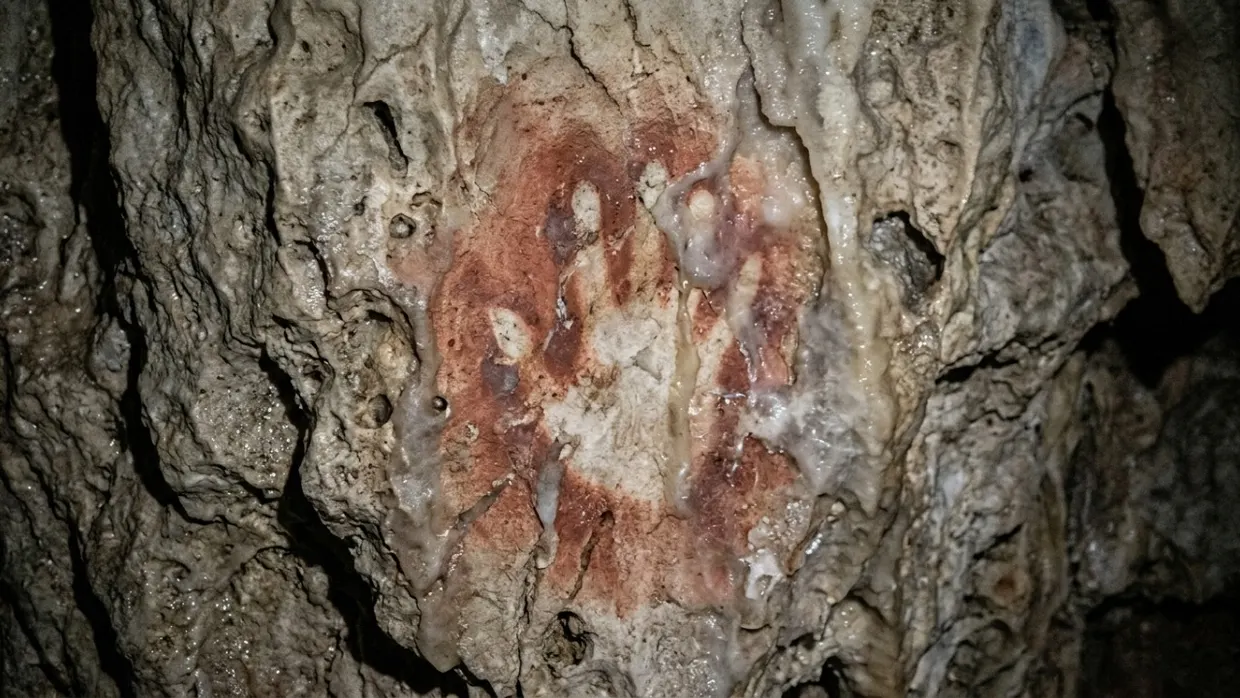
A faded hand stencil in the Liang Metanduno cave on Muna island, near the southeastern peninsula of Sulawesi, Indonesia, is at least 67,800 years old, according to a study in Nature as reported by Super Rádio Tupi. tupi.fm
Super Rádio Tupitupi.fmOpen source ↗ An international team of researchers studied the image together with other paintings in the cave. What remains is a faded area of about 14 by 10 centimeters showing part of the fingers and the region near the palm.
Other paintings at the site are more visible and appear more recent. The team examined different layers of the wall to separate images from different periods, rather than assign the age of the oldest mark to all of them.
How the age was measured
The stencil was made by placing a hand against the rock and applying pigment around it, leaving a negative silhouette. It is not a print made by pressing a paint-covered palm. The team used laser uranium-series dating on calcite deposits that formed naturally over the pigment. Because the mineral formed after the painting, the image must be at least as old as the dated part of that layer.
One sample gave an estimate of 71,600 years, with an uncertainty of 3,800 years. The authors adopted 67,800 years as the minimum age of the stencil. tupi.fm
Super Rádio Tupitupi.fmOpen source ↗ This does not mean the hand was painted in that year: the image may be older, but the available analysis cannot fix a precise date. The age comes from the calcite, not from a direct measurement of the pigment.
What the record covers
Among minimum ages demonstrated for cave wall paintings, the authors found the Muna stencil to be the oldest published so far. It exceeds by about 1,100 years the minimum reported for a hand stencil in Spain, which some studies associate with Neanderthals; the dating of that European example is also debated.
The result is narrower than the claim of the oldest artwork in the world. Other objects with ancient marks exist outside cave walls, and the definition of art varies. According to the team's analysis, one finger appears to have been deliberately narrowed, though it may also have been altered by added pigment or hand movement. The intent behind the shape is unknown, and there is no basis to assign it a ritual meaning.
The team considers the tradition likely linked to Homo sapiens, but no method identifies directly the species of the person who left the hand. It is also unknown whether that person acted alone or why the site was chosen. tupi.fm
Super Rádio Tupitupi.fmOpen source ↗