Non-condensing ALK and RET fusions drove Ras–Erk signalling and transformed cells in tumour models
Cell experiments with synthetic and natural RTK fusions showed that small assemblies, even monomers, are enough for signalling; mesoscale condensates were not required.
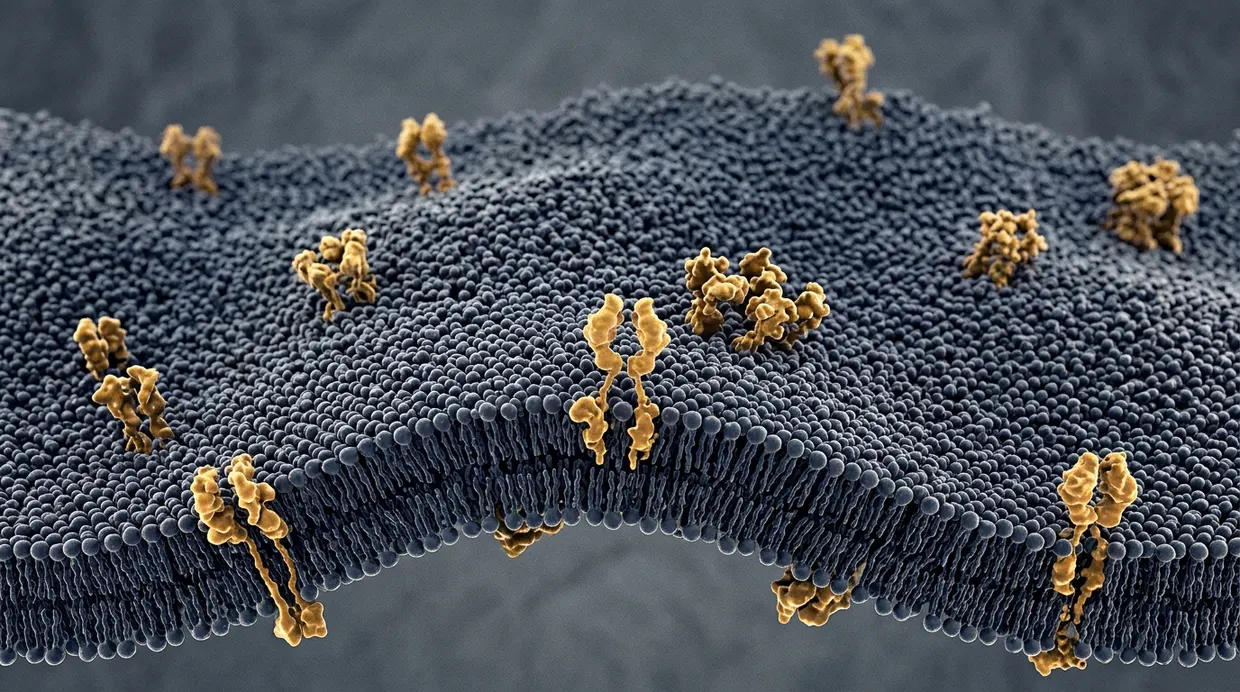
A study in Nature Cell Biology, available via doi.org, tested whether mesoscale condensates are needed for oncogenic signalling by receptor tyrosine kinase (RTK) fusions. The authors used advanced microscopy, single-cell analysis and synthetic fusions. They report that small, diffuse assemblies are sufficient to transmit the signal from the cytoplasm nature.com
doi.orgnature.comOpen source ↗.
RTK fusions are found in about 5% of cancers, and more than 1,000 distinct fusions have been identified. Typically, the intracellular kinase fragment of a transmembrane RTK is joined to a partner fragment that forms oligomers. Such fusions often lack a transmembrane domain and sit in the cytoplasm, yet they still activate pathways that start at the plasma membrane.
Condensation and signalling in EML4–ALK
EML4–ALK is a prominent fusion that forms condensates 0.1–1 µm in size. The authors expressed its variants in HeLa, Beas2B and HEK 293T cells and measured the share of cell area occupied by condensates alongside ERK phosphorylation in single cells. They found poor correlation between condensation and signalling, and abundant EML4–ALK activity in the diffuse phase.
Synthetic fusions and tumour models
To separate multimerization from condensation, the authors built synthetic RTK fusions. Cytoplasmic dimers of ALK or RET domains, and even constitutively active monomers, induced strong Ras–Erk signalling without condensates. Non-condensing fusions were sufficient to transform cells in vitro and in subcutaneous tumour models nature.com
doi.orgnature.comOpen source ↗.
The authors also examined a panel of other cancer-driving RTK fusions. Low-order multimerization was widespread across them, whereas mesoscale condensation was rare and did not correlate with signalling.
The authors conclude that low-order multimerization is sufficient to drive fusion phosphorylation. In their results, this phosphorylation is necessary and sufficient to trigger downstream oncogenic signalling. Earlier work had found it hard to establish whether condensates play a causal role, because perturbing multimerization disrupts both condensation and kinase activity.