Madrid team tests radiant-capacitive building cooling in full-size cells: up to 12 °C below reference
Two full-size experimental cells were compared in summer clear-sky conditions: sky-facing radiators and water-filled ceiling panels, no compressor. The maximum difference was 12 °C.
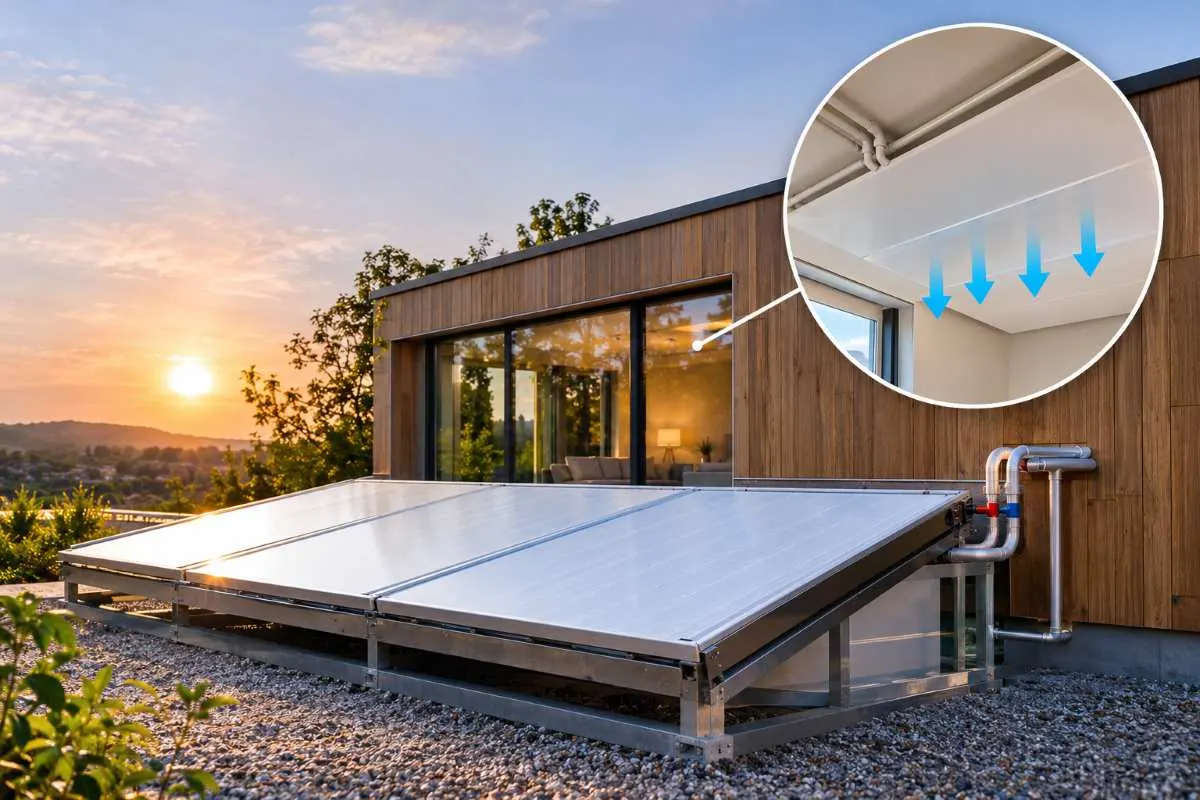
A research team including Eduardo González-Cruz, Gloria Pérez and Borja Frutos tested a radiant-capacitive cooling system (RCCS) for buildings in Madrid. The study was published in Building and Environment and is described by ecoinventos.com ecoinventos.com
ecoinventos.comecoinventos.comOpen source ↗. The system removes heat without a compressor and refrigerant cycle: outdoor radiators face the sky, and water-filled panels are installed in the indoor ceiling. The researchers used two full-size experimental cells, one with the system and one as a reference, in summer clear-sky conditions. The maximum observed difference from the reference cell was 12 °C.
How radiative cooling works in the system
The principle is radiative cooling. Every body emits infrared radiation, and a surface designed to emit it efficiently toward the sky loses heat and cools without a compressor. At night, with no solar radiation, the process is especially favourable. In daytime the radiators can work with passive daytime radiative cooling (PDRC) coatings, which reflect much of the solar radiation and emit thermal energy in selected infrared wavelengths; daytime performance depends on weather.
Indoors, the ceiling panels act as a heat exchange surface and as storage. When they are colder than the indoor air, they absorb heat by radiation and convection, and their thermal mass buffers temperature swings. The source notes that this does not necessarily mean the installation is fully autonomous or that its electricity consumption is zero.
Measured figures and open questions
The outdoor radiators reached a median cooling power of about 56 W/m², with values from 43 to 74 W/m² across experimental series ecoinventos.com
ecoinventos.comecoinventos.comOpen source ↗. The indoor panels removed on average 2.8–3.2 kWh of thermal energy per day depending on configuration, or 432–494 Wh/m² of panel area. A commercial PDRC coating extended the effective cooling period by 2–4 hours per day and increased the daily heat removed by more than 10 %.
The 12 °C figure is the maximum difference against the reference cell, not a guarantee for any dwelling. The study provides no full economic comparison and no percentage of electricity savings relative to commercial air conditioners. Cloud cover and high humidity can reduce effectiveness. Buildings with large glazing, poor insulation or high internal loads may need more capacity than the system offers. If panels fall below the dew point, moisture may form on them, so control and monitoring are required. Installation cost, coating durability, hydraulic maintenance and behaviour during prolonged heat remain to be studied.