Gemini North and JWST find quasar pair J1602+4228AB, 900 million years after the Big Bang
The compact pair of black holes of 1.5 billion and 400 million solar masses is the oldest known; there is no theoretical explanation yet for such masses so early.
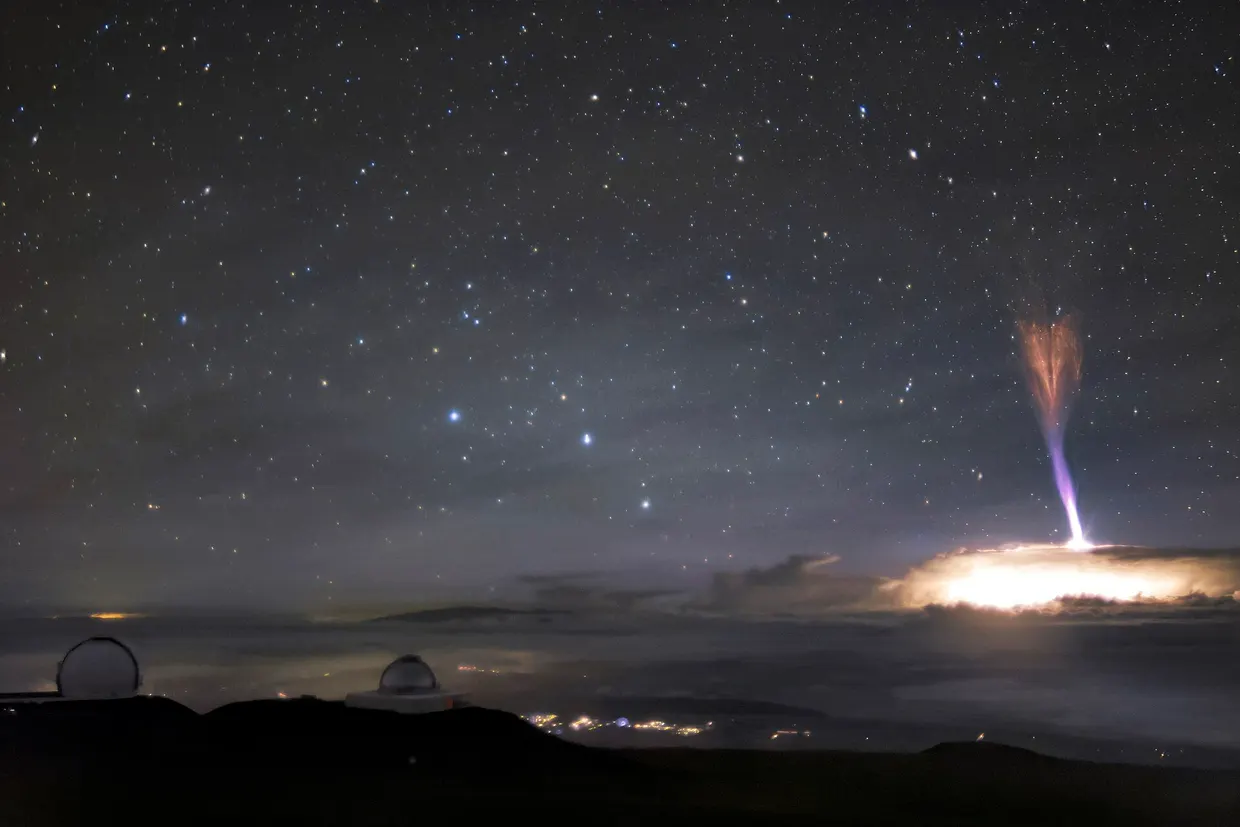
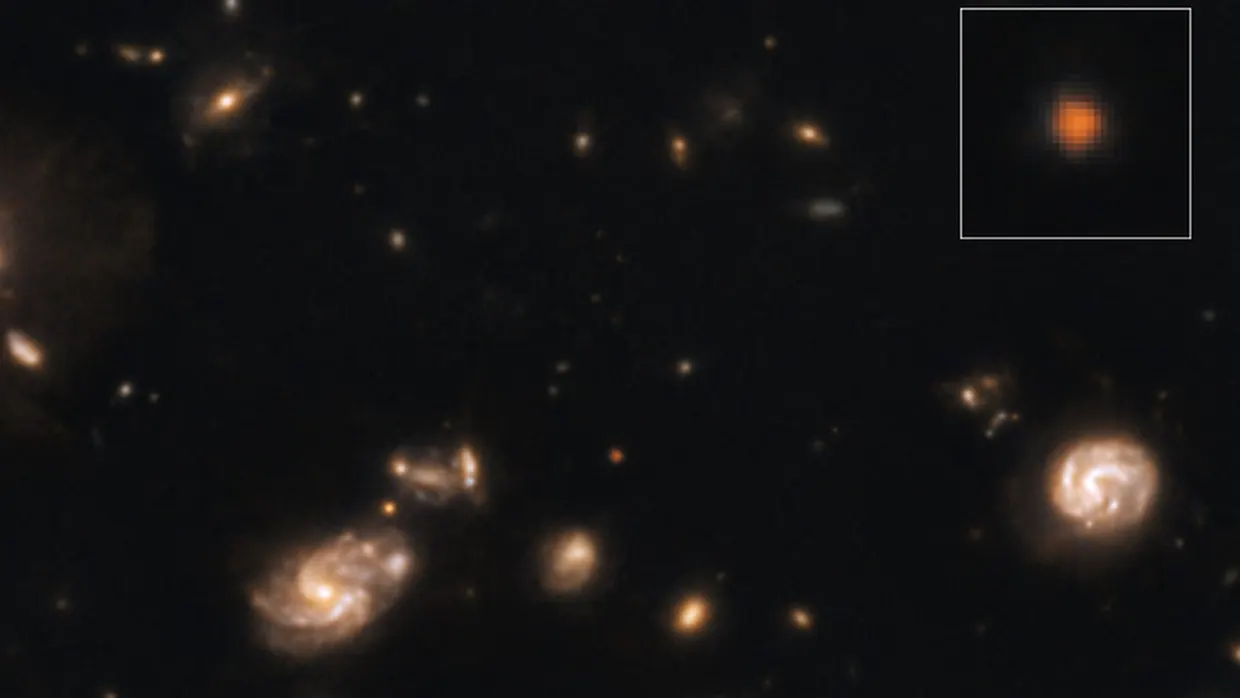
Astronomers have found J1602+4228AB, the most distant and therefore oldest known pair of compact quasars, according to noirlab.edu. We see it as it was 900 million years after the Big Bang, during the cosmic dawn. The pair is also the most compact quasar pair detected in that epoch and the third one known from it. noirlab.edu
noirlab.edunoirlab.eduOpen source ↗ The team was led by Silvia Onorato of NSF NOIRLab, and the results are published in The Astrophysical Journal Letters.
The pair was given the Hawaiian name Nāpōwawāʻenakaulua by the A Hua He Inoa program of the ʻImiloa Astronomy Center of Hawaiʻi and Ka Haka ʻUla O Keʻelikōlani, the College of Hawaiian Language at the University of Hawaiʻi.
Masses and separation
The two supermassive black holes, both in a feeding phase, are about 18,100 light-years apart, roughly one fifth of the Milky Way's diameter. Their masses are 1.5 billion and 400 million times the mass of the Sun. At that time the Universe was one thirteenth of its present age. Onorato states that there is no definitive theoretical explanation for how even one such giant quasar could exist so early, let alone two, and that the masses are comparable to those seen today.
Pairs of quasars are expected to be common, because galaxy interactions and mergers are common. Finding them is hard: the quasar phase is relatively brief, the objects are distant and faint for ground-based telescopes, and at small separations they are difficult to resolve as individual sources. noirlab.edu
noirlab.edunoirlab.eduOpen source ↗
How the pair was found
The pair turned up in data from the Aether survey, a JWST program led by Emanuele Paolo Farina of NSF NOIRLab/Gemini that builds a census of objects in the early Universe. Using the Near-Infrared Spectrograph Integral Field Unit, the survey collected 200 quasars, 43% of all known quasars of that period. Visual inspection of the data showed that quasar J1602+4228A had a companion.
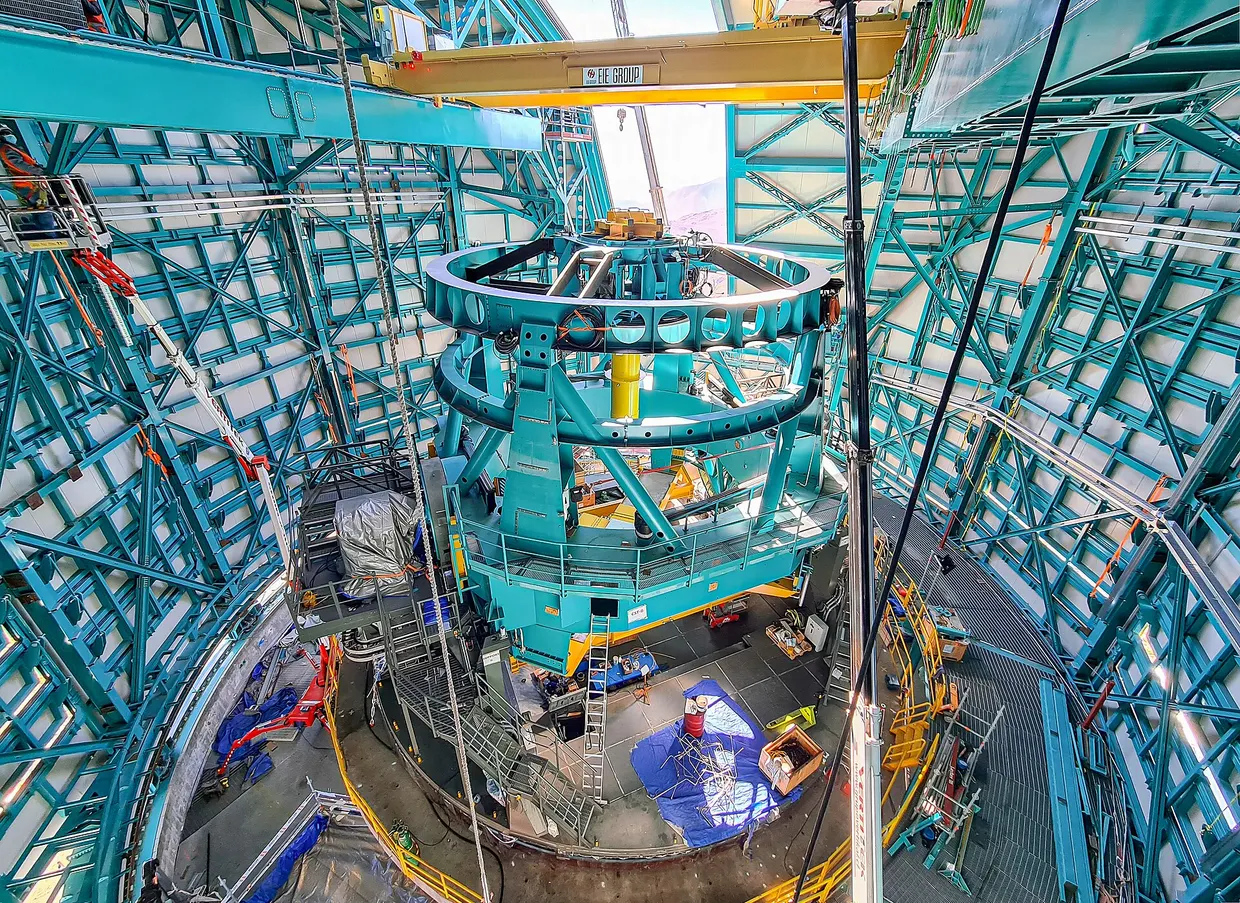
Follow-up observations with the Gemini Near-Infrared Spectrograph (GNIRS) on Gemini North, on Maunakea in Hawaiʻi, confirmed two distinct quasars. J1602+4228B is so faint and so close to J1602+4228A that observing it from the ground should have been nearly impossible. Exceptionally clear sky let the team collect the data in two nights.
The team also considered a gravitational lens, in which a massive galaxy bends the light of one quasar into a second image. Lensed copies would share the same spectral shape, but spectra from the Gemini Multi-Object Spectrograph (GMOS) differ noticeably, so the team regards two separate black holes as more likely. The lens option can be finally ruled out only after a lens model is built.