UC San Diego fluorine-free battery binder dissolves in water; lab cells kept 75.7% after 1,000 cycles
A polyacrylic acid–cellulose binder crosslinked by citric acid replaces PVDF in lab cells, processes in water and leaves no fluorinated residue on recycled electrodes.
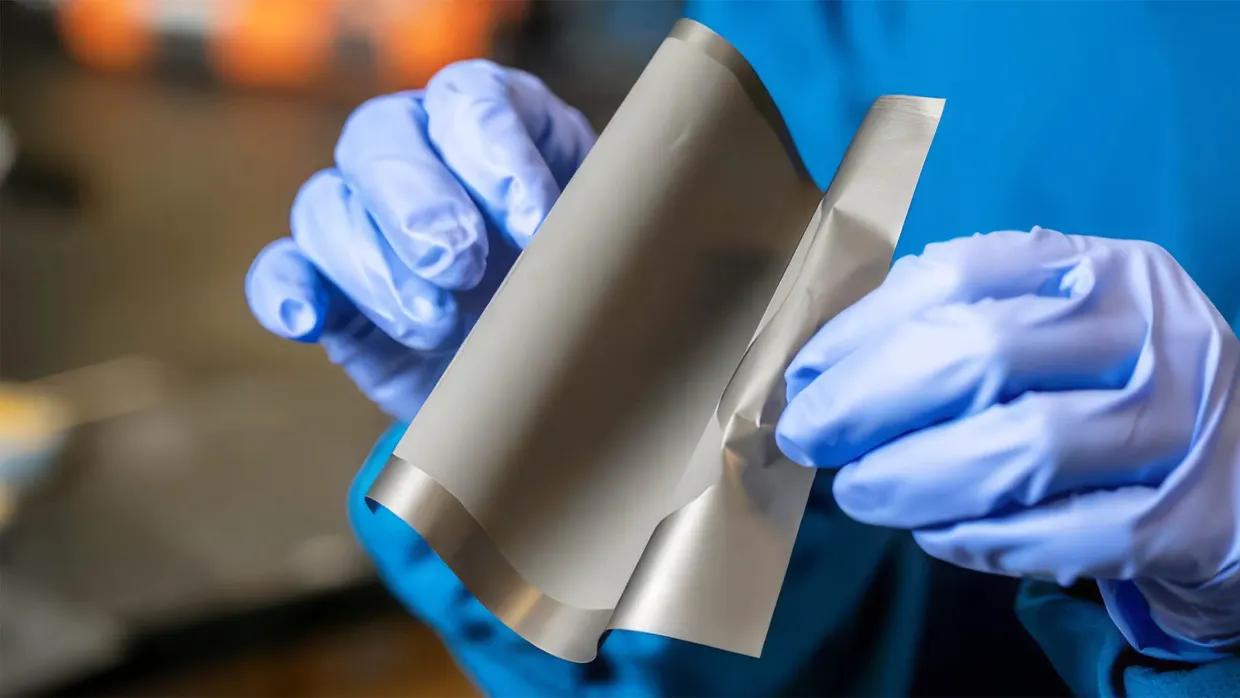
Engineers at the University of California San Diego, working with Toyota Research Institute of North America and Arizona State University, developed a fluorine-free, water-processable binder for lithium-ion electrodes. The work was published in Nature Communications. The binder combines polyacrylic acid and carboxymethyl cellulose crosslinked by citric acid, and it makes up 2 percent of electrode weight. nature.com
Nature Communicationsnature.comOpen source ↗ All tests ran in small laboratory cells, from watch-battery size to pouch cells about 3.3 cm across.
Binder and electrode manufacturing
Conventional electrodes use polyvinylidene fluoride (PVDF), which has to be dissolved in the toxic solvent N-methyl-2-pyrrolidone. The solvent is then driven off in ovens and captured for reuse. In these tests, PVDF electrodes were dried under vacuum at 120°C for 12 hours, while electrodes with the new binder dried in an ordinary oven at 60°C for four hours.
Electrodes made with either polymer alone, or with the two mixed without citric acid, cracked or pulled away from the foil as they dried. According to the authors, the crosslinked network joins binder chains, active particles and current collectors through hydrogen, covalent and ionic bonds. This gives strong adhesion along with oxidative and thermal stability. In a tape test almost nothing came off the new coating, while PVDF electrodes lost material after a few peels. Lithium hydroxide kept the mixture mildly acidic so it would not corrode the aluminum foil.
Cycling and recycling results
LiFePO4 positive electrodes with the new binder showed initial capacity comparable to PVDF controls. After 1,000 charge–discharge cycles they retained 75.7 percent of starting capacity, while PVDF cells lost capacity faster, especially after about 400 cycles. A pouch cell with a graphite counter electrode kept 76.4 percent after 1,600 cycles. A multilayer stack retained 74.5 percent after 700 cycles against 83.5 percent for a single layer, which the authors attribute to uneven conditions inside the stack. The binder also worked with nickel-rich and silicon electrodes. nature.com
Nature Communicationsnature.comOpen source ↗
For recycling, cells were taken apart after 100 cycles. The new-binder electrodes soaked in purified water until the binder dissolved and the coating came off the foil. Recovered material showed no detectable fluorine, whereas material from PVDF cells still carried fluorine on its surface. Regenerated LiFePO4 held more capacity and handled fast charging better than material recycled from PVDF cells, and recovered graphite worked through 420 cycles.
A life-cycle analysis, which the authors describe as a comparison of scenarios and not plant measurements, gave 6.9 percent lower greenhouse gas emissions and 9.3 percent lower energy use in cell production. Recycling used 10 percent less energy and released 7.2 percent less greenhouse gas. Fluorine remains in the electrolyte salt, so total fluorine per cell falls by about 30 percent. Production at scale and full-size cells have not yet been tested.