University of Tokyo team demonstrates 11-frame logarithmic ultrafast photography with delays up to 10 ns
The method places 11 frames unevenly between femtosecond and nanosecond timescales, so one shot records both the start of an event and its later stages.
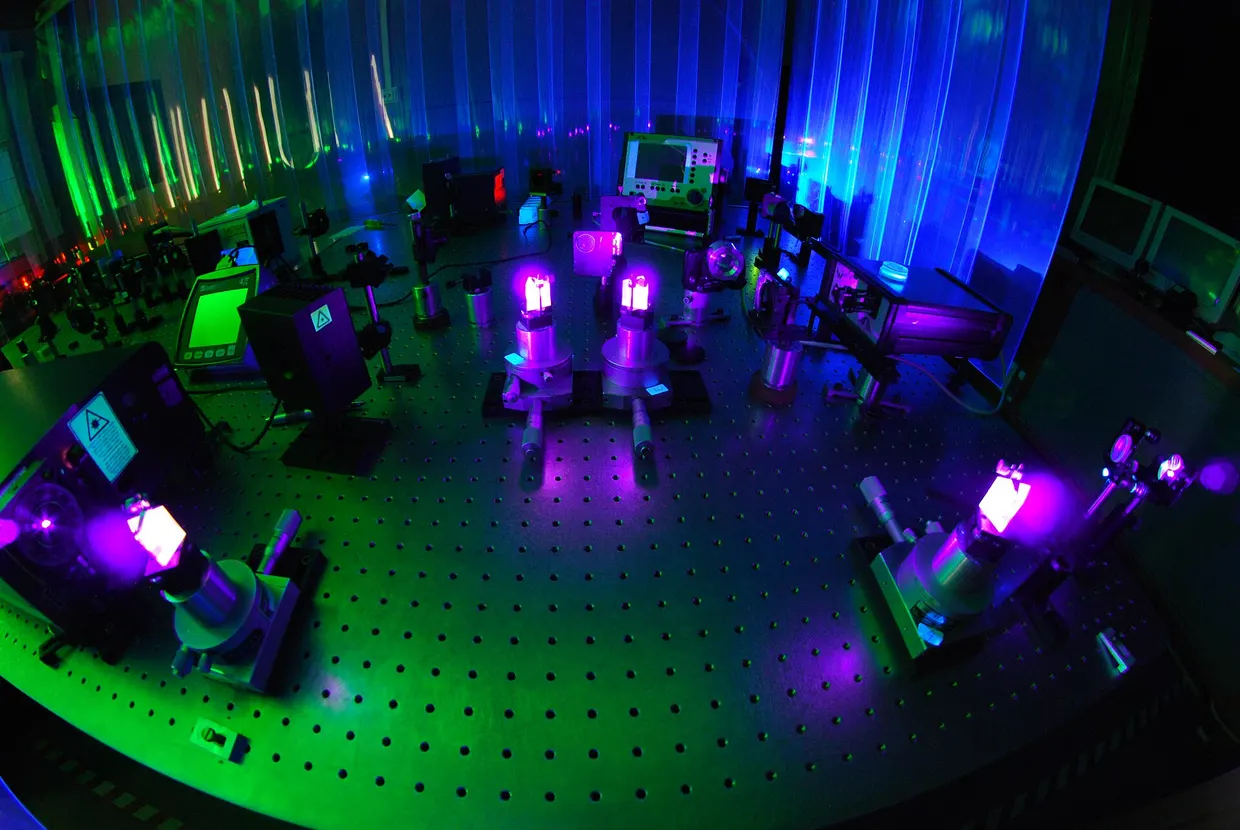
A team led by Keiichi Nakagawa at the University of Tokyo has demonstrated logarithmic ultrafast photography, a single-shot imaging method with nonuniform frame spacing. According to the paper in Optica, the system recorded 11 frames with an exposure of about 260 fs, a minimum interval of 600 fs and configurable delays of up to 10 ns optica.org
Opticaoptica.orgOpen source ↗.
Existing single-shot ultrafast imaging usually uses a uniform interval within a chosen time window. With a limited number of frames, this favors a detailed view of one stage over a record of the whole process. The authors note that interactions of light with matter span femtosecond-to-nanosecond timescales, which standard frame allocation does not cover well.
How BRIDGE sets the delays
The frame timing is controlled by band-resolved individual delay generation (BRIDGE). It sequentially extracts discrete wavelength bands through angle-dependent filter transmission and gives each band its own adjustable free-space delay. The delays are produced without dispersive pulse stretching.
The team implemented BRIDGE in temporal-wavelength-division imaging, a sequentially timed all-optical mapping approach. Each wavelength band stays tied to a specific instant of the recorded process, and the gaps between frames can be tailored to the event optica.org
Opticaoptica.orgOpen source ↗.
Ablation and shock waves in water
The authors used the method to survey ablation dynamics across timescales. They report that differences depending on the material and on the excitation became prominent in the nanosecond regime.
In water, the logarithmic imaging showed that picosecond excitation strengthened and expanded a localized breakdown response triggered by a femtosecond pulse. After that, a compact asymmetric shock wave formed.
"We wanted to find a way to connect these very different timescales in a single measurement," said Keitaro Shimada, lead author of the study. Nakagawa said the group is interested in phenomena that are difficult to reproduce exactly, where early and later stages of the same event can be recorded together.
The researchers propose applying the technique to laser processing, material dynamics, plasma and shock-wave research, and biomedical studies. The work so far is a laboratory demonstration of the imaging method.