Klipdrift Shelter ochre surface, 60 000 years old, contains eland collagen, palaeoproteomics shows
Palaeoproteomics found type I collagen of common eland in two samples from an ochre-rich surface in South Africa, which the authors read as deliberate mixing of proteins with ochre powder.
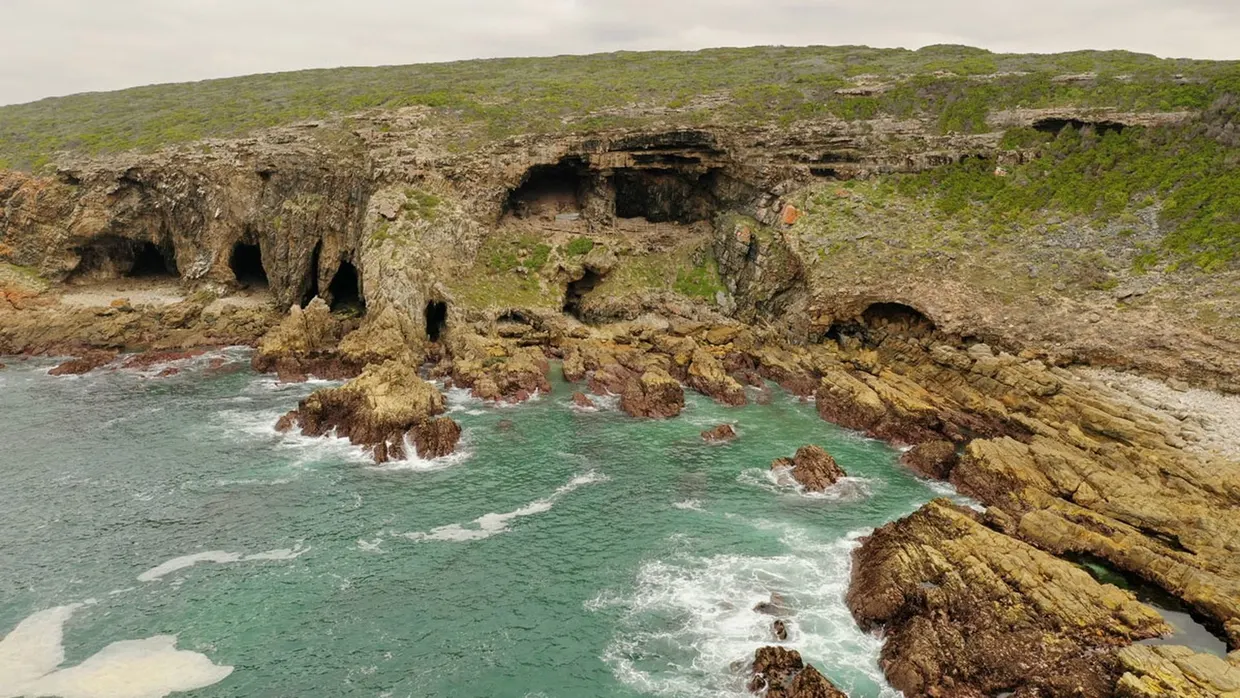
A team led by Zahra Haghighi of the University of Bergen identified type I collagen of common eland (Taurotragus oryx) in two samples from an ochre-rich sediment surface at Klipdrift Shelter, South Africa. The layers belong to the Howiesons Poort and are 60 000 years old, according to the paper in Proceedings of the Royal Society B Biological Sciences doi.org
Proceedings of the Royal Society B Biological Sciencesdoi.orgOpen source ↗. The surface is possibly over 1 m long, 40 cm wide and up to 1 cm thick.
Ochre surface and palaeoproteomics
The African Middle Stone Age is the cultural context associated with the emergence of Homo sapiens, and ochre use is treated as an indicator of both technical and symbolic behaviour. Powdered ochre is known from southern African ethnographic and archaeological contexts together with organic materials, some of them protein-based. Proteinaceous residues, however, are rarely recovered from this period.
The shelter lies in the coastal cliffs of De Hoop Nature Reserve. The ochre-rich surface was removed during excavation, and small sediment samples from it were archived in Cape Town. The authors analysed these archived samples, none of which had been collected with protein work in mind. Because sediment does not release proteins as readily as bone, the group developed an acid and base digestion method and read the resulting peptides on a mass spectrometer.
What the collagen shows
Collagen was confidently identified in two samples, and it matched common eland doi.org
Proceedings of the Royal Society B Biological Sciencesdoi.orgOpen source ↗. Nearly all the asparagine and glutamine residues in the peptides had undergone deamidation, a chemical change that accumulates over long periods. The authors suggest that iron in the ochre may have helped the collagen survive.
Stray eland bone could also leave collagen in sediment, so the authors examined further samples under optical and scanning electron microscopes. Only a few contained anything resembling bone, in small fragments, and the ochre surface layer had none. Together with the complex nature of the feature, the authors conclude that the findings suggest deliberate mixing of eland-derived proteins with ochre powder. They also describe a second scenario: an ochre-coated eland hide left in the shelter, which later decayed while the ochre stayed in place.
The result rests on two small samples from one feature at one site, and the tissue from which the collagen came is unknown. Eland are revered in San mythology, but the authors state that this single case is not sufficient to support a ritual significance of eland in the Middle Stone Age. They call for the work to be repeated at other sites of the period and conclude that palaeoproteomics can be a reliable tool for reconstructing the protein component of early human material culture.