Three atmospheric oxygen rises dated by sulfate isotopes; deep ocean lagged up to 600 million years
A review of sulfate triple-oxygen isotope records places the second and third atmospheric oxygen rises at 1.3–1.0 and 0.44–0.41 billion years ago, ahead of the ocean.
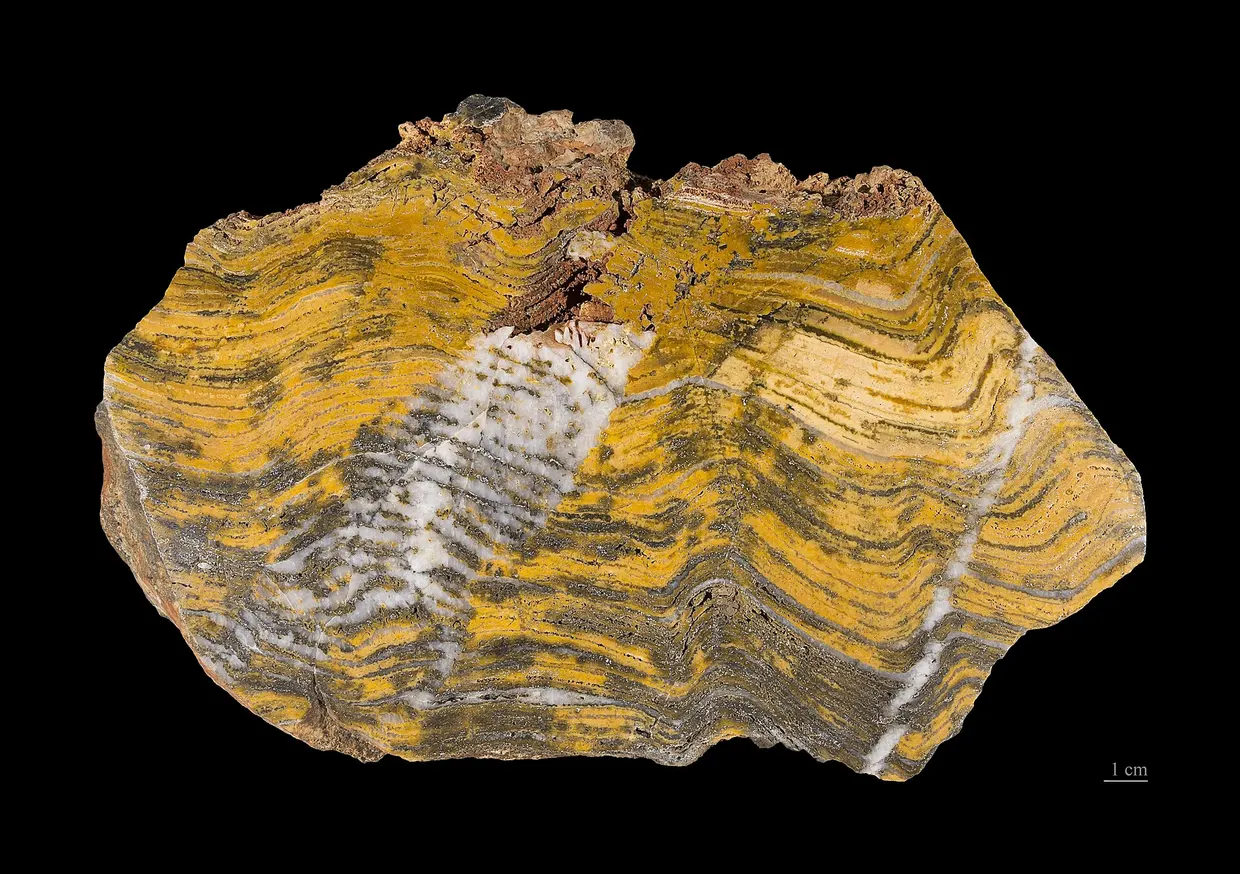
Two geochemists at Chengdu University of Technology have published a review in The Innovation that reconstructs how oxygen entered Earth's atmosphere and oceans. Using sulfate triple-oxygen isotope records, they describe three major steps in atmospheric O2, with the deep ocean lagging behind each one, in the last case by some 600 million years sciencedirect.com
The Innovationsciencedirect.comOpen source ↗.
Sulfate isotopes as an atmospheric record
Atmospheric oxygen carries a characteristic deficit in oxygen-17, produced by O2–O3–CO2 photochemistry. The signal passes into sulfate when sulfide minerals weather, so sedimentary sulfate archives the atmosphere rather than the sea. Earlier reconstructions read ocean chemistry from the rock record as a stand-in for the air, but ocean redox also depends on nutrients, productivity, circulation and basin shape.
On this record the first rise, the Great Oxidation Event, falls at 2.4–2.1 billion years ago. It lifted oxygen from below one part in a million of the modern level to between a thousandth and a tenth. The second and third rises are placed at 1.3–1.0 and 0.44–0.41 billion years ago. The classic Neoproterozoic and Paleozoic oxygenation events, at 0.8–0.5 and 0.42–0.36 billion years, are then treated as the ocean's lagging responses, roughly 200 and 30 million years behind the air.
Between the rises oxygen stayed scarce. Modelling calibrated to the isotope data puts the mid-Proterozoic atmosphere at 0.1–1% of the modern level. Charcoal, which needs about three-quarters of the modern level to burn, appears only around 420 million years ago sciencedirect.com
The Innovationsciencedirect.comOpen source ↗.
Coupling of air and ocean
Over a billion years the two reservoirs rise together, while over a million years they can diverge. A pulse of oxygen into the ocean oxidises stored organic carbon and sulfide, consuming the gas and lowering atmospheric levels. Some spikes once read as rising oxygen may therefore mark its decline.
Ocean oxygenation was patchy. Oases of oxygen produced by photosynthetic microbes appear from 3 billion years ago or earlier, while oxygen delivered from the air dominates later. A fully oxygenated ocean interior does not arrive until about 0.41 billion years ago.
According to the authors, oxygen was a hard limit on life under anoxic air and became a permissive one through the Proterozoic. Only after the third rise did it actively amplify complexity: larger bodies, active predation, deeper habitats sciencedirect.com
The Innovationsciencedirect.comOpen source ↗. The authors note the limits of the work: isotope resolution is coarse, absolute levels after 1.0 billion years ago remain poorly constrained, and further steps in the transition may be invisible. The study is a literature review, not new measurements.
Sources · 2
Found a mistake?Read also