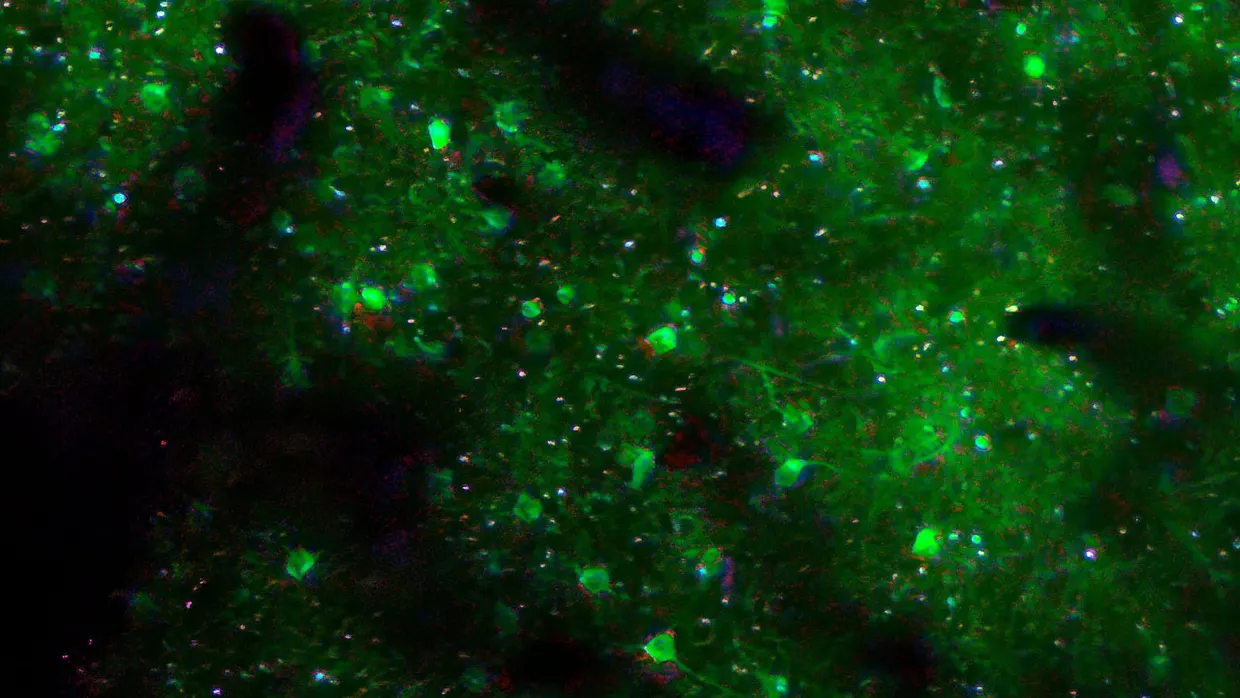
Rutgers: one day of high-fat diet raised excitability of hypothalamic neurons in male mice
In mice, one day of high-fat food made lateral hypothalamic glutamatergic neurons fire more easily in males but not in females, the authors reported.
Yi Lu and Mark Rossi of Rutgers University studied how glutamatergic neurons of the lateral hypothalamic area respond to a high-fat diet in mice. According to the study in the Journal of Neuroscience, one day of fatty food was enough to change these cells in males. In females, their excitability stayed the same doi.org
Journal of Neurosciencedoi.orgOpen source ↗.
The cells release glutamate, and activating them makes a mouse eat less, so the team calls them a brake on feeding. Earlier work measured them after at least two weeks on a high-fat diet, when their activity was blunted.
Recordings after one to seven days
The authors recorded from single neurons in thin brain slices using a glass pipette. On a normal diet, female cells fired more times for the same current than male cells and had narrower spikes. They also received inhibitory signals more often. The baseline data came from 40 cells in three male mice and 51 cells in three female mice.
The experimental diet supplied 60% of calories from fat, against 21% in the usual chow. In males, the cells fired more for the same current and needed less current to fire after one, two and seven days. In females, the firing rate did not change at any of these points doi.org
Journal of Neurosciencedoi.orgOpen source ↗.
Excitatory input to male cells became less frequent. In females, inhibitory input dropped, but only briefly: by day seven it was back to normal. The input recordings came from two mice per group, which the authors list as a limit.
Excitability and body weight
To test the effect, the team gave the cells the bacterial sodium channel NaChBac, which keeps them more excitable, and weighed the mice daily for a week. Treated males gained less weight than control males, both on chow and on the fatty diet. Females on chow were unaffected, while females on the fatty diet lost weight.
The treated mice did not eat less: over six hours with fatty food available, treated mice of both sexes ate more of it. Their activity in an open arena did not change. The authors wrote that the weight difference most likely comes from higher energy expenditure, though they did not measure it directly.
Limits of the study
All the work was done in mice, in a brain region where many cell types are mixed. The recordings could not separate subtypes of these cells, and no hormone was tested. How the early rise in excitability turns into the blunting seen by week two remains an open question, and the authors say it would require following the same cells over that whole period.