Tunable plasma photonic crystals in barrier discharge: lattice and bandgap switched by voltage
A team led by Jing Wang and Xiaoyong Hu built a laboratory dielectric barrier discharge setup whose plasma lattices are reconfigured by voltage, shifting microwave bandgaps.
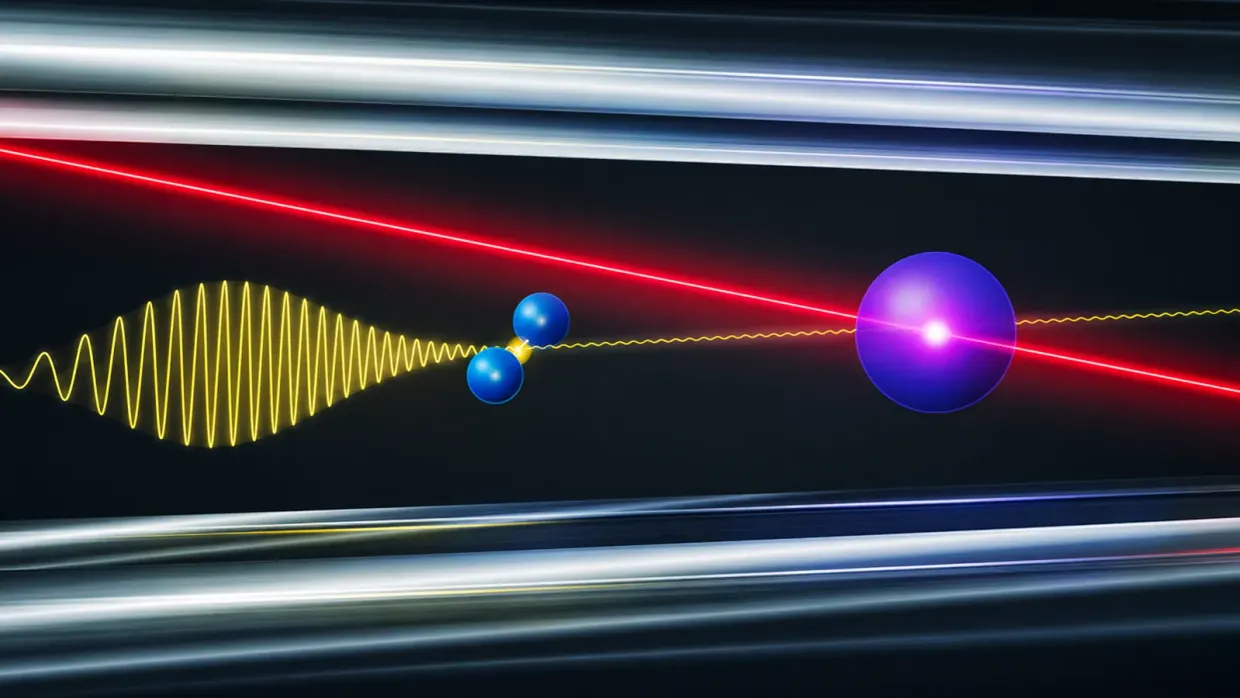
A research team led by Jing Wang, Shuang Liu, Weili Fan and Xiaoyong Hu has demonstrated a laboratory platform that produces tunable plasma photonic crystals in dielectric barrier discharge, according to a paper in Frontiers of Optoelectronics springer.com
Frontiers of Optoelectronicsspringer.comOpen source ↗. The setup controls five structural parameters: symmetry, dielectric constant, crystal orientation, lattice constant and the structure of individual scattering elements. The authors also report switching between non-topological and topological lattice states.
Discharge setup and lattice transitions
One side of the discharge cell is a water electrode: an 80-millimeter-inner-diameter container with tap water, sealed with glass plates 0.5 to 2 millimeters thick. The other side is an interchangeable metal mesh electrode, driven by a sinusoidal source of up to 10 kilovolts and 0 to 80 kilohertz, separated from the water by a 1 to 4 millimeter quartz frame. Micro-discharge filaments self-organize into two-dimensional arrays with electron densities of 10^13 to 10^15 per cubic centimeter.
With a honeycomb mesh (lattice constant 8.66 millimeters) in air at 114 Torr and 50 kilohertz, raising the voltage from 3.2 to 5.0 kilovolts turned a simple honeycomb lattice into a series of superlattices. The first omnidirectional bandgap, measured in the microwave range, moved from 23.5 to 26.7 gigahertz for the baseline lattice to 37.7 to 47.0 gigahertz for superlattice IV. Dirac cones at the K point were identified in superlattices II, III and IV.
Disorder, Moiré patterns and topology
With a Kagome mesh (8 millimeters), voltage steps produced alternating disordered and ordered states. A Kagome lattice at 3.7 kilovolts showed a bandgap of 27.3 to 33.6 gigahertz, and an ordered honeycomb superlattice at 4.1 kilovolts showed 44.8 to 55.1 gigahertz springer.com
Frontiers of Optoelectronicsspringer.comOpen source ↗.
Moiré lattices were produced by rotating two identical meshes against each other. Striped arrays with 10-millimeter spacing were tested in an argon-air mixture at 190 Torr, and square and honeycomb arrays at 152 Torr; rising voltage turned basic interference patterns into multi-scale superlattices.
For the topological case, selected mesh nodes were covered with polytetrafluoroethylene film. In an argon-to-air mixture of 3 to 2 at 135 Torr and 3.6 kilovolts, the open nodes gave triangular plasma elements with 3.0-millimeter sides, oriented at either negative or positive 30 degrees. The elements fired synchronously within one 350-nanosecond current pulse per half-period, with jitter below 30 nanoseconds. Joining domains of opposite orientation produced Line-type, Z-type and Omega-type interfaces.
Sources · 2
Found a mistake?Read also