Fudan team grows CsPbBr3 single crystals with 5.1 × 10¹⁰ Ω·cm resistivity for radiation detection
Ligand-regulated solution growth gave CsPbBr3 single crystals that, per the authors, withstand 200 V·mm−1 instead of 40 and detect ionizing radiation in two modes.
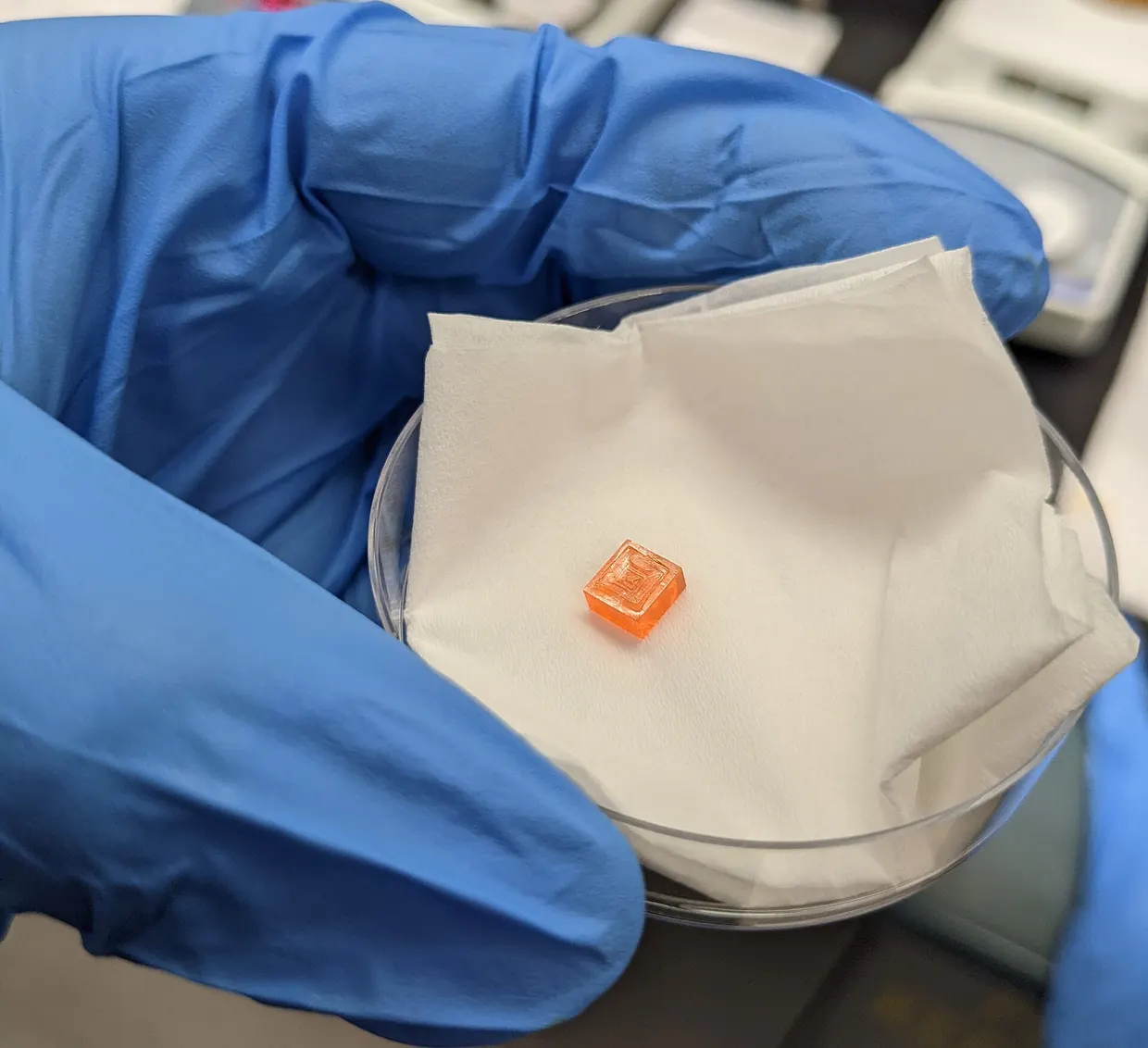
A team from Fudan University, Northwestern Polytechnical University and the Anhui Institute of Optics and Fine Mechanics of the Chinese Academy of Sciences has described a ligand-regulated crystallization strategy for lead-bromide perovskites grown from solution. The study was published in Nature Communications on 14 November 2026. According to the authors, the strategy achieves near-equilibrium growth of single crystals nature.com
Nature Communicationsnature.comOpen source ↗. They note that controlling crystallization pathways for such solution-grown crystals remains a major unresolved challenge.
Growth regulation and crystal quality
The authors report that the regulation mitigates kinetic imbalance during crystal growth. This suppresses the incorporation of non-equilibrium defects, improves lattice coherence and facilitates spatially uniform growth. The strategy is applicable to a representative set of lead-bromide perovskites, the authors state. The paper is titled "Kinetic balancing for near-equilibrium growth of defect-suppressed lead bromide perovskite single crystals".
For CsPbBr3, the resulting single crystals exhibit a resistivity of 5.1 × 10¹⁰ Ω·cm and a carrier mobility of up to 93.95 cm2·V−1·s−1. These values refer to the crystals grown with the new approach.
Conduction barrier and radiation detection
According to the authors, reduced electron-phonon coupling weakens optical-phonon scattering. It also raises the effective thermally activated conduction barrier from 0.43 to 0.71 eV nature.com
Nature Communicationsnature.comOpen source ↗. As a result, the range of stable bias operation extends from 40 to 200 V·mm−1.
On this basis, the crystals enable sensitive and stable ionizing-radiation detection in both photon-counting and charge-integrating modes, the authors report. They describe the work as establishing a general kinetic-design principle for defect-suppressed, near-equilibrium crystallization of lead-bromide perovskites, enabling reliable high-field operation for ionizing-radiation detectors.
The corresponding authors are Ziqing Li, Yadong Xu and Xiaosheng Fang. The author list also includes Xiao Zhao, Tao Zhou, Yingying Hao, Shimao Wang and Gang Meng.