Large Helical Device: parallel ion energy rose 30% within 0.1 ms of an MHD burst in plasma
Researchers at Japan's National Institute for Fusion Science observed plasma heating itself through waves from its own instability. The effect was seen in an experiment, not in a fusion reaction.
A research group led by Professor Katsumi Iida at the National Institute for Fusion Science in Japan reported a direct observation of how bulk ions gain energy in unstable plasma. In the Large Helical Device, ion energy parallel to the magnetic field rose by 30% at the location of an MHD burst, within 0.1 ms of its onset. The results were published in Communications Physics on 10 November 2026 nature.com
Communications Physicsnature.comOpen source ↗.
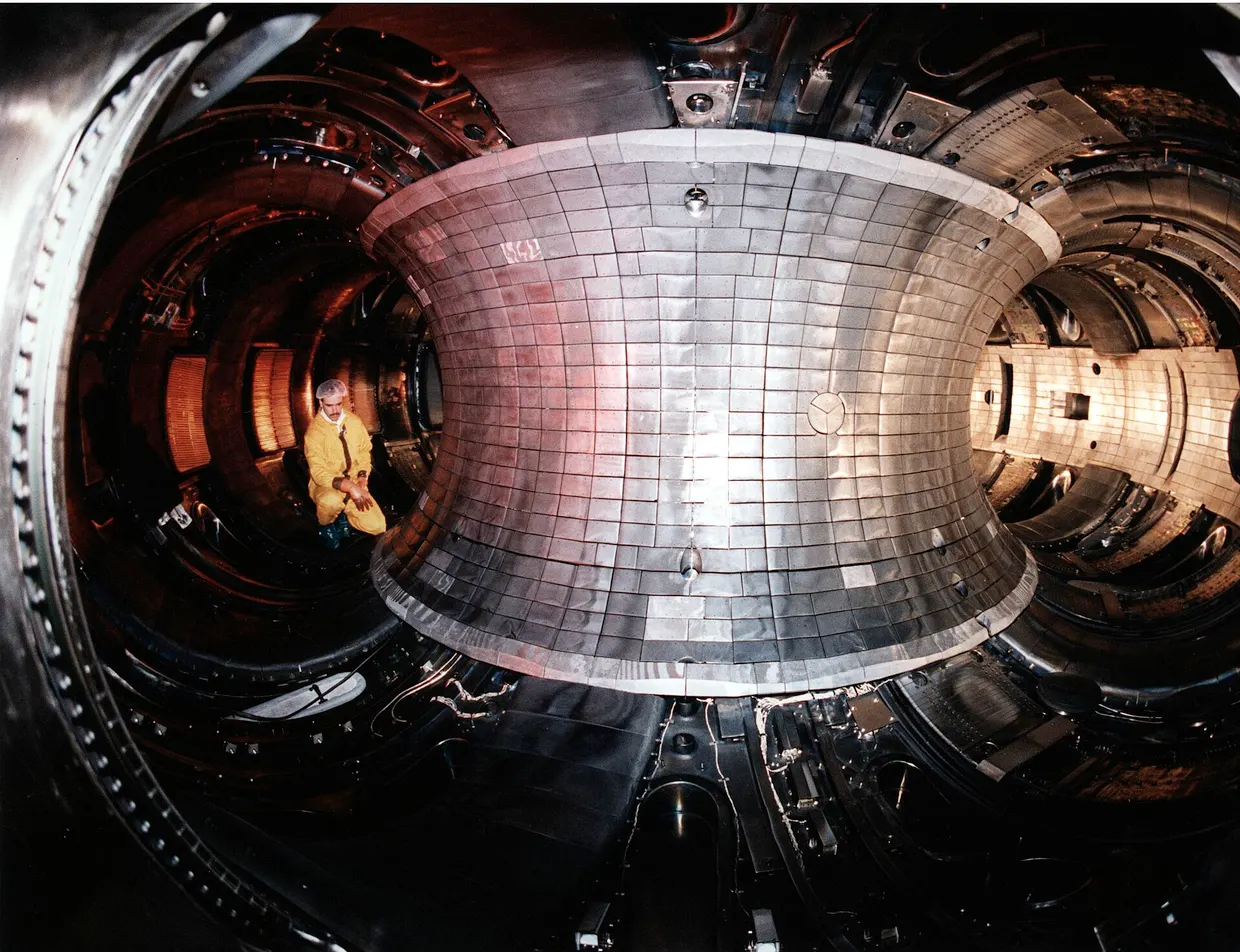
The Large Helical Device is the institute's main experimental facility. It is a superconducting helical device with a heliotron magnetic field, and experiments on it began in March 1998. Its field structure differs from that of tokamaks. The bursts studied in the paper were driven by energetic particles.
Velocity distribution and ion heating
Bulk ions accelerate parallel to the magnetic field. Wave-particle interactions such as Landau and transit-time damping can pull their velocity distribution away from a Maxwellian. The authors observed flattening in velocity space, meaning a decrease in the velocity gradient, together with the rapid rise in parallel ion energy.
The anisotropy of the ion velocity distribution, caused by the acceleration of ions along the field, disappeared within the ion-ion collision time scale of 2 to 3 ms nature.com
Communications Physicsnature.comOpen source ↗.
According to the release, it was already known that waves produce a temporary distortion of the distribution function. It had not been clear how the temperature changed afterwards. In this work, once the distortion had returned to normal, the spread of particle motion was larger, which indicates a higher plasma temperature.
Core and periphery
The transient increase in ion energy decays within 6 ms at the plasma periphery. In the plasma core it persists much longer and contributes to the rise in core-ion energy.
The group deliberately produced unstable plasma and examined it in detail. Until now, instability was mostly studied as something to suppress, since waves were thought to take energy from the plasma. The recorded sequence is: instability, waves, distortion of the distribution function, then growth of its spread, which is plasma heating nature.com
Communications Physicsnature.comOpen source ↗.
The release notes that no device can yet demonstrate the full self-heating process of fusion, which requires large facilities such as ITER, with a demonstration expected around 2040. The process observed here, in which waves from an instability heat the plasma, is one of the underlying steps and can be tested on present-day facilities. The authors add that the same process occurs in the plasma of Earth's magnetosphere.