HKUST builds hemispherical artificial retina with 1,905 ppi and 367,500 pixels
HKUST researchers built a curved image sensor with a 160°+ aberration-corrected field of view and in-sensor motion detection, a laboratory step past the resolution limit of such sensors.
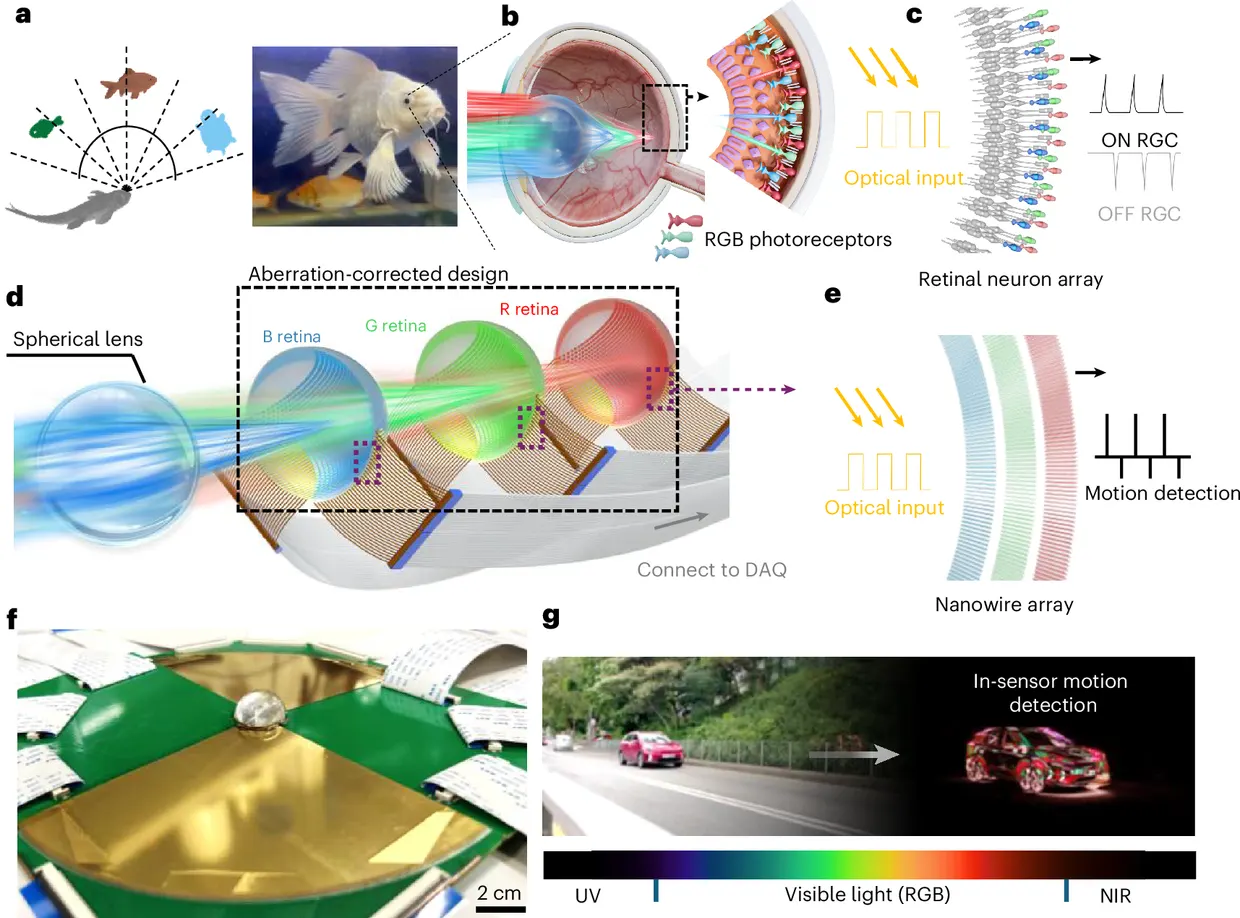
Researchers at the Hong Kong University of Science and Technology (HKUST), led by Prof. Fan Zhiyong, have developed a bionic eye based on a hemispherical tandem artificial retina, according to a paper on nature.com nature.com
nature.comnature.comOpen source ↗. The sensor has a pixel density of 1,905 ppi and 367,500 pixels in total. The work appeared in Nature Materials, and the university published its release on 12 November 2026. This is a laboratory device, not a commercial product.
Why curved sensors matter
Conventional planar vision sensors rely on multielement optics and external processors to correct optical aberrations. According to the authors, this limits miniaturization, reduces power efficiency and generally narrows the field of view. Curved sensors can provide compact, aberration-corrected imaging, but their resolution has so far been below practicable levels.
The difficulty is in manufacturing. Conventional lithographic processes are designed mainly for flat substrates, so dense pixel arrays on strongly curved surfaces are hard to make. The HKUST team developed a 3D laser fabrication approach that allows dense arrays of light-sensitive pixels to be formed on a hemispherical surface.
Colour, field of view and event-driven detection
The sensor provides full-colour imaging across 300–800 nm. Its aberration-corrected field of view exceeds 160° nature.com
nature.comnature.comOpen source ↗. The tandem design also enables in-sensor, event-driven motion detection.
Compared with frame-based imaging, this approach reduces the demand for bandwidth by over 99.95%, the authors report. Motion recognition accuracy reaches 98.6%. The authors state that the work addresses the resolution bottleneck of hemispherical sensors and point to compact, multifunctional vision applications.
The HKUST release describes the system as a possible route toward compact vision sensors for future robots and autonomous systems. Among the co-authors are Dr. Swapnadeep Poddar, Research Assistant Professor, and PhD students Wang Kaichen, Sun Xiaofei, Ye Zilong, Li Jianye and Shivam Kumar. Fan Zhiyong also directs the State Key Laboratory of Displays and Opto-Electronics at HKUST.