Cornell grows silicon-doped α-(AlGa)2O3 films with a bandgap above 7 eV and builds a transistor
Cornell researchers made conductive silicon-doped aluminium gallium oxide films with a bandgap above 7 eV and a preliminary transistor, the AlphaFET, on a sapphire substrate.
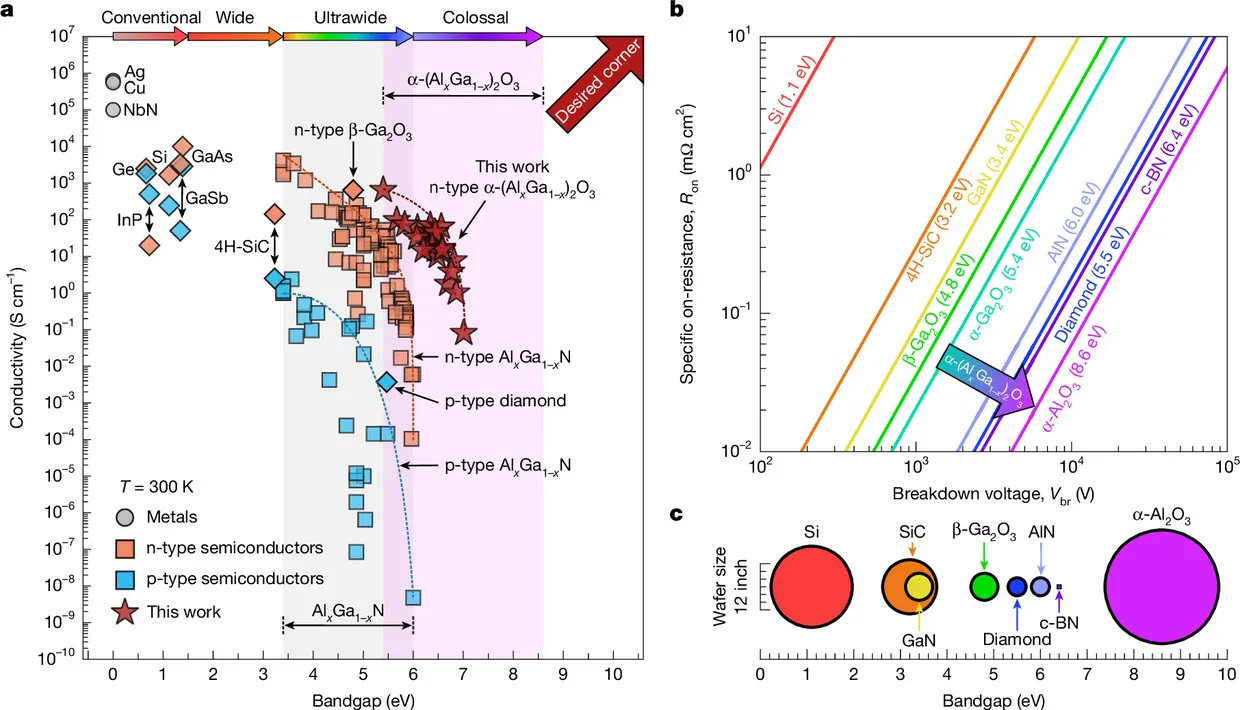
Researchers at Cornell University have grown silicon-doped α-(AlxGa1−x)2O3 films with a bandgap exceeding 7.0 eV, according to a paper in Nature (volume 658, 7 October issue, pp. 623–628, 2026) available on nature.com nature.com
nature.comnature.comOpen source ↗. The films were grown by suboxide molecular-beam epitaxy. The value surpasses cubic boron nitride, the next-widest-bandgap semiconductor known. The previous record was about 6 eV.
Bandgap and doping
In rectifying power electronics, wider-bandgap semiconductors allow higher efficiency and power density, with the Baliga figure of merit proportional to Eg^5.5. Such materials withstand stronger electric fields before breaking down, which suits electric vehicles and power-grid infrastructure. The difficulty is that controlled modulation of conductivity by doping becomes harder as the bandgap grows, and wide-gap materials tend to behave like insulators.
The lead author, doctoral student Jacob Steele, incorporated silicon atoms into the material at sufficiently low temperature, which introduced mobile electrons. In the colossal-bandgap regime, above 6 eV, the films have room-temperature conductivity more than 100 million times higher than all previous reports, the authors report.
Devices on sapphire
The team fabricated a Schottky diode and a field-effect transistor, named AlphaFET, with colossal-bandgap channels nature.com
nature.comnature.comOpen source ↗. Debaditya Bhattacharya designed, fabricated and measured the device, and Huili Grace Xing and Debdeep Jena oversaw the work. According to Xing, the preliminary transistors show a change in current of more than four orders of magnitude, modulated by the capacitively coupled metal gate and the colossal-bandgap channel.
The films were grown on sapphire, an abundant, inexpensive substrate produced at large scale. The authors contrast this with diamond and cubic boron nitride, where synthesis is difficult and costly and the samples are small. Jena said that further work is needed to make the devices practical.