Northwestern's EITWatch smartwatch prototype recognizes six hand gestures with over 92% accuracy
Northwestern researchers presented two experimental wrist systems at UIST 2026: one reads gestures from tissue impedance, the other learns new activities from short demonstrations.
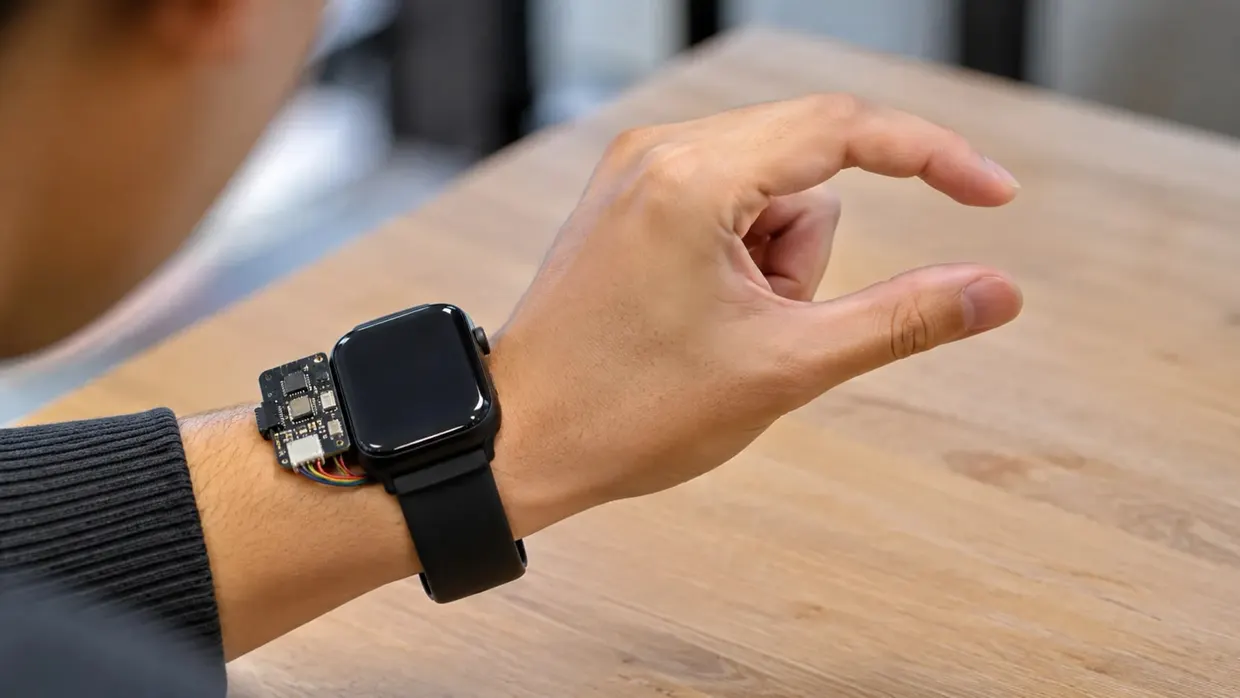
Researchers at Northwestern University in the United States presented two experimental wrist-worn systems that recognize hand gestures and everyday activities without cameras, according to redimin.cl. redimin.cl
redimin.clredimin.clOpen source ↗ The work was shown on November 3 at the UIST 2026 symposium in Detroit. The systems are called EITWatch and TransfHAR.
In controlled tests, EITWatch recognized six common hand gestures with accuracy above 92%, the authors reported. The evaluation involved 12 participants performing predefined movements.
EITWatch: impedance tomography at the wrist
EITWatch uses electrical impedance tomography, a technique that detects changes in the electrical properties of tissue under the skin. The prototype has eight small electrodes arranged in a ring 31 mm in diameter on the back of the watch, in contact with the wrist. The electrodes apply low-intensity electrical signals and record how they change as muscles and tendons shift. The system takes 35 impedance measurements per cycle at 48 cycles per second.
The researchers analyzed two categories: broad hand gestures and small finger movements. redimin.cl
redimin.clredimin.clOpen source ↗ The results come from supervised tests under controlled conditions, and the highest figures were obtained for people whose own data were used to train their recognition models. When participants put the device on again 48 hours later, accuracy fell to 73.2% for broad gestures and 70.4% for small movements. It also dropped for people who were not part of the training. Recognizing gestures of different users without individual calibration remains an open problem.
TransfHAR: learning new activities from short demonstrations
TransfHAR works differently: it uses accelerometers and gyroscopes, sensors already present in many smartwatches. It is designed to recognize activities that were not originally programmed, learning from brief demonstrations rather than large sets of labeled examples.
In a test with ten participants, each performed seven new activities. The system reached a balanced accuracy of 86.7% with five training examples per activity. With a one-minute recording per activity, the result rose to 90.4%. The work involved researchers from Northwestern, Carnegie Mellon and Google Health Research.
The article lists possible uses in assistive technology, rehabilitation tracking and industrial work. redimin.cl
redimin.clredimin.clOpen source ↗ These applications still require clinical validation and further testing. There are no results showing that either system can replace industrial safety systems or control critical equipment; that would require testing under vibration, dust, moisture and while wearing gloves.