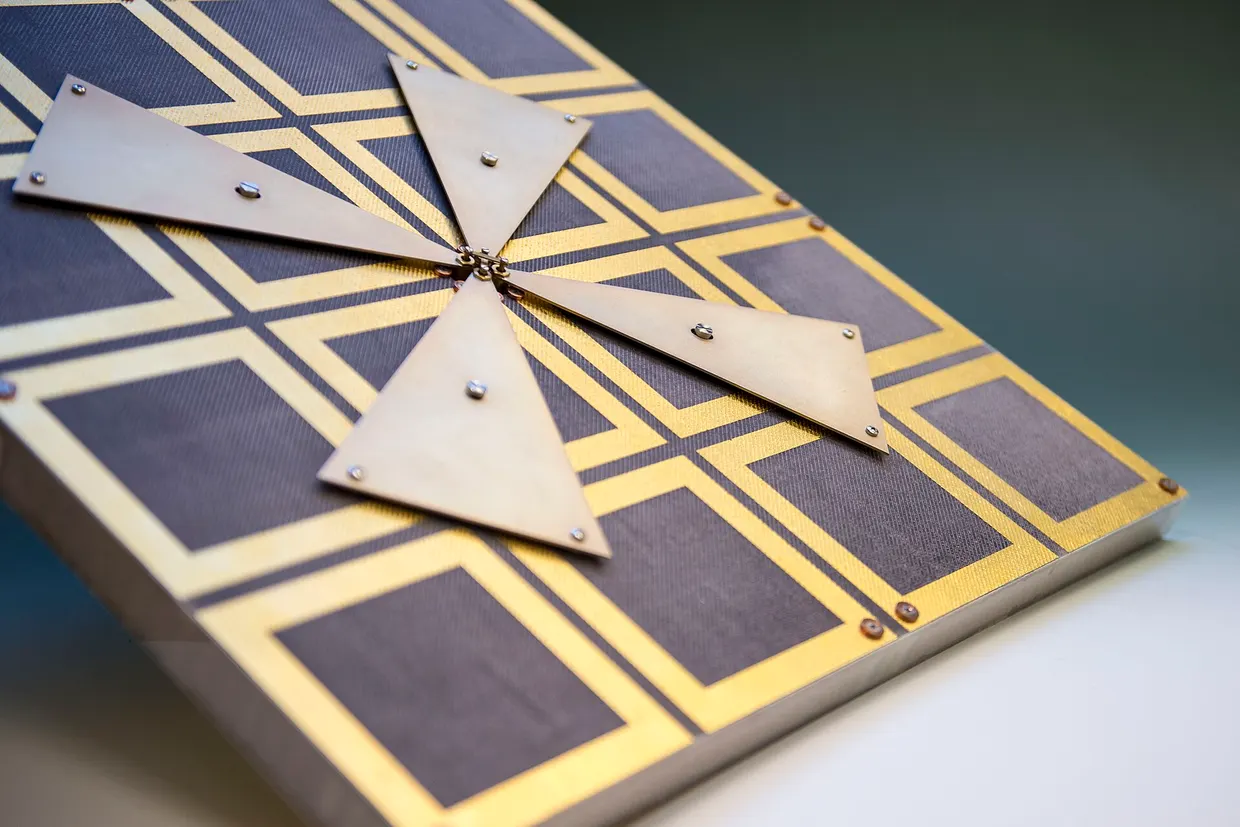
Printed terahertz metalenses raise resonant tunneling diode directivity 2.29 times at 0.312 THz
Metalenses printed by super inkjet on polymer films narrowed the beam of a 0.312 THz diode source in experiments; one lens took two days to make instead of over a month.
Researchers led by Kaito Ebisawa, Kento Sato, Kazuisao Tsuruda and Takehito Suzuki printed two types of terahertz collimating metalenses on cyclo-olefin polymer and polyimide films and mounted them on a resonant tunneling diode oscillating at 0.312 THz. According to the paper in Applied Physics A, the lenses raised the directivity of the diode 2.29 and 1.46 times, respectively springer.com
Applied Physics Aspringer.comOpen source ↗. The work is an experimental demonstration of inkjet-printed planar optics for continuous-wave terahertz sources.
Why the beam needs shaping
Compact solid-state terahertz sources, such as resonant tunneling diodes, emit between microwatts and milliwatts and radiate over wide angles. Combined with atmospheric absorption, this divergence strongly attenuates the signal in the far field. Bulk dielectric lenses can narrow the beam, but they are heavy and thick, which conflicts with the miniaturization of integrated wireless devices.
Optically thin metasurfaces can convert wide-angle radiation into a directed plane wave, but they are hard to make: a metasurface several centimeters across holds thousands of micrometer-scale elements. Earlier metalenses for such diodes were made by photolithographic etching of metal-coated substrates, a process that often took more than a month.
Double-sided design and inkjet printing
The metalens consists of concentric pairs of circular metal patches on the front and back of a 50-micrometer dielectric film. Outer diameters and edge-to-edge gaps change from the center outward, so that the transmission phase delay decreases from the axis to the edge. The patches excite electric and magnetic resonances at the same time, which allows impedance matching close to unity and suppresses reflections springer.com
Applied Physics Aspringer.comOpen source ↗. The lens is mounted 3.0 mm, or 3.12 free-space wavelengths, above the diode.
The patterns were printed with a super inkjet printer that ejects droplets of single-femtoliter volume. For the cyclo-olefin polymer lens (metalens A), the film was treated with plasma for one minute, silver paste ink was deposited in four passes, and the film was baked at 150 °C for two hours, below the polymer glass transition temperature of 170 °C. The same steps were repeated on the reverse side, and the whole lens took two days.
The same geometry was printed on polyimide (metalens B), whose glass transition temperature is about 320 °C, so the silver ink was sintered at 220 °C for one hour. At 0.312 THz polyimide has a dielectric loss tangent of 0.056, against 0.0016 for cyclo-olefin polymer. An etched lens (metalens C) was made as a benchmark. The authors state that the method is intended for flat terahertz optics in 6G and beyond wireless devices.