Curators: gilded bronze leg from Milsington belongs to an equestrian statue of Antoninus Pius in Scotland
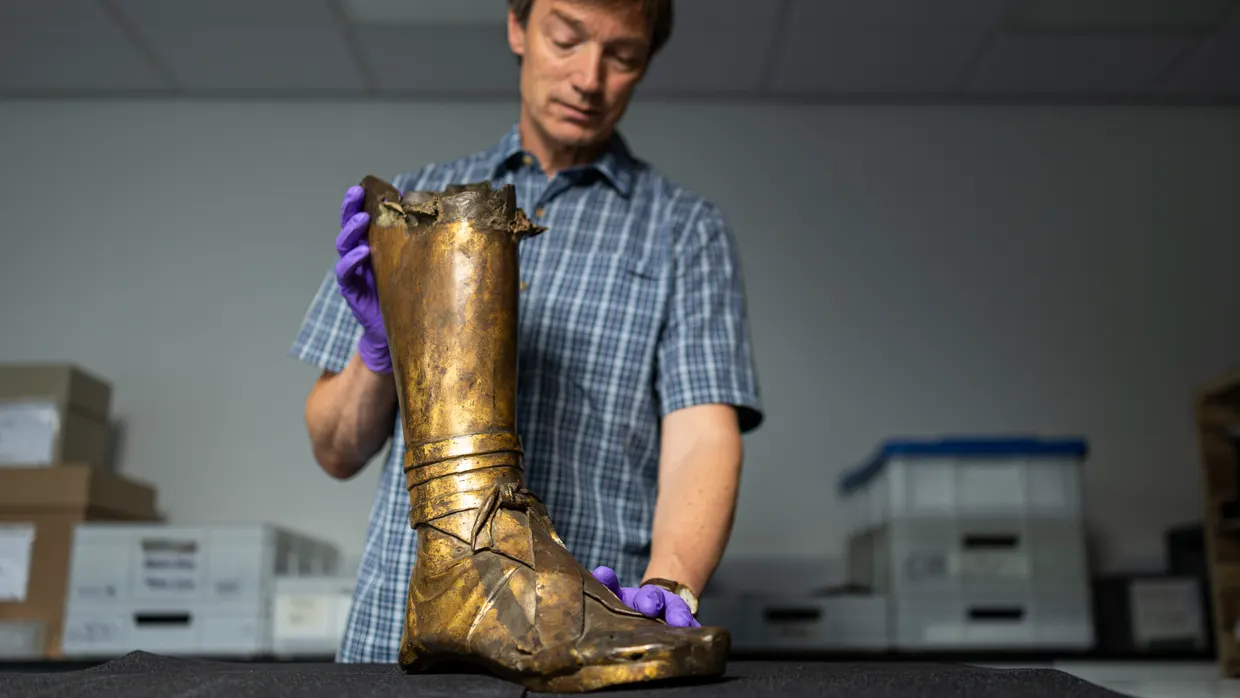
National Museums Scotland has reconstructed a monument to Antoninus Pius from a leg found in a bog in 1820; it is the only known such statue from Scotland.
National Museums Scotland (media.nms.ac.uk) reports that a large monument to the Roman Emperor Antoninus Pius once stood in the Scottish Borders. The statue has been reconstructed from its surviving gilded bronze leg ahead of the exhibition Roman Scotland: Life on the Edge of Empire, which opens at the National Museum of Scotland on 14 November 2026 nms.ac.uk
media.nms.ac.ukmedia.nms.ac.ukOpen source ↗. It is the only known example of such a sculpture from Scotland.
The larger than life-sized lower leg with a boot-clad foot was found in a bog at Milsington near Hawick in 1820. It dates to the AD 140s. For over two centuries it was assumed to be loot from further south, perhaps from York (Eboracum).
Where the statue stood
Experts now believe the leg came from a statue of Pius on horseback, similar to the surviving monument to his successor Marcus Aurelius in Rome. It was erected to mark the conquest of southern Scotland. A wider study of statue fragments from the Roman frontier showed that bronze imperial statues, including equestrian ones, were set up in frontier forts, which makes a Scottish location more feasible.
The curators attribute the statue to Pius because he was the only emperor who paid particular heed to his Scottish victories. His conquest of southern Scotland was the only foreign campaign he commemorated with the title Imperator nms.ac.uk
media.nms.ac.ukmedia.nms.ac.ukOpen source ↗.
Careful removal
The examination of the top of the leg found no cut marks: it remains as it was cast. There is no gilding around the knee, which indicates that this area was covered by a tunic or cloak. Lumps around the top filled the folds of the tunic and attached the leg to it.
According to the museum, this suggests a deliberate dismantling of a valued sculpture as the Romans withdrew from southern Scotland in the AD 160s or 180s, rather than a local act of revenge. The leg was carefully removed, not brutally hacked off. Statues destroyed after a battle, when an emperor's memory was condemned, or cut up for scrap, typically leave irregular fragments on a much smaller scale. Similar careful burial is found elsewhere in Roman Scotland after the Antonine conquests were abandoned, for example the Antonine Wall inscriptions and the Inveresk Mithras altars, which are also in the exhibition.
Dr Fraser Hunter, Principal Curator of Prehistoric and Roman Archaeology, said the finding turns on its head the understanding of Rome's second attempt at conquering Scotland. He also asked where the rest of the statue is nms.ac.uk
media.nms.ac.ukmedia.nms.ac.ukOpen source ↗. The exhibition runs until 18 April 2027.