UT Austin simulations tie Uranus and Neptune's tilted magnetic fields to conductivity rising with depth
Simulations show that electrical conductivity increasing with depth can reproduce the Voyager 2 fields of Uranus and Neptune, which may shift by tens of degrees within decades.
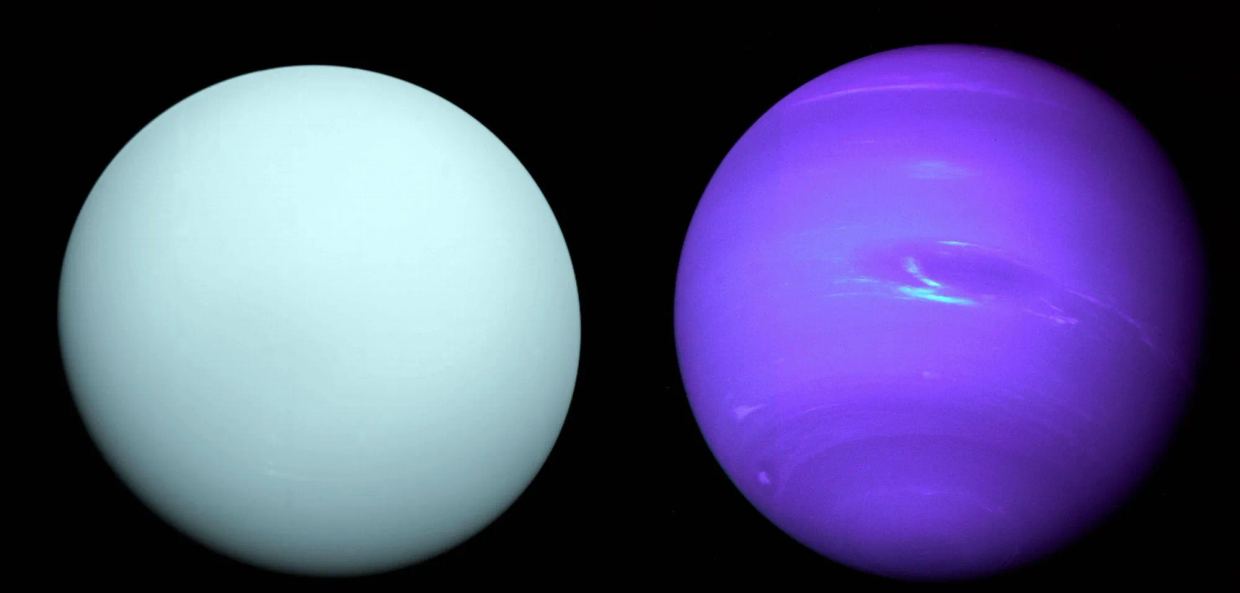
A team led by The University of Texas at Austin, with collaborators from UCLA, Imperial College London and Northumbria University, reports in Communications Physics that changes in electrical conductivity deep inside Uranus and Neptune may explain their unusual magnetic fields. The work was described by jsg.utexas.edu. jsg.utexas.edu
jsg.utexas.edujsg.utexas.eduOpen source ↗ NASA's Voyager 2 probe found in the 1980s that both fields are highly disordered, unlike Earth's, which has well-defined north and south poles.
jsg.utexas.edu
jsg.utexas.edujsg.utexas.eduOpen source ↗
Tilted dipoles of the ice giants
Magnetic fields arise when electrically conducting fluids move inside a planet, a process called a dynamo. On Earth, convection of molten iron in the outer core, influenced by rotation, produces a field resembling a bar magnet. jsg.utexas.edu
jsg.utexas.edujsg.utexas.eduOpen source ↗ Earth's dipole is tilted relative to its rotational axis by only 11 degrees. Uranus' dipole is tilted by 59 degrees and Neptune's by 47 degrees.
jsg.utexas.edu
jsg.utexas.edujsg.utexas.eduOpen source ↗
Both planets are about four times wider than Earth and are called ice giants. Their exact makeup is unknown, but they are thought to consist mainly of hydrogen, helium, water, ammonia, methane and rocky material. jsg.utexas.edu
jsg.utexas.edujsg.utexas.eduOpen source ↗
Conductivity and a changing field
According to lead author Chi Yan, a research associate at the UT Jackson School of Geosciences, pressures and temperatures deep inside the planets are extremely high. Under such conditions water molecules can break apart into ions, and the material may become increasingly conductive with depth. jsg.utexas.edu
jsg.utexas.edujsg.utexas.eduOpen source ↗
The researchers used computer simulations to reproduce the fields observed by Voyager 2. They assumed conductivity increases at greater depths, considered diverse interior configurations, and simulated how fluid motion, temperature and magnetic fields evolve together. jsg.utexas.edu
jsg.utexas.edujsg.utexas.eduOpen source ↗
The models suggest the fields could change substantially within decades and may differ from those seen during the Voyager 2 mission. Earth's magnetic tilt drifts by only a degree or so over 50 years, Yan said. In the models of the ice giants, the tilt in some stretches swings by tens of degrees within decades, and in others it shifts only slightly over the same span. jsg.utexas.edu
jsg.utexas.edujsg.utexas.eduOpen source ↗
What comes next
Researchers are also analyzing high-resolution infrared images from the James Webb Space Telescope showing auroral emissions of Uranus and Neptune, which may indicate whether the dipole has shifted. Tom Stallard of Northumbria University, who led the JWST observation campaign, said the shape and structure of the aurora and other patterns in the ionosphere could show how the fields have changed. jsg.utexas.edu
jsg.utexas.edujsg.utexas.eduOpen source ↗
The team plans to combine the JWST auroral images, Voyager 2 magnetic field data and dynamo simulations to estimate how the fields are configured today. The researchers say that understanding the planets' interiors will require additional missions to the ice giants. jsg.utexas.edu
jsg.utexas.edujsg.utexas.eduOpen source ↗
Sources · 2
Found a mistake?Read also