Seven-year camera-trap study in Cambodian mangroves finds declining occupancy of four threatened mammals
Camera traps at 156 sites in Koh Kapik and Peam Krasop show that mangrove and Melaleuca habitats shelter threatened mammals, but several species trend downward.
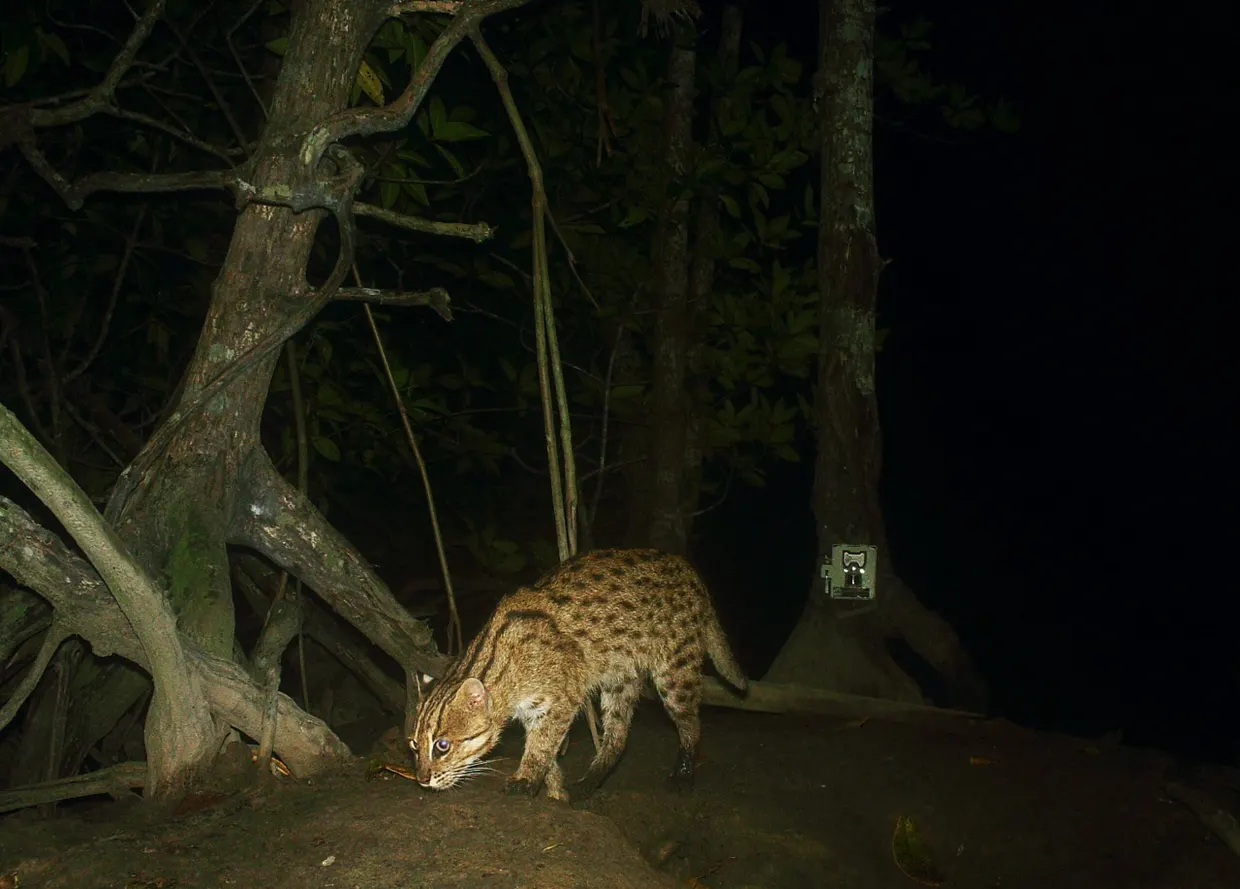
Researchers monitored mammal communities with camera traps in the Koh Kapik Ramsar Site and the Peam Krasop Wildlife Sanctuary on the Cambodian coast from 2017 to 2023, according to a paper in Ecology and Evolution. Cameras were set at 20–30 sites per year, 156 sites in total wiley.com
Ecology and Evolutionwiley.comOpen source ↗. The team, including Vanessa Herranz Muñoz of the Phnom Penh company Fishing Cat Ecological Enterprise, aimed to build a long-term baseline for species that are rarely observed and for which such data are scarce.
Occupancy and habitat preferences
The authors applied a multi-species hierarchical occupancy model to estimate occupancy, detection probability, habitat associations, human influence and temporal trends for eight mammal species. The Endangered long-tailed macaque (Macaca fascicularis) and the Vulnerable fishing cat (Prionailurus viverrinus) had the highest occupancy probabilities. The Endangered hairy-nosed otter (Lutra sumatrana) and the Critically Endangered Sunda pangolin (Manis javanica) had consistently low and uncertain occupancy. Detection probability varied widely, and the smooth-coated otter (Lutrogale perspicillata) was the easiest to detect.
Habitat associations differed by species. Fishing cats selected back and fringe mangroves, hairy-nosed otters were associated with riverine mixed mangroves, and large-spotted civets (Viverra megaspila) favored Melaleuca swamp forests. Across the community, occupancy rose with tree cover.
Human presence and trends over time
Responses to distance from villages differed among species, which the authors interpret as a mix of tolerance and avoidance of human activity wiley.com
Ecology and Evolutionwiley.comOpen source ↗. According to Mongabay's account, fishing cats, smooth-coated otters and macaques were often photographed not far from villages, while hairy-nosed otters, large-spotted civets and Sunda pangolins tended to stay farther from settlements.
The trend analysis suggests declining occupancy for several threatened species: long-tailed macaque, fishing cat, smooth-coated otter and large-spotted civet. Herranz Muñoz told Mongabay that protection should cover not only mangroves but also the surrounding Melaleuca forests and riverine mixed mangroves. The researchers also named human-wildlife conflict, poaching, and forest loss to fire and urbanization as concerns, as reported by Mongabay.
The authors describe the dataset as one of the first community-level baselines for evaluating and guiding conservation in Southeast Asian mangrove landscapes.