Cornell chip-based laser cooling brings a calcium ion near its ground state in 150 µs
Cornell researchers cooled a single trapped calcium ion close to its quantum ground state in 150 microseconds, versus about 500 with a conventional setup. The demonstration used one ion.
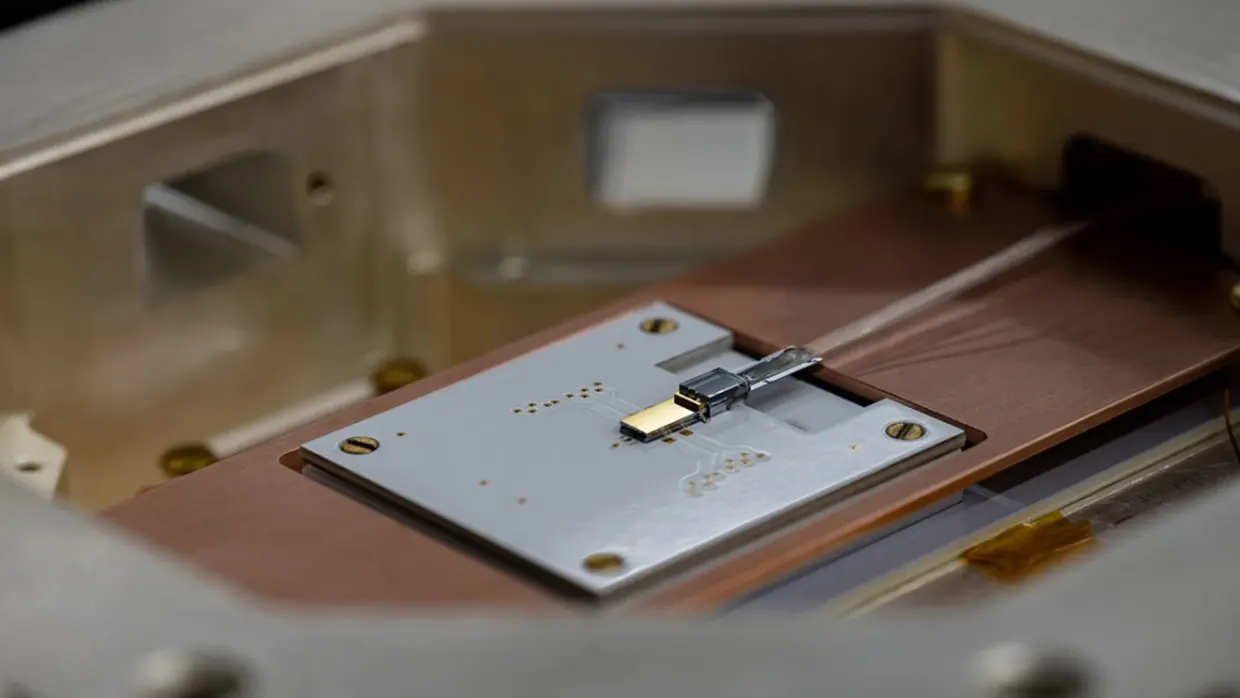
Researchers at Cornell University, led by Karan Mehta, assistant professor of electrical and computer engineering at the Duffield College of Engineering, have developed a chip-based laser-cooling technique. According to interestingengineering.com, it brings a trapped calcium ion close to its quantum ground state in about 150 microseconds interestingengineering.com
interestingengineering.cominterestingengineering.comOpen source ↗. A conventional running-wave laser setup needs roughly 500 microseconds, so the new method is around three times faster. The study was published in PRX Quantum.
Why cooling is a bottleneck
Trapped-ion quantum computers use electrically charged atoms held in electromagnetic fields to store and process quantum information. Unwanted atomic motion can interfere with operations. Lasers must therefore repeatedly remove this motion and cool the ions close to their lowest possible energy state.
These cooling procedures can take a substantial portion of a quantum computer's operating time. Mehta said that cooling, particularly to the quantum ground state, has become a major bottleneck in leading trapped-ion systems.
Standing wave and EIT cooling on a chip
The team delivers laser light through integrated optical components on a microfabricated ion-trap chip. Two beams directed in opposite directions form a standing wave, a pattern of alternating high- and low-intensity regions. The calcium ion sits at a low-intensity point, a node, which suppresses unwanted light interactions that can heat the ion. This arrangement was combined with electromagnetically induced transparency (EIT) cooling interestingengineering.com
interestingengineering.cominterestingengineering.comOpen source ↗.
The method cooled three measured motional modes simultaneously, across a range of approximately 5 megahertz, instead of requiring a separate operation for each mode. The targeted mode reached an average phonon occupancy of around 0.05. The results also showed cooling below the conventional Doppler limit, experimentally verifying a long-standing theoretical prediction.
The chip routes several wavelengths, from ultraviolet to near-infrared, needed to control the ion. The team also developed packaging that lets the device operate at cryogenic temperatures. The chips were commercially fabricated in the Netherlands through a collaboration with ETH Zurich, and Cornell facilities helped prepare them for the experiments.
Scope of the demonstration
The experiment used a single calcium ion, not a multi-ion quantum processor. The researchers said the approach could be applied to larger trapped-ion systems. They added that integrating optical components into ion-trap devices could reduce the need for complex external laser arrangements as processors scale to more qubits interestingengineering.com
interestingengineering.cominterestingengineering.comOpen source ↗.