Natural History Museum: Praearcturus gigas confirmed as the largest known scorpion, about 1 m long
Revised fossils held in London since the 1870s show Praearcturus gigas was a scorpion about a metre long that lived 415 million years ago, before forests appeared.
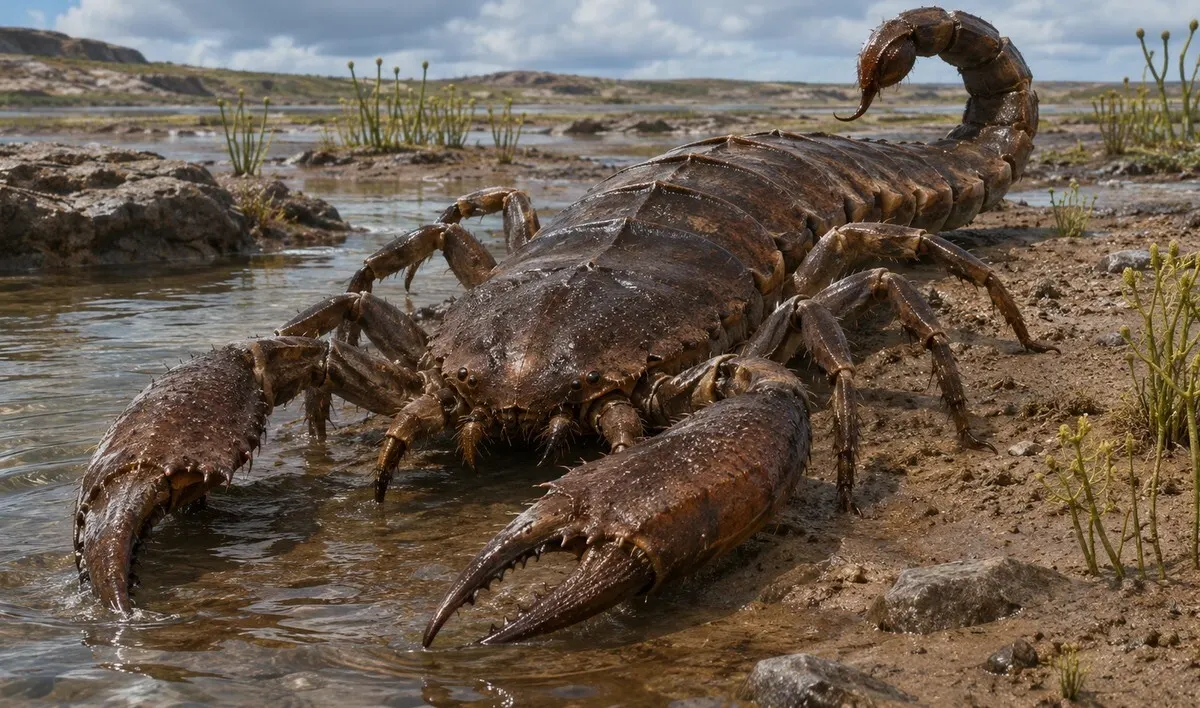
Researchers led by Dr Richard J. Howard of the Natural History Museum in London have confirmed that Praearcturus gigas, a scorpion that lived in what is now England and Wales about 415 million years ago, is the largest scorpion ever discovered, according to nhm.ac.uk. nhm.ac.uk
nhm.ac.uknhm.ac.ukOpen source ↗ Its length is estimated at around one metre, and its pincers were more than 16 centimetres long. The study, "A revision of Praearcturus gigas: a giant scorpion from the Lower Devonian (Lochkovian) of Britain", is published in the journal Palaeontology.
From a woodlouse-like crustacean to a scorpion
The fossils used to identify Praearcturus have been in the museum collection for more than 150 years. The animal was first described in 1871 as a giant crustacean similar to a woodlouse. The known material is fragmentary and lacks key features such as a tail, so the animal could not be classified with confidence for more than a century.
The team applied modern analytical techniques and compared the specimens with new fossil species described in recent years. The better preserved finds revealed anatomical features unique to scorpions. On this basis the authors conclude that Praearcturus is a scorpion and a distinct species.
Howard noted that giant arthropods are usually pictured in Carboniferous rainforests, as giant millipedes or dragonfly-like insects. Praearcturus lived at least 50 million years earlier, before trees evolved. nhm.ac.uk
nhm.ac.uknhm.ac.ukOpen source ↗
Large size without high oxygen
Praearcturus lived in the Early Devonian, when small plants and fungi had only begun to spread and complex terrestrial ecosystems such as forests did not yet exist. Unlike later giant arthropods, it therefore did not benefit from the high atmospheric oxygen associated with the rise of forests. The authors suggest that its size may reflect a world with relatively little competition from other large predators.
Some specimens show flap-like structures on the abdomen similar to those of modern crustaceans such as lobsters. According to the authors, this suggests the animal may have been able to move between water and land. Dr Greg Edgecombe, a co-author, said the boundary between land and sea was much less defined at that time. He added that Praearcturus may represent a lineage that returned to the water after earlier ancestors had begun living on land.
The authors state that the findings point to ecological opportunity, such as a lack of competition, as a possible crucial factor in the gigantism of early arthropods, rather than environmental conditions such as oxygen levels alone. nhm.ac.uk
nhm.ac.uknhm.ac.ukOpen source ↗