Floaty robot from Max Planck Institute hovers in 10 m/s updrafts at 10 W/kg in wind tunnel
A wind-tunnel prototype with four wing flaps holds position in vertical airflow without thrusters, drawing about 10 W/kg, an order of magnitude below thruster-powered systems.
Researchers at the Max Planck Institute for Intelligent Systems and the University of Stuttgart have built Floaty, a shape-changing robot that hovers and maneuvers in vertical airflow without active propulsion, according to a paper on nature.com. In wind tunnel experiments it held position, maneuvered and rejected disturbances in updrafts of up to 10 m/s, with a specific power consumption of 10 W/kg nature.com
nature.comnature.comOpen source ↗. The authors say this is an order of magnitude lower than thruster-powered systems. The work is published in npj Robotics.
How Floaty flies
Floaty has four independently actuated flaps that change its aerodynamic profile. By opening and closing them, the robot modulates drag forces and controls its attitude and position. Closing or opening all flaps at once changes the projected flap area and thereby the vertical acceleration. The robot does not stay airborne by flapping: it is placed in an updraft manually and then adjusts the flaps to control the airflow around it, according to New Atlas.
The design is optimized for passive stability, and the control policy is derived from an aerodynamic model learned experimentally. An early flat version tended to flip over under disturbances in vertical wind tunnel tests. The team lowered the center of gravity and added a bend to the previously rigid flaps.
Between multirotors and fixed wings
The authors describe a trade-off. Multirotors hover and maneuver well but spend energy continuously on thrust, while fixed-wing aircraft are efficient but need forward velocity for lift and cannot hover nature.com
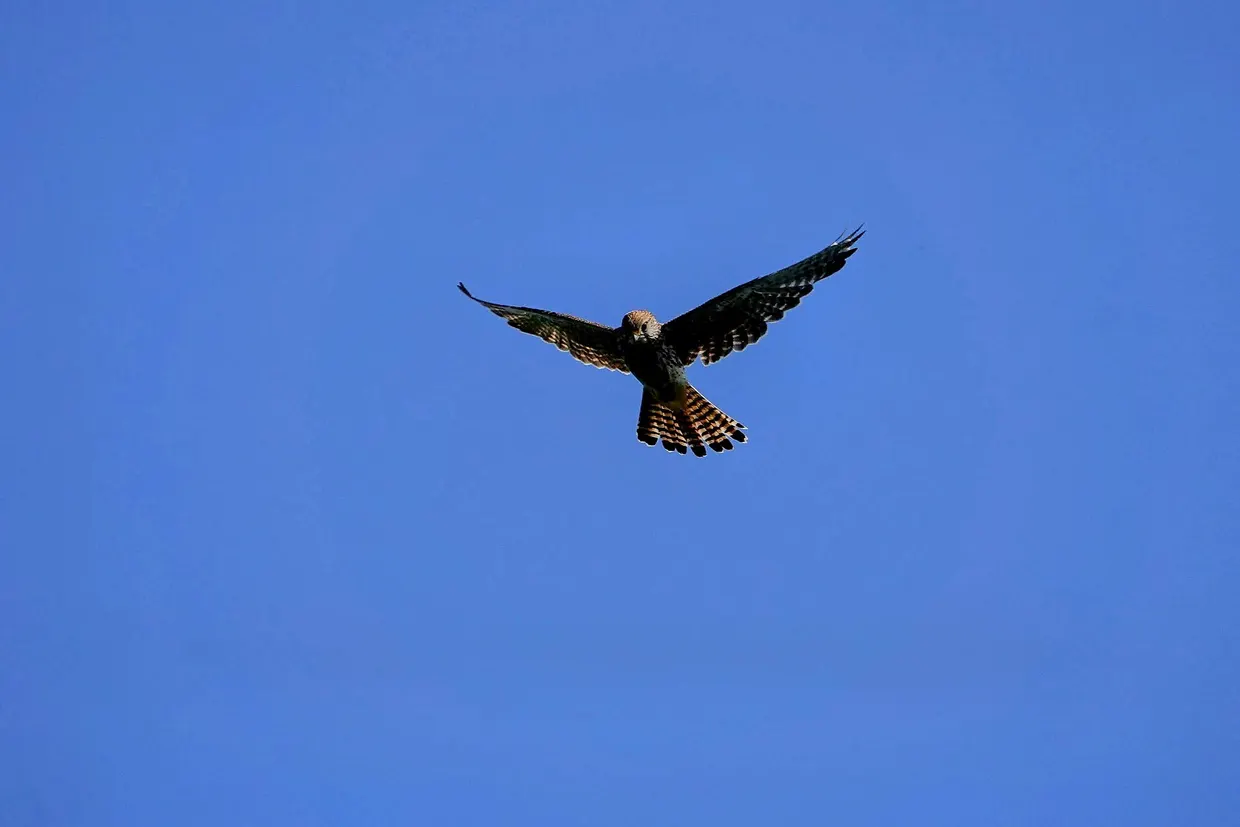
nature.comnature.comOpen source ↗. Floaty is meant to sit between them by drawing energy from external wind. The inspiration is soaring birds, such as the kestrel, that hold altitude in updrafts with zero net horizontal velocity.
The tests so far were done in a custom-built wind tunnel, with motion capture cameras tracking the robot. The authors note that the concept could be applied in factory smokestacks or in natural updrafts. Michael Mühlebach of the Max Planck Institute said Floaty could inspect smokestacks with strong upward airflow with little modification, and that similar technology might help control rockets during re-entry or guide weather balloons.