NV centers in diamond record deuterium NMR spectra from nanoscale volumes at low magnetic fields
Authors report deuterium NMR spectra with quadrupolar line shapes from nanoscale volumes, with spin sensitivity seven to eight orders above inductive detection, at fields two orders lower.
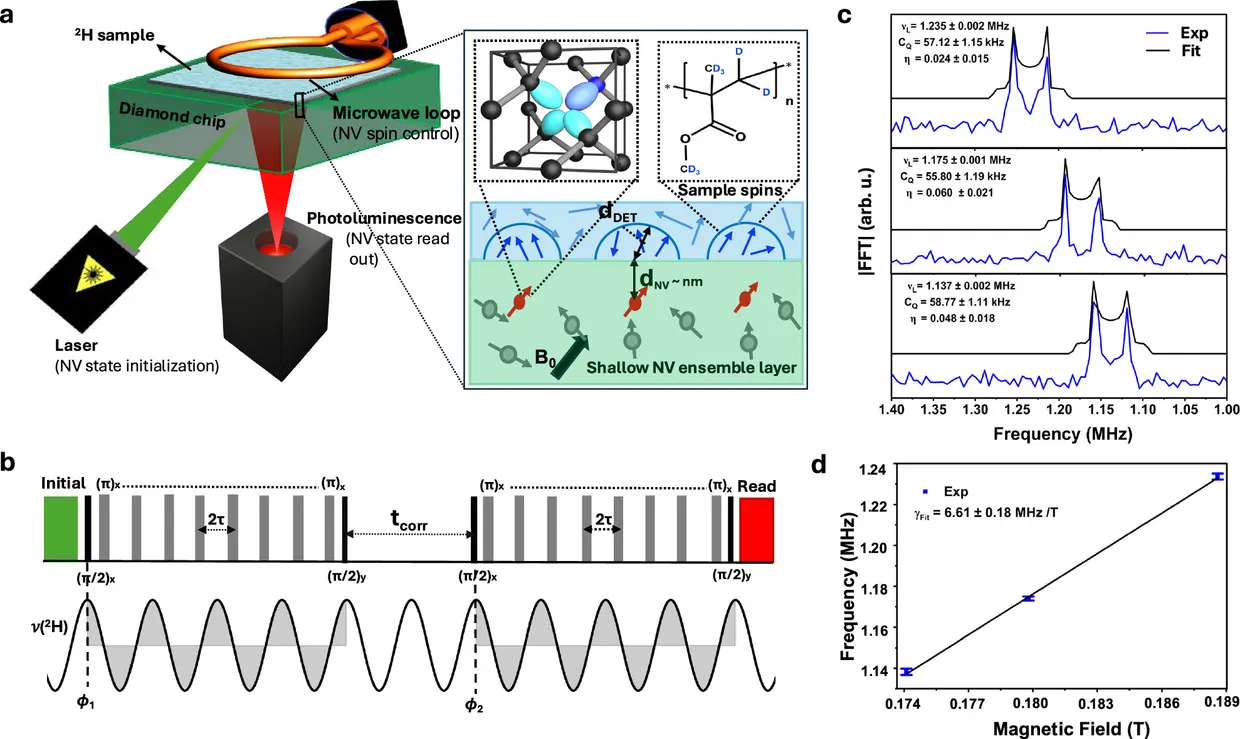
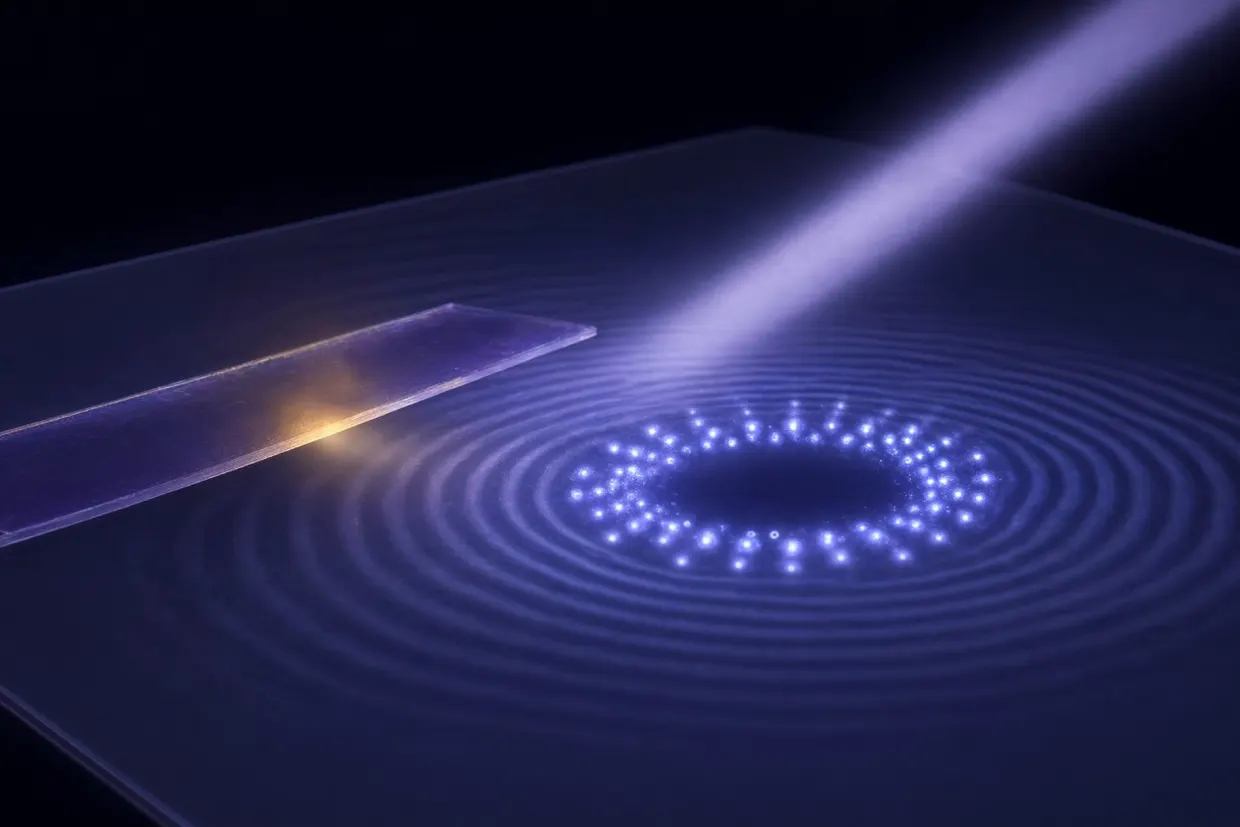
A research team reported in Nature Communications nanoscale deuterium (2H) NMR spectroscopy with an ensemble of nitrogen-vacancy (NV) centers in diamond. The centers were implanted about 8 nm below the surface of an electronic-grade diamond chip, and a deuterated layer, such as PMMA-d₈, was deposited on it. The measured spectra show characteristic quadrupolar powder line shapes (Pake patterns), which also appear in conventional bulk solid-state NMR nature.com
Nature Communicationsnature.comOpen source ↗. According to the authors, this is the first NV-based NMR approach to deliver chemical information in the form of such a pattern.
Sensitivity at low field
The method detects statistical spin fluctuations from nanometer-scale detection volumes. The authors report a spin-sensitivity gain of seven to eight orders of magnitude over inductive detection. The measurements were made at magnetic fields two orders of magnitude lower than those used in conventional NMR. This detection scheme needs no radiofrequency excitation of nuclear spins and no longitudinal (T₁) recovery between measurements.
Deuterium is a harder target than hydrogen: its gyromagnetic ratio is about 6.5 times smaller than that of 1H, which reduces signal strength about 40-fold. To compensate, the authors built an improved NV-diamond platform optimized for spin sensitivity. Earlier work by Lovchinsky et al. detected 2H signals in single proteins, but no quadrupolar line shape was observed there.
Measurement scheme and results
The NV spin state is initialized and read out with green laser light, and microwave pulses from a loop on the diamond surface control it. Of the four crystallographic NV orientations, the subset aligned with the external magnetic field forms the sensing ensemble. The pulse sequence for correlation spectroscopy uses XY8-N dynamical decoupling blocks, with two identical blocks separated by a variable time tcorr nature.com
Nature Communicationsnature.comOpen source ↗.
The team ran temperature-dependent measurements on a deuterated polymer and a molecular solid. They compared nanoscale NV spectra with bulk spectra and found distinct motional averaging and phase transitions, detected with nanoscale sensitivity. The authors describe the technique as a tool for probing molecular dynamics on the nanoscale, with capabilities beyond those of most existing spectroscopic methods.