University of Basel detects forbidden vibrations in single nitrogen ions, with tenfold precision
Researchers at the University of Basel excited rarely allowed vibrations of single trapped N2+ ions and kept each molecule intact, so it could be measured repeatedly.
A team led by Prof. Stefan Willitsch at the Department of Chemistry of the University of Basel has detected "forbidden" vibrational transitions in single positively charged nitrogen molecules. The results were published in Nature Communications, according to unibas.ch on 10 November 2026 unibas.ch
unibas.chunibas.chOpen source ↗. Unlike earlier methods, the molecules were not destroyed by the measurement.
In quantum physics, "forbidden" means extremely improbable, not impossible. Such vibrations are excited by infrared light billions of times less readily than ordinary molecular vibrations. They respond only to light of a very precisely defined frequency, which makes them interesting as a possible reference for a clock.
Quantum-logic spectroscopy on a trapped ion pair
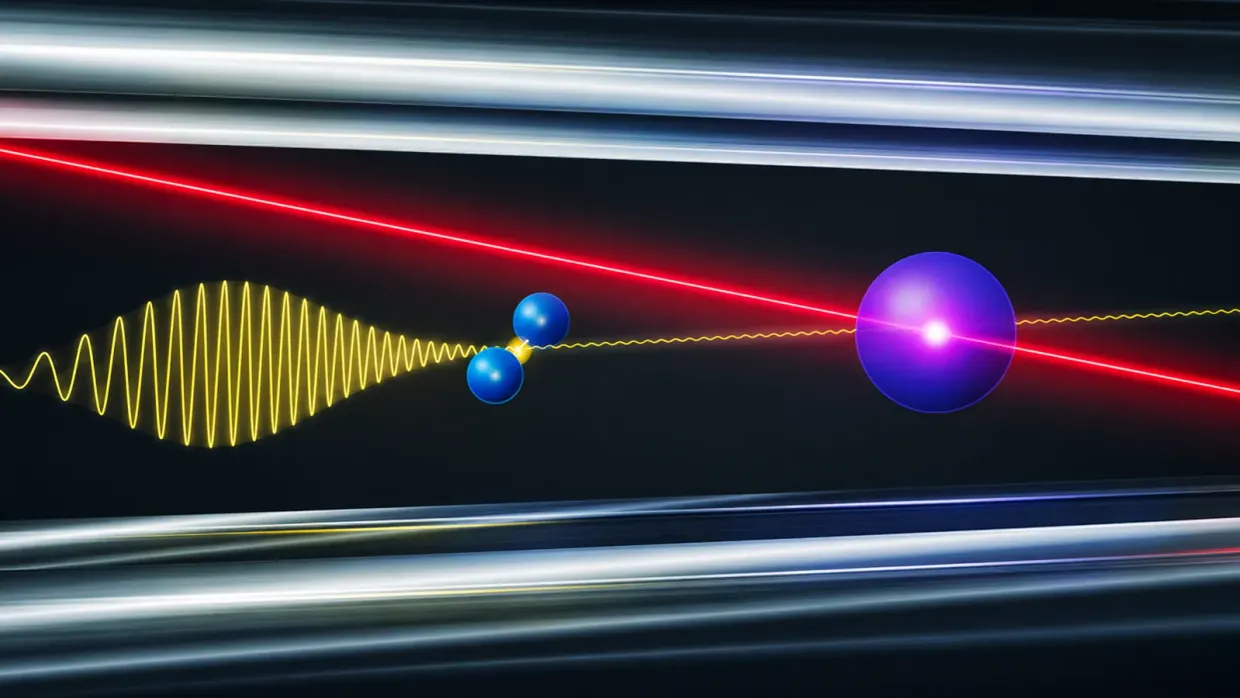
The researchers held a single charged nitrogen molecule together with a charged calcium atom in a trap. The calcium ion can be made to fluoresce under laser light and thereby reveals the state of the molecule. This approach is called quantum-logic spectroscopy.
A precisely tuned laser sets both particles in motion, but only if the nitrogen molecule is in its lowest energy state. The calcium ion's response therefore shows the molecular state, and the readout does not change that state. Willitsch's group had first seen forbidden vibrations in a sample of many molecular ions in 2014, but the chemical detection used then destroyed the molecules in every measurement unibas.ch
unibas.chunibas.chOpen source ↗.
Repeated measurements and a tenfold gain
A second laser was scanned in frequency until it matched a forbidden transition. One pulse moved the molecule to a higher energy state, and a second returned it. The same molecule could thus be studied again and again. According to co-first author Aleksandr Shlykov, this reuse made the search for such weak spectral lines possible.
From measurements on several hundred single molecules, the team determined the characteristic vibrational frequency of the nitrogen ion ten times more precisely than before.
According to theoretical predictions, the frequencies of some of the transitions studied should hardly change under external influences. Willitsch calls them very promising candidates for future molecular clocks and qubits. The authors also note that precise vibration measurements could be used to test whether the proton-to-electron mass ratio stays constant over time unibas.ch
unibas.chunibas.chOpen source ↗.