Penn Engineers create CoilLCE artificial muscle fibers with feedback control, shown on a finger and an eye
The fibers combine liquid crystal elastomer, graphene and a copper coil that heats and senses, letting a lab prototype hold intermediate positions.
Engineers at the University of Pennsylvania have developed artificial muscle fibers that sense their own state, hold intermediate positions and coordinate with other muscles, according to engineering.upenn.edu (November 12, 2026). engineering.upenn.edu
engineering.upenn.eduengineering.upenn.eduOpen source ↗ The team was led by Shu Yang, Joseph Bordogna Professor in Materials Science and Engineering (MSE), and Cynthia Sung, Associate Professor in Mechanical Engineering and Applied Mechanics (MEAM). Ziyun Zhang, a Ph.D. student in MSE, and Xuelin Wu, a master's student in MEAM, also took part. The research was published in Advanced Functional Materials.
Liquid crystal elastomer, graphene and a copper coil
The fibers, called CoilLCE, combine liquid crystal elastomers (LCEs), flexible materials that change shape when heated, with graphene and an embedded ultrathin copper coil. According to the authors, graphene makes the material softer yet tougher and allows it to stretch while withstanding the forces that arise when artificial muscles work against one another.
When heated, LCEs can keep contracting or return toward their original shape as they cool, which makes it hard to hold an intermediate position. The copper coil addresses this: it heats the material to trigger contraction and also measures changes in electrical resistance as the muscle moves. Wu explained that the team used the coil's resistance as a feedback signal and adjusted the heating power in real time to keep the resistance near a target value, so no separate sensor was needed. This closed-loop control lets the muscle hold intermediate contraction levels for extended periods.
Finger and eye demonstrations
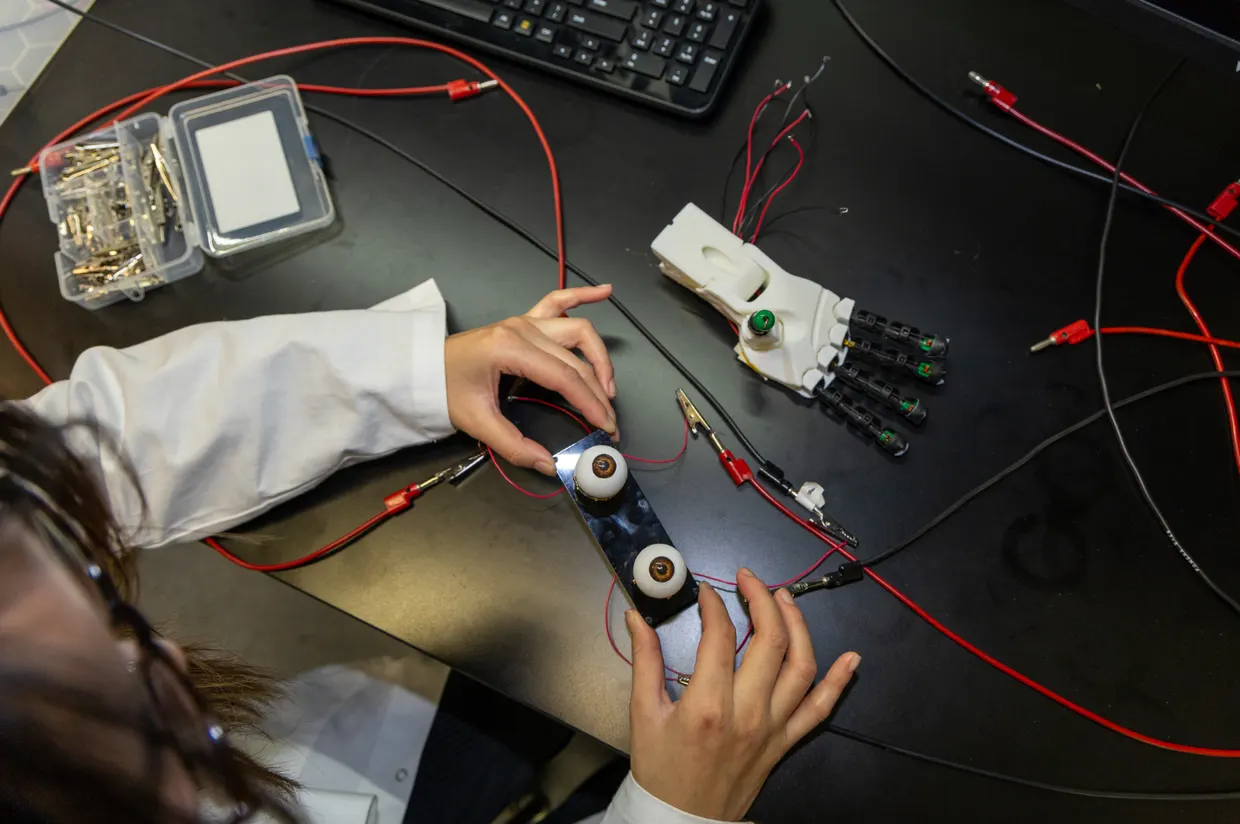
The design draws on the small muscles of the human hand and eye, which require fine control and coordination. The team demonstrated the system with artificial fingers that press piano keys and with artificial eyes driven by four pairs of opposing actuators. engineering.upenn.edu
engineering.upenn.eduengineering.upenn.eduOpen source ↗ In such pairs, one muscle contracts while another stretches, which can reduce the number of control inputs needed.
Sung said this is the first time feedback control has been demonstrated on an LCE actuator. Replicating this dexterity with conventional robotic motors can require bulky components and complex mechanical designs, the team notes.
The authors say the approach could eventually support applications such as humanoid robotic faces, where dozens of small, coordinated muscles must fit into a confined space. The next step, according to Zhang, is to combine more of these muscles into integrated systems that perform increasingly complex movements.
Sources · 2
Found a mistake?Read also