Laacher See: 1043 microquakes show a tilted magma reservoir deeper than earlier estimates
Seismic sensors and a fibre-optic line recorded 1043 microquakes in a year near Germany's Laacher See; the authors say the signals do not point to an imminent eruption.
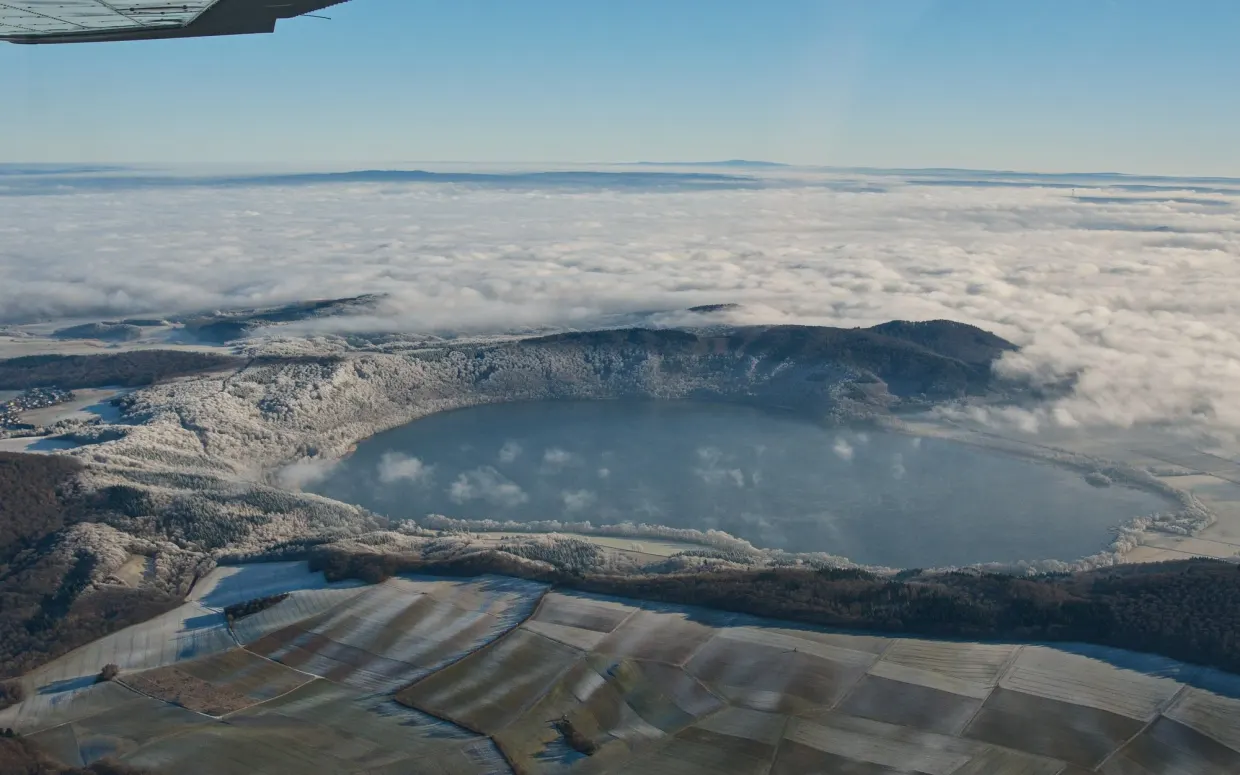
Researchers deployed a network of about 500 seismic sensors and used more than 60 km of fibre-optic line around Laacher See, a caldera lake in the Eifel region of western Germany, about 600 km from Poland. The results were published in 2026 in Geophysical Journal International and described by Earth.com, rp.pl reports. rp.pl
rp.plrp.plOpen source ↗
From September 2022 to August 2023 the equipment recorded 1043 microquakes. People could not feel them, but they allowed the authors to build the most detailed picture to date of the underground structures.
Tilted magma reservoir
The magma reservoir beneath Laacher See lies deeper than previously thought. It is not vertical but clearly tilted to the south-east.
According to Earth.com, this means magma or fluids may not rise straight up. They may instead move along weakened crust, where older structures have already formed fissures and fractures. rp.pl
rp.plrp.plOpen source ↗
Most of the microquakes were concentrated east of the lake, near the town of Ochtendung, and occurred at the edges of the magma reservoir. This may indicate strong stress in the rocks caused by high temperature, pressure, and the migration of fluids and hot gases at depths of several to more than ten kilometres.
The Eifel area is a volcanic field: a broad area with many smaller eruption points linked to a single underground magma system rather than one crater.
Eruption about 13 thousand years ago
Today Laacher See covers about 3.3 km² and is up to 51 metres deep. It fills a caldera formed by a powerful eruption about 13 thousand years ago. rp.pl
rp.plrp.plOpen source ↗
According to scientists, it was one of the most powerful volcanic eruptions in the history of Europe. Within a few days the Rhine valley was covered by a seven-metre layer of ash and pumice, which formed a dam that stopped the river and caused extensive flooding. Ash reached an area from Scandinavia to Italy.
Experts say none of the recorded signals indicates that the volcano will erupt soon. The authors stress that the series of microquakes is a manifestation of natural geological activity and does not foretell a disaster.
Continuous monitoring of volcanic fields lets scientists track long-term trends and detect possible anomalies beneath the surface well in advance. rp.pl
rp.plrp.plOpen source ↗