Nordic observatory data: range shifts can mask earlier spring passage of short-distance migrants
In 33 passerine species at four Nordic observatories, northward shifts of breeding ranges were linked to later early passage in short-distance migrants.
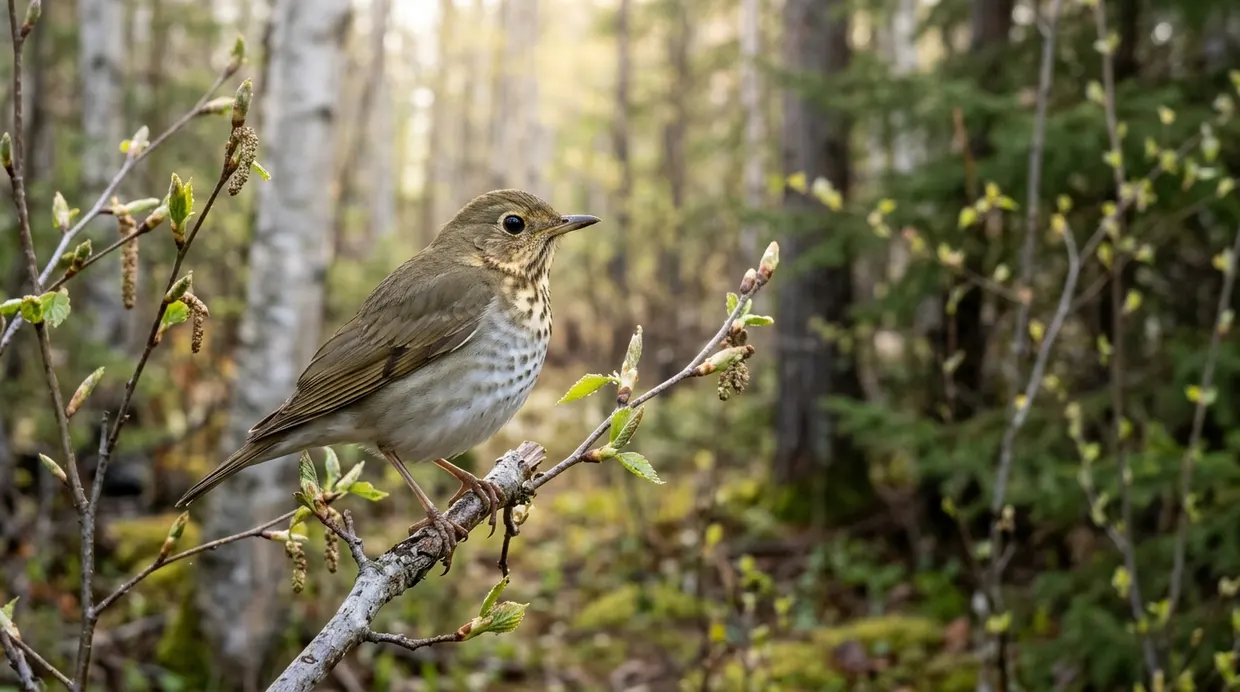
Otterbeck and Lindén analysed spring passage records of 33 passerine species from four Nordic observatories for 1980–2004 and compared them with shifts in Finnish breeding distributions, according to a study in Movement Ecology biomedcentral.com
Movement Ecologybiomedcentral.comOpen source ↗. Among short-distance migrants, faster north-northeast redistribution of breeding ranges was associated with relatively later early passage. No comparable association was found among long-distance migrants.
Why passage records can mislead
Fixed observatories are widely used to infer spring migration timing. The birds recorded at a site, however, need not be the same mixture of populations from year to year. Spring onset and optimal arrival occur later at higher latitudes, so northbound birds heading to northern breeding grounds pass en-route observatories later than southbound conspecifics.
If breeding populations move north, their share among passing birds grows. This can shift species-level passage later even when arrival advances within individual breeding populations. The authors tested this predicted compositional bias.
Data and results
The team related trends in the 10th, 50th and 90th percentiles of spring passage to north-northeast range-shift velocities. The velocities measured changes in density-weighted centroids of Finnish breeding distributions from line-transect surveys biomedcentral.com
Movement Ecologybiomedcentral.comOpen source ↗. Models with migration strategy, range-shift velocity, their additive and interactive effects, and an intercept-only baseline were compared with the Akaike information criterion. Simulation extrapolation (SIMEX) accounted for species-specific measurement error.
After correction, a 1 km per year faster north-northeast shift was associated with an early-passage trend 0.054 ± 0.022 days per year later, equivalent to approximately 1.3 days over 24 years. Median and late passage showed no clear support for the predicted positive association.
Range shifts averaged close to zero among short-distance migrants in this system, so accounting for redistribution did not relevantly change their group-average passage trend. At the species level, the modelled contribution of range shifts could span several days and sometimes reverse the apparent trend.
The authors conclude that fixed-site passage trends can reflect both phenological change within breeding populations and redistribution among populations that migrate at different times. They state that changes in breeding distributions should be considered when passage-date series are used to infer arrival phenology and assess climate-change responses biomedcentral.com
Movement Ecologybiomedcentral.comOpen source ↗.