Jilin University cathode with ‒OH nanotubes keeps 89.34% capacity after 10000 cycles in Zn-I2 cell
Jilin University and Changchun Institute of Applied Chemistry tuned surface groups on carbon nanotubes to suppress I3− shuttling in laboratory aqueous zinc-iodine cells.
Researchers at Jilin University and Changchun Institute of Applied Chemistry developed self-supporting carbon nanotube cathodes (SSCC) with controlled surface functional groups for aqueous Zn-I2 batteries, according to a release published by EurekAlert. The hydroxyl-modified version, SSCC-OH/I2, delivered an initial reversible capacity of 175.5 mAh/g at 1 A/g and retained 89.34% of it after more than 10000 cycles, corresponding to over 3500 hours, the authors reported eurekalert.org
EurekAlerteurekalert.orgOpen source ↗. The work appeared in Science China Chemistry.
Why the iodine cathode needed a redesign
Aqueous zinc-ion batteries use a zinc metal anode with a high theoretical specific capacity and an aqueous electrolyte that is inherently safe. Among them, Zn-I2 cells are noted for long cycling stability, good rate performance and high theoretical capacity. Iodine cathodes, however, have poor electrical conductivity, change volume during cycling and suffer from the shuttle effect of I3− eurekalert.org
EurekAlerteurekalert.orgOpen source ↗.
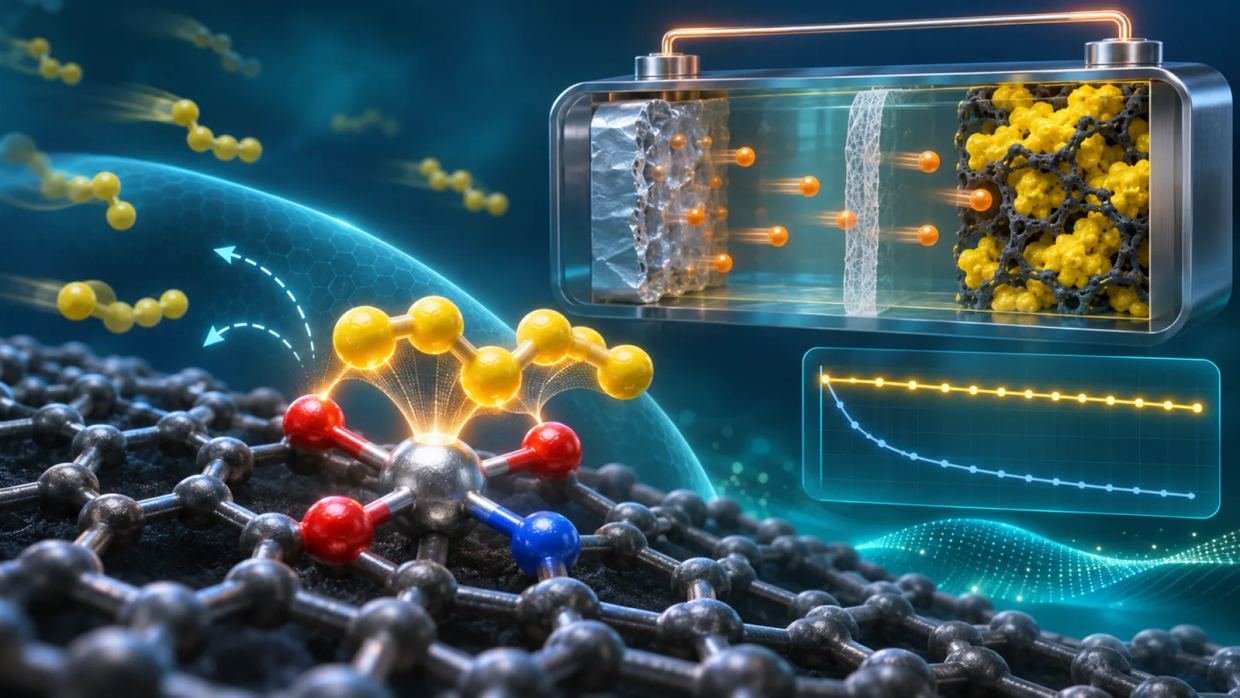
Guided by density functional theory calculations, the team compared pristine nanotubes and nanotubes modified with hydroxyl (‒OH), carboxyl (‒COOH) and amine (‒NH2) groups. The ‒OH variant showed the strongest adsorption of I2 species. The adsorption energy of I3− on it was −7.42 eV and the interaction energy was −5.69 eV, stronger than on the pristine, ‒COOH- and ‒NH2-modified nanotubes eurekalert.org
EurekAlerteurekalert.orgOpen source ↗.
Cycling and pouch-cell results
The SSCC‒OH cathode had a specific surface area of about 1005 m2/g, which helped confine I2 species inside the nanotube channels. Spectroscopy and microscopy confirmed the functional groups and uniform I2 loading eurekalert.org
EurekAlerteurekalert.orgOpen source ↗.
At a current density of 10 A/g the cathode gave an initial capacity of 120 mAh/g with a cycling life of 93400 cycles. In situ Raman spectra and ex situ X-ray photoelectron spectroscopy showed that iodine species were converted reversibly during charge and discharge. I3− disappeared completely at the end of charging and discharging, which the authors take as evidence that the shuttle effect was effectively suppressed eurekalert.org
EurekAlerteurekalert.orgOpen source ↗.
A laboratory pouch cell with a high I2 loading of 150 mg gave an operating voltage of 1.1 V at 3.612 mA/cm2, an actual capacity of 23.8 mAh and 91.7% capacity retention after 350 cycles. The researchers conclude that functional group chemistry, especially ‒OH modification, improves iodine conversion kinetics and stabilizes aqueous zinc-iodine batteries eurekalert.org
EurekAlerteurekalert.orgOpen source ↗.
Sources · 1
Found a mistake?Read also