SKKU perovskite films with eutectic additives reach 26.5% solar cell efficiency and 26.1% LED EQE
Researchers at Sungkyunkwan University grew perovskite films with a zinc bromide and MACl eutectic, lowering defect density. The same films worked in solar cells and LEDs.
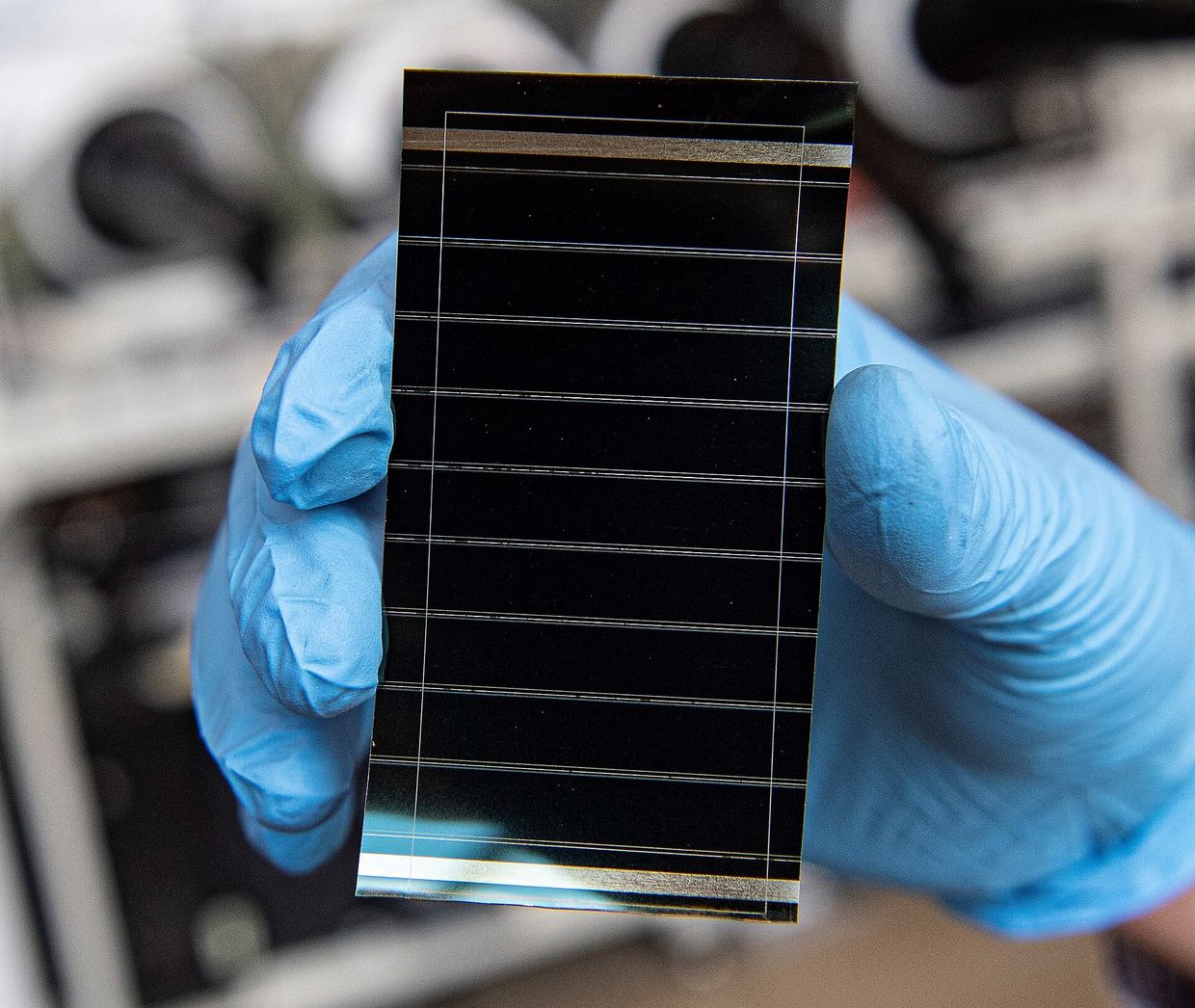
A team led by Professor Seong Sik Shin of the SKKU Advanced Institute of Nanotechnology at Sungkyunkwan University, together with the Korea Research Institute of Chemical Technology, the University of California, San Diego, and Princeton University, has made halide perovskite thin films with a reduced density of defects. The work was published in Science on October 8, 2026 doi.org
Sciencedoi.orgOpen source ↗. The films were used both in solar cells and in LEDs with the same device architecture
doi.org
Sciencedoi.orgOpen source ↗.
Defects at grain boundaries and surfaces trap or remove photogenerated charge carriers, which lowers device efficiency and lifetime. To limit them, the authors tailored perovskite crystallization using the eutectic interaction between zinc bromide and methylammonium chloride (MACl) additives doi.org
Sciencedoi.orgOpen source ↗.
Eutectic crystallization
Nanoprobe X-ray microscopy showed local melting of the eutectic at grain boundaries during annealing. This reduced the density of structural defects inside the grains doi.org
Sciencedoi.orgOpen source ↗. According to the research team, the film was heated to about 100°C, and the mixture at the grain boundaries became a thin liquid layer in which small grains merged into larger ones.
Annealing also homogenized the distribution of halides. The volatile MACl evaporated, and zinc segregated to the grain boundaries doi.org
Sciencedoi.orgOpen source ↗.
Film quality and device results
The resulting films had high photoluminescence quantum yield, long charge carrier decay times and low surface recombination velocity doi.org
Sciencedoi.orgOpen source ↗. The authors reported a carrier lifetime of about 295 μs and a surface recombination velocity of 0.3 cm/s, which they compare with the best values for passivated silicon.
Solar cells made with the volatile eutectic reached a power conversion efficiency of 26.5%, certified at 25.9%. Perovskite minimodules with an area of more than 15 square centimeters reached 23.9% doi.org
Sciencedoi.orgOpen source ↗. Small-area cells with a poly[bis(4-phenyl)(2,4,6-trimethylphenyl)amine] hole transporter retained 85.8% of their initial 24.1% efficiency after 1400 hours of continuous operation at 85°C
doi.org
Sciencedoi.orgOpen source ↗.
An LED built with the same approach reached an external quantum efficiency of 26.1% doi.org
Sciencedoi.orgOpen source ↗. Shin said the process requires no expensive specialized equipment. Co-first author Seongsik Nam said the team expects the results over large areas to help the commercialization of perovskite solar cells.