Nankai University gel electrolyte polymerizes at room temperature; 9.53 Ah pouch cell reaches 656.6 Wh kg⁻¹
A room-temperature route to in situ gel electrolytes cut the initiation barrier from 0.46 to 0.11 eV. A 9.53 Ah lithium pouch cell reached 656.6 Wh kg⁻¹.
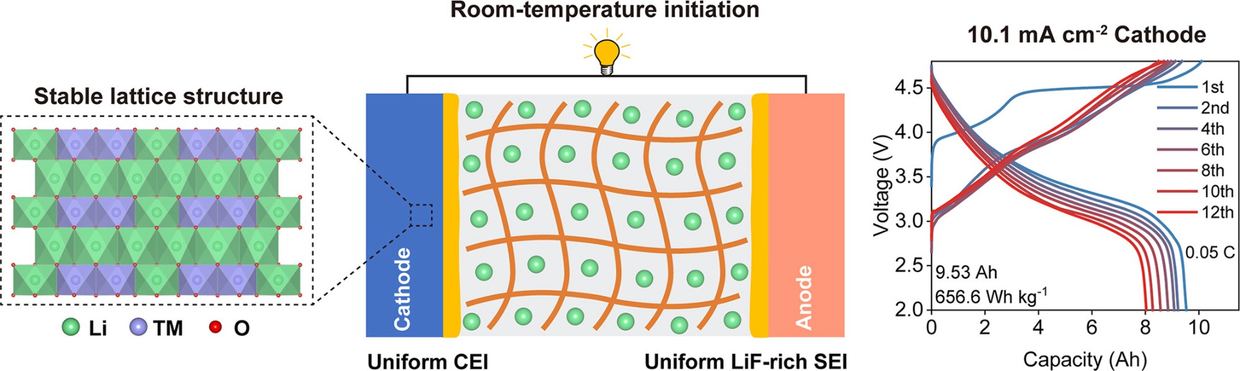
Researchers at Nankai University and the Haihe Laboratory of Sustainable Chemical Transformations in Tianjin, China, developed a way to polymerize quasi-solid-state gel electrolytes (QSEs) inside a battery at room temperature. According to the study published online on 20 July 2026 in eScience, a 9.53 Ah pouch cell with a lithium-rich manganese-based oxide (LRMO) cathode delivered 656.6 Wh kg⁻¹ doi.org
eSciencedoi.orgOpen source ↗.
Room-temperature initiation
In situ polymerized gel electrolytes usually require thermal initiation above 60 °C with azobisisobutyronitrile (AIBN). The publication notes that this can cause instant polymerization, heat and gas buildup, uneven solid electrolyte interphase (SEI) and cathode electrolyte interphase (CEI) layers, and electrode degradation doi.org
eSciencedoi.orgOpen source ↗.
The team used pentaerythritol tetraacrylate (PETEA) as the acrylate monomer, AIBN as the initiator and tris(pentafluorophenyl)borane (TPFPB) as an activator with high maximum molecular surface electrostatic potential (ESPmax). TPFPB coordinates with the carbonyl group, redistributes electron density away from the C=C bond and increases its condensed local softness doi.org
eSciencedoi.orgOpen source ↗. The ¹¹B NMR signal shifted from −0.07 to 0.66 ppm, and density functional theory calculations showed the initiation barrier falling from 0.46 eV to 0.11 eV. Polymerization then proceeded at room temperature in bottles and coin cells
doi.org
eSciencedoi.orgOpen source ↗.
Cell results
The room-temperature electrolyte (RT-QSE) formed uniform SEI and CEI layers rich in lithium fluoride and supported stable lithium plating and stripping for more than 1,200 h at 0.5 mA cm⁻² and 1.0 mAh cm⁻² doi.org
eSciencedoi.orgOpen source ↗. Atomic force microscopy showed a higher DMT modulus for the RT-QSE-derived SEI than for the high-temperature QSE (HT-QSE). The LRMO lattice remained more stable, without voids or vacancies, while HT-QSE showed disordered surfaces and uneven interphases
doi.org
eSciencedoi.orgOpen source ↗. Ultrasonic scanning showed better electrolyte infiltration.
A 4 mAh cm⁻² LRMO cathode kept 95.1% of its capacity after 100 cycles doi.org
eSciencedoi.orgOpen source ↗. The 9.53 Ah pouch cell, with a cathode above 10 mAh cm⁻², reached 656.6 Wh kg⁻¹ with an initial Coulombic efficiency of 94.4%
doi.org
eSciencedoi.orgOpen source ↗.
The authors state that the approach is not limited to one monomer or activator and offers a general criterion for choosing them. They note that low-temperature performance of thick LRMO cathodes still needs improvement through cathode modification and plasticizer engineering.
Sources · 2
Found a mistake?Read also