ALMA measures a 6.5-billion-solar-mass black hole in galaxy W2246-0526 from gas dynamics
A Universidad Diego Portales team resolved gas motion near a black hole in a galaxy seen when the universe was 1.3 billion years old, a rare check on indirect mass estimates.
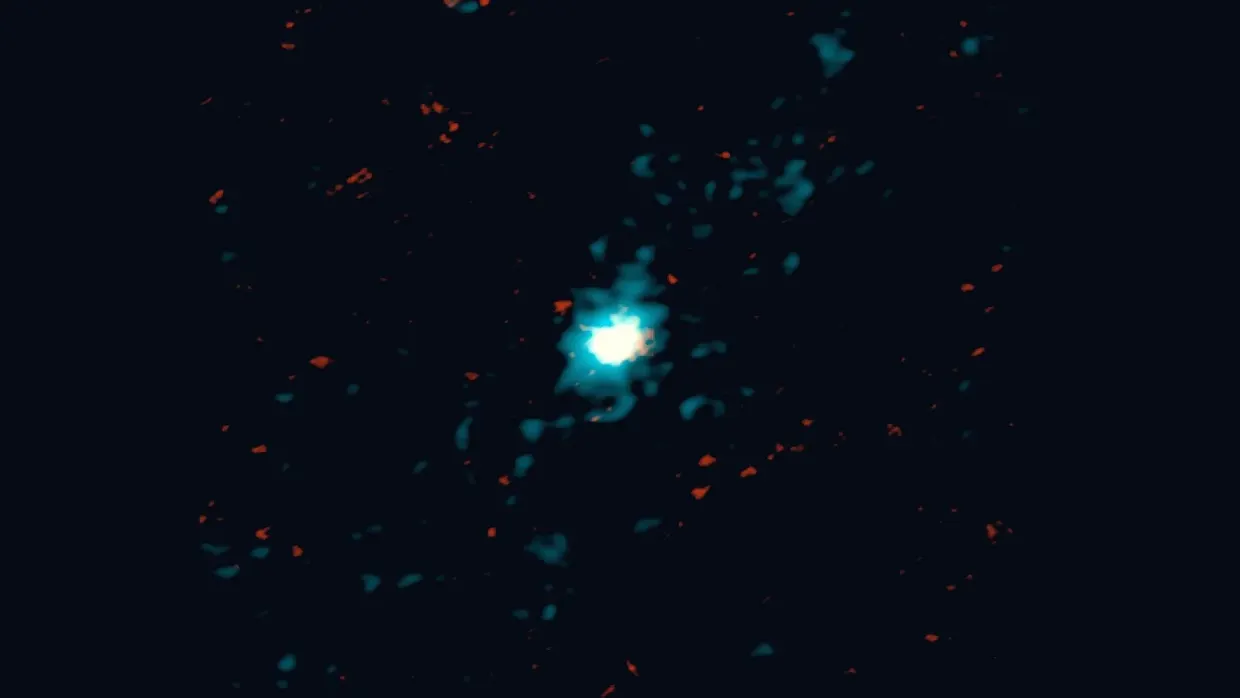
A team at Universidad Diego Portales (UDP) led by Dr. Mai Liao used the Atacama Large Millimeter/submillimeter Array (ALMA) to study the extremely luminous galaxy W2246-0526, scinexx.de reports. Its light has travelled for more than twelve billion years (redshift 4.6), so the galaxy is seen when the universe was about 1.3 billion years old. The gas dynamics give its central black hole a mass of about 6.5 billion solar masses scinexx.de
scinexx.descinexx.deOpen source ↗.
Why mass is hard to measure at this distance
Black holes in the young universe are so far away that their gravity acting on individual gas clouds can hardly be resolved. Their mass is therefore usually estimated from a quasar's brightness and the width of its spectral lines. These indirect methods are calibrated on nearer objects and need not be equally reliable under all conditions of the early universe.
Quasars whose luminous centers are hidden behind dense dust are especially hard to access. W2246-0526 is one such heavily obscured source. At its distance ALMA could distinguish structures of about 700 light-years.
Gas motion and the comparison with the older estimate
The observations recorded emission from singly ionized carbon and carbon monoxide. Because gas also flows outward from the quasar, the outflows had to be separated computationally from motion in the gravitational field. The corrected data show that the spread of gas velocities rises sharply toward the center, consistent with motion under the gravity of a concentrated, enormous mass scinexx.de
scinexx.descinexx.deOpen source ↗.
The joint model of both gases gives about 6.5 billion solar masses; the exact figure depends on assumptions about the surrounding galaxy. According to the report, at redshift above two the sphere of influence of a black hole in a galaxy not magnified by gravitational lensing had not been resolved in this way before.
An earlier indirect estimate for W2246-0526, based on a magnesium spectral line, gave roughly four billion solar masses with large uncertainty. The two values are compatible within their error ranges. This does not mean indirect methods are reliable for all early black holes: motions in W2246-0526 are shaped by outflows and turbulence, and the mass distribution of the host galaxy is not fully understood.
The researchers suggest that dense dust may shield carbon from X-ray ionization, which in bright unobscured centers weakens the emission line near the black hole. This remains a hypothesis. Chao-Wei Tsai of the National Astronomical Observatories, Chinese Academy of Sciences, said the measurement confirms that the black hole is in a phase of extremely high matter accretion scinexx.de
scinexx.descinexx.deOpen source ↗. Whether other obscured quasars can be measured this way requires further observations. The study was published in Science Advances.