Epochalypse catalog of 15,120,984 simulated systems tests orbit recovery methods for Gaia DR4
Astronomers built a synthetic catalog to test satellite-search algorithms on Gaia DR4 data. The test shows that detecting a signal is easier than recovering the orbit.
An international group of astronomers has prepared Epochalypse, a catalog of 15,120,984 simulated systems for testing methods that search for stellar companions and recover their orbits in Gaia DR4 data, ixbt.com reports ixbt.com
ixbt.comixbt.comOpen source ↗. Gaia DR4 is the fourth release of observations from the European space telescope. It is due to provide, for the first time, epoch astrometric measurements for billions of sources.
How the catalog is built
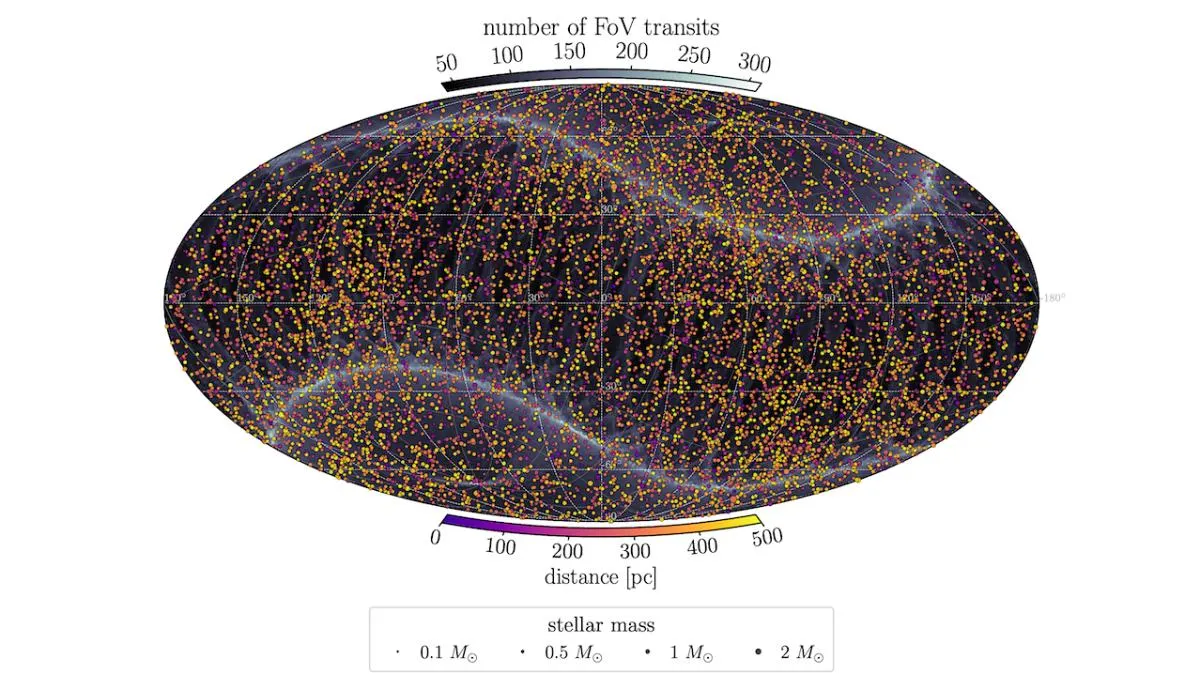
The catalog is based on 5,040,328 main-sequence stars from the G23H catalog, all within 500 light-years of the Sun. For each star the authors created three variants: no companions, one companion and two companions. The simulated masses range from the mass of Mars to 80 Jupiter masses, and the semi-major axes of the orbits from 0.03 to 100 astronomical units.
The sample deliberately includes objects that Gaia will probably not be able to detect. This makes it possible to check both the efficiency of the search and the number of false positives. The initial parameters of every system are stored, so the output of an algorithm can be compared with the exact characteristics of the simulated objects.
Detection versus characterization
To test the catalog, the team ran an algorithm that looks for periodic shifts in a star's position caused by a companion's gravity. The calculation accounted for the number of Gaia measurements per star, the scanning direction and the expected noise ixbt.com
ixbt.comixbt.comOpen source ↗. It revealed a fundamental problem with long orbits. If a companion's period exceeds the duration of the observing program, the telescope can register the change in the star's path but cannot cover enough of the orbit to determine the period.
The estimated observing span for Gaia DR4 is about 5.5 years, and orbits with a period of about 3.9 years proved the most favorable. Outside this range the ability to determine the period degrades quickly, although the astrometric signal is still recorded. Among 439,503 potentially detectable single-companion systems, the algorithm found 204,308 significant periodic signals. The period was localized in 106,339 cases and not in 97,969. A further 42,771 systems showed signs of a companion through the acceleration of the star, but no period could be derived.
The authors also compared their results with a separate forecast for Gaia DR4. In that model, of 29,129 systems with a candidate exoplanet signal, only 1,938 received sufficiently accurate period and mass estimates, while 27,191 showed a significant signal without full orbit parameters. That is about 14 times more detected companions than fully characterized orbits, and the ratio may be understated because the model considered only periods up to 7 years.
The catalog, the code used to create it and tutorials on orbit simulation are openly available ixbt.com
ixbt.comixbt.comOpen source ↗.