Webb finds three active black holes in galaxy J0148-4214 at Universe age of 1.2 billion years
Astronomers at the Max Planck Institute for Extraterrestrial Physics found a trio of active black holes in a distant galaxy, two of them close together at its centre.

Astronomers at the Max Planck Institute for Extraterrestrial Physics have found three active black holes in galaxy J0148-4214, more than 12.5 billion light-years from Earth, according to news.rambler.ru. The team analysed data from the spectrograph on the James Webb Space Telescope, and the results were published in Astronomy & Astrophysics rambler.ru
news.rambler.runews.rambler.ruOpen source ↗. We see the galaxy as it was when the Universe was about 1.2 billion years old.
Three black holes in one galaxy
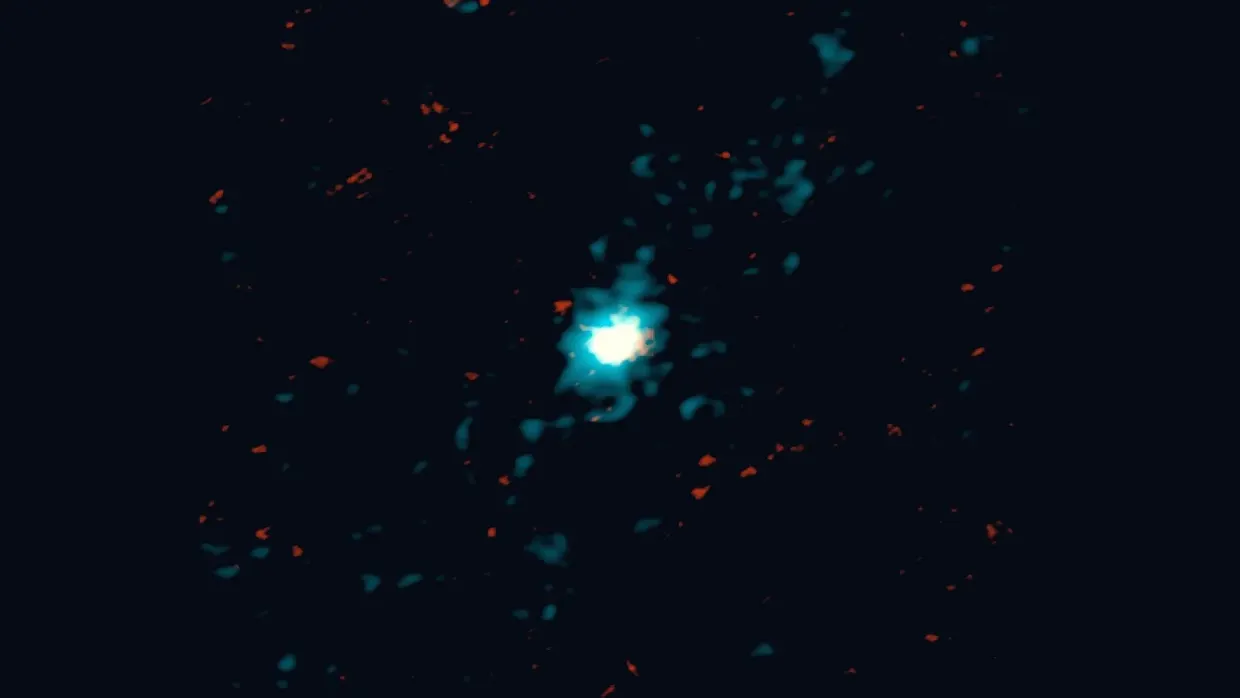
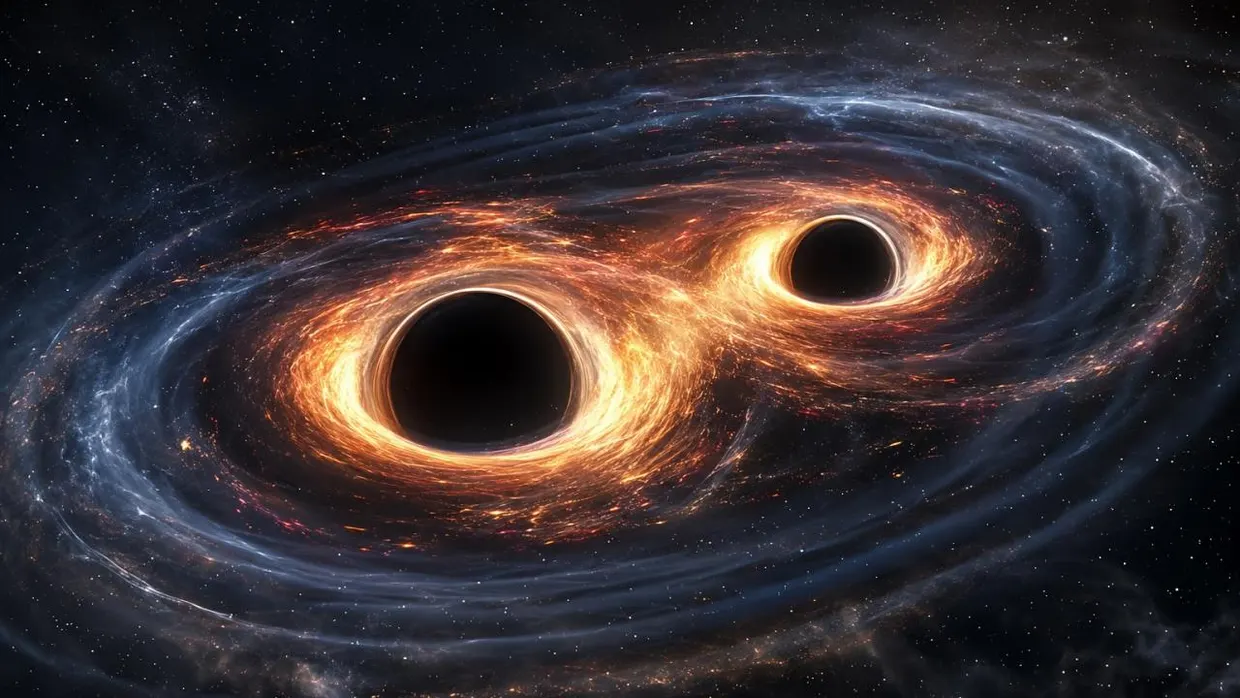
Two black holes have moved close together at the galaxy's centre, separated by only about 620 light-years. The larger has a mass of up to 80 million solar masses, the smaller about 600 thousand. The smaller one accretes matter so actively that it exceeds the Eddington limit, the theoretical maximum growth rate of a black hole. The third black hole, of about 2 million solar masses, lies on the galaxy's outskirts, 5.5 thousand light-years from the centre.
Gas falling onto the black holes at speeds of thousands of kilometres per second broadened the hydrogen lines in the galaxy's spectra to an anomalous width.
Merger estimates and the method
The authors calculate that the central pair will merge in roughly 700 million years, and the third black hole may join it later. Mergers of black holes produce gravitational waves, ripples of spacetime itself. They are expected to be detected by the space observatory LISA, which the European Space Agency plans to launch in 2035. The researchers put the chance of detecting the first of these events at 38% and the second at 82% rambler.ru
news.rambler.runews.rambler.ruOpen source ↗.
Triples of black holes have been found before, but only in the nearby Universe, in relatively mature galaxies. Both central black holes in the new study could be identified only with an integral field spectrograph, which records a spectrum at every point of the image simultaneously. In ordinary observations the telescope would have distinguished only the most massive of the three.