Shanghai University: MnO2 slurry lifts manganese flow battery capacity to 156.2 Ah/L in lab tests
Researchers added solid MnO2 to a manganese electrolyte and reached 3.76 M soluble manganese, a 409% capacity gain over MnSO4 electrolytes, in laboratory cells.
Researchers at Shanghai University have developed a semi-solid slurry electrolyte for manganese redox flow batteries with a specific capacity of 156.2 Ah per litre of catholyte. According to the study in Nano-Micro Letters, this is 409% above reported MnSO4-based electrolytes doi.org
Nano-Micro Lettersdoi.orgOpen source ↗. The results were obtained in laboratory cells.
Solubility limit of manganese electrolytes
In conventional H2SO4 electrolytes, the common-ion effect of SO4 2− limits the solubility of MnSO4 to 1 M or less, which keeps the specific capacity of manganese flow batteries low doi.org
Nano-Micro Lettersdoi.orgOpen source ↗. Semi-solid MnO2 batteries are expected to raise capacity, but their slow reaction kinetics limited earlier cells to current densities of 1 mA cm−2 or below
doi.org
Nano-Micro Lettersdoi.orgOpen source ↗.
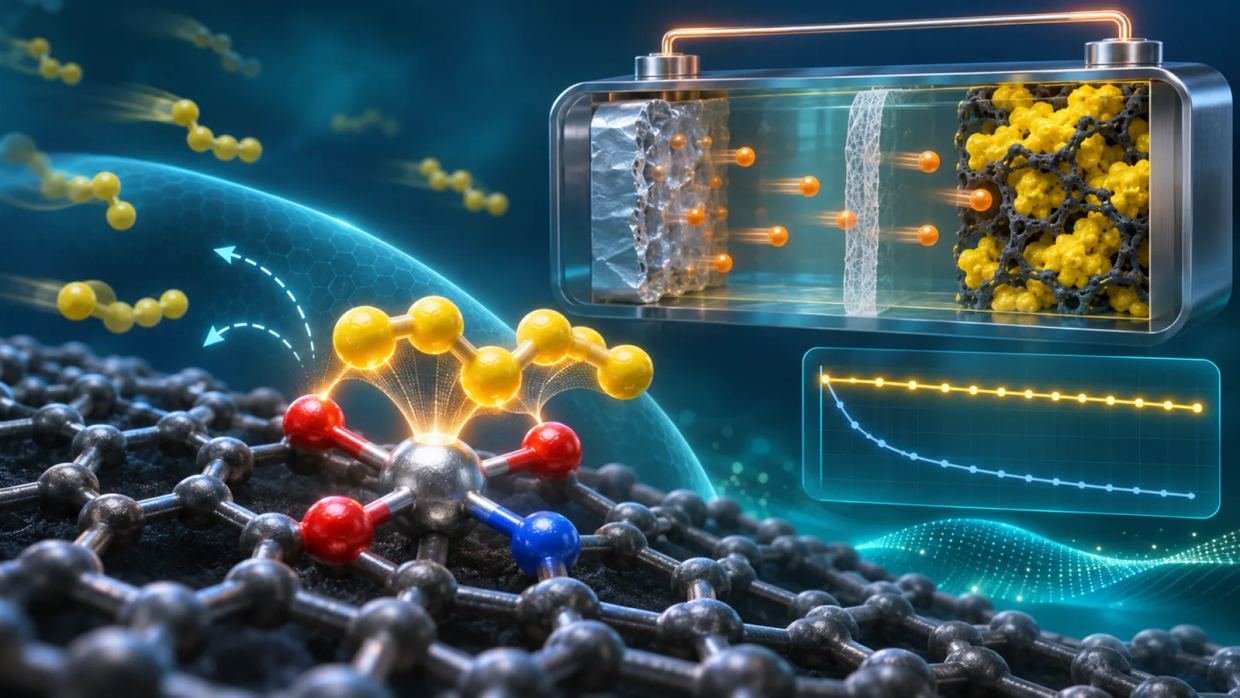
The authors introduced a high concentration of MnO2 into the conventional manganese electrolyte. The MnO2/Mn2+ electrochemical reaction circumvents the common-ion effect: a slurry with 4 M MnO2 gave a soluble manganese concentration of 3.76 M doi.org
Nano-Micro Lettersdoi.orgOpen source ↗.
Higher current density and cycling
During the second charging cycle, reverse disproportionation of the electrolytic MnO2 shifts the redox mechanism from the solid MnO2/Mn2+ couple to the dissolved Mn3+/Mn2+ pair, the authors report. This raises the discharge voltage and allows stable operation at 30 mA cm−2, 30 times higher than in reported Mn-based semi-solid flow batteries doi.org
Nano-Micro Lettersdoi.orgOpen source ↗. Capacity stayed above 151 Ah per litre at the same slurry concentration at this current density, with energy efficiency above 71%.
In a separate test, a cell with a 1 M MnO2 slurry completed 100 charge-discharge cycles with about 99% Coulombic efficiency and 76% energy efficiency. The researchers note that further work is needed to reduce capacity loss caused by manganese crossover and particle buildup.
The authors present the approach as a design strategy for semi-solid slurry electrolytes that could improve the applicability of flow batteries in grid-scale storage of renewable energy doi.org
Nano-Micro Lettersdoi.orgOpen source ↗.
Sources · 2
Found a mistake?Read also