Tübingen: two crows judged dot motion direction in 235 ms, about twice as fast as primates in similar tasks
In a Science study, two trained crows reported the dominant direction of moving dots in 235 ms on average; neural signals tied to the decision appeared about 70 ms after stimulus onset.
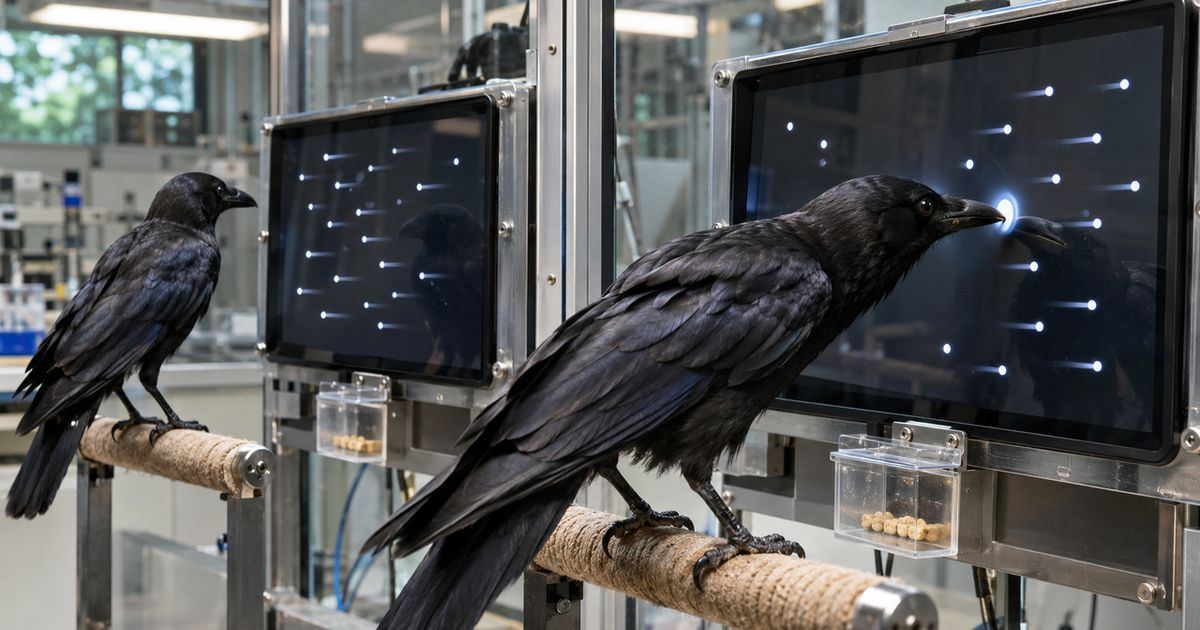
Researchers at the University of Tübingen measured how fast two crows, Iggy and Lemmy, decide on the direction of moving dots. According to Catraca Livre, which covered the study published in Science on 22 October 2026, the mean decision time was 235 milliseconds, about twice as fast as in comparisons with primates on similar tasks catracalivre.com.br
Catraca Livrecatracalivre.com.brOpen source ↗. The birds were trained by Philipp Schmidbauer and Andreas Nieder
catracalivre.com.br
Catraca Livrecatracalivre.com.brOpen source ↗.
Task design with moving dots
The crows viewed dot patterns on a touchscreen. Some dots moved in a predominant direction, while others moved without a useful pattern. The bird had to choose the correct direction, left or right, and received a larva as a reward catracalivre.com.br
Catraca Livrecatracalivre.com.brOpen source ↗. Varying the share of coherent dots changed the difficulty while the rule of the task stayed the same
catracalivre.com.br
Catraca Livrecatracalivre.com.brOpen source ↗.
The task did not require recognizing a familiar object, so the birds had to extract a statistical trend from the whole set of dots. The data came from thousands of trials. The analysis measured the time between stimulus and response, and the accuracy of choices was part of the interpretation, since a fast guess would have little value catracalivre.com.br
Catraca Livrecatracalivre.com.brOpen source ↗.
Neural signals and limits of the result
Recordings of neuronal activity showed signals linked to the decision about 70 milliseconds after stimulus onset catracalivre.com.br
Catraca Livrecatracalivre.com.brOpen source ↗. Electrodes registered the activity of specific cells during the task, and the team related these patterns to correct choices. This is a correlation of activity with behavior, not a full explanation of what the brain does
catracalivre.com.br
Catraca Livrecatracalivre.com.brOpen source ↗.
The 235 ms figure is an average across the two individuals; times vary between trials and difficulty levels. The comparison with humans and other primates relies on earlier work and depends on similar test conditions and differences in method catracalivre.com.br
Catraca Livrecatracalivre.com.brOpen source ↗.
Two birds allow a detailed analysis of their own performance and neural signals, but not the claim that all crows would respond equally fast. Small samples are common in invasive neurophysiology, and generalization requires replication with other individuals, species and protocols. Birds trained over many sessions may also develop strategies that differ from those of birds without experience with screens catracalivre.com.br
Catraca Livrecatracalivre.com.brOpen source ↗. The study did not test language, autobiographical memory or planning
catracalivre.com.br
Catraca Livrecatracalivre.com.brOpen source ↗.